




Top Small RV Generator Recommendations
- Best Overall: Honda EU2200IC 2200-Watt Companion Inverter Generator
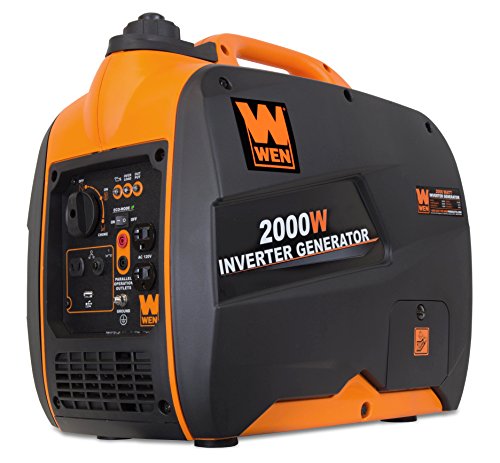
- Best Budget: WEN 56200i 2000-Watt Gas Powered Inverter Generator
- Best Lightweight: YAMAHA EF2200iS Inverter Generator
- Best Dual-Fuel: Champion 4000-Watt Dual Fuel RV Ready Portable Inverter Generator
- Best High Output: Westinghouse 5000 Peak Watt Super Quiet Inverter Generator
- Best Solar Power Station: EF ECOFLOW DELTA 2 Portable Power Station
I’ve made just about every mistake you can make when picking a generator for a small RV, and none of them were cheap lessons. Go too big and you end up with a loud, fuel-hungry machine that everyone around you can hear.
Go too small and it trips the moment you try to run anything serious, especially your AC. Try to save money with a cheap unit and you risk unstable power that can quietly damage your electronics over time.
That’s exactly why this guide exists. No fluff, no spec sheet hype, just what actually works in the real world when you are trying to power a small RV without overcomplicating things.

What “Small RV” Really Means?
Most guides throw around the term “small RV” without ever defining it, and that’s where people start making bad buying decisions.
We’re talking about Class B vans, teardrops, and small travel trailers. These setups are built for simplicity, not for running a full household on wheels. Space is tight, storage is limited, and more importantly, your actual power demand is nowhere near what most generator guides assume.
In real use, your daily routine is pretty predictable.
- At night, it’s usually just a fan, a few lights, and charging your phone or laptop.
- In the morning, maybe a coffee maker or something small to get the day started.
- Every now and then, you might run a microwave or try to kick on the AC, but that’s not happening all day long.
This isn’t a constant heavy load situation. It’s short bursts of higher demand with mostly light usage in between.
The goal is not to have the biggest unit you can afford. The goal is to have just enough power to match how you actually camp. That mindset alone will save you from making the wrong choice.
The Only 3 Generator Setups That Make Sense for Small RV
Forget the usual “buy this many watts” advice. That’s how people end up with the wrong generator. What actually matters is how you use your RV day to day. Once you look at it that way, it really comes down to three setups. Nothing more, nothing less.
Setup 1: Minimalist (No AC, Just Essentials)
This is the simplest and most efficient way to go. A 1000W to 2000W inverter generator covers the basics without adding unnecessary weight or noise. You can run lights, charge your devices, keep a fan going, and maybe power a small appliance here and there without pushing the limits.
These units are quiet, easy on fuel, and usually light enough to carry without thinking twice. That alone makes a big difference when you are loading and unloading at a campsite.
This setup is perfect for weekend campers or anyone who keeps things simple and does not rely on air conditioning. If you are mostly outdoors and just need power for the essentials, this is all you need.
Setup 2: Balanced (Most People Should Be Here)
This is where most small RV owners should land. A 2000W to 3000W inverter generator gives you enough flexibility to actually use your RV comfortably without constantly managing your power.
You can run your lights, charge devices, and use a microwave or coffee maker without worrying about tripping the generator. With the right conditions and a soft start installed, you can even run your RV AC occasionally, though you will still need to be mindful of what else is running at the same time.
It is a solid middle ground. Not too big, not too limited. You get real usability without dragging around something oversized.
Setup 3: Comfort Setup (AC Without Stress)
If running your AC is non-negotiable, this is the setup that makes life easier. A 3000W to 4000W inverter generator gives you the headroom needed to handle startup surges without constant overload issues.

This is where you stop worrying about whether the AC will kick on and just let it run. You still need to manage your load a bit, but it is far less restrictive compared to smaller units.
Yes, these generators are heavier and take up more space. There is no way around that. But if comfort matters and you plan to camp in hot weather, the trade-off is worth it.
Review Best Generators for Small RV (No-Nonsense Picks)
This is not a spec dump. These are picks based on how they actually behave when you use them in a small RV. Runtime under partial load, how they sound in a real campground, and whether they can handle startup without tripping. That’s what matters.
Best Overall (Balanced Use)
This is the one that consistently hits the sweet spot. Not the cheapest, not the most powerful, but it just works every time you need it to. The build quality is on another level, and more importantly, the power delivery is clean and stable. That matters more than most people think, especially if you are running laptops or sensitive electronics.
In real use, this generator handles your core setup without stress. Lights, fan, laptop, phone charging all day long with no drama. You can run a coffee maker or a small microwave if you manage your load properly. It is not built to run an AC on its own, but that is not what this setup is for.

Where it really stands out is noise and consistency. Around half load, it just blends into the background. You are not getting complaints from neighbors, and you are not burning through fuel unnecessarily. This is the kind of generator you buy once and keep for years.
Best Lightweight Option (Easy to Carry and Store)
At around 44 pounds, this is about as light as you can go without sacrificing real usability. If you are constantly moving your generator in and out of storage, weight becomes a bigger deal than specs on paper.
Despite being lightweight, it still delivers solid performance. It handles the same core loads as the Honda, and the Smart Throttle feature does a good job keeping fuel consumption low when you are not pushing it hard.

In a small RV, space is always tight. This unit fits easily into storage compartments and does not feel like a burden to carry around. Noise-wise, it stays controlled and smooth, especially under moderate load. It is a practical choice for people who value portability just as much as performance.
Best Budget Pick (Good Enough Without Regret)
This is where you save money, but you need to understand what you are giving up. On paper, it delivers similar wattage to more expensive units, and for basic use, it gets the job done.
You can run lights, charge devices, and handle small appliances without much issue. For occasional camping or light use, it is more than enough. But once you start pushing it harder, the differences show up. The noise is a bit rougher, and the overall build does not feel as refined.
Runtime is decent at low to moderate load, but do not expect the same efficiency or long-term durability as premium models. If your budget is tight and you just need something functional, this is a reasonable compromise. Just do not expect it to behave like a high-end unit.
Best for Running AC Reliably
If your goal is to run an RV air conditioner without constantly worrying about overload, this is where stepping up in power makes a real difference. That extra headroom is what allows the generator to handle startup surge without tripping.
In real use, this unit gives you flexibility. You can run your AC and still keep essential devices going without shutting everything else off. That is something smaller generators struggle with.

It is heavier and less compact, no way around that. But if comfort matters and you camp in hot conditions, the trade-off is worth it. Noise stays reasonable for the power level, especially when you are not running at full load all the time.
Best Dual Fuel (Gas and Propane Flexibility)
Dual fuel sounds like a bonus feature, but it actually solves a real problem. Propane is easier to store, burns cleaner, and does not go bad like gasoline. That makes it a solid option for people who do not use their generator every weekend.
On gasoline, you get full power. On propane, you lose a bit of output, but gain convenience and cleaner operation. In real-world RV use, that trade-off often makes sense.
This generator handles moderate to heavy loads well, including AC with the right setup. Noise stays controlled, and it does not feel overly aggressive in a campground setting. It is a flexible option if you want more control over how you fuel your setup.
Best Solar Power Station (Silent Alternative)
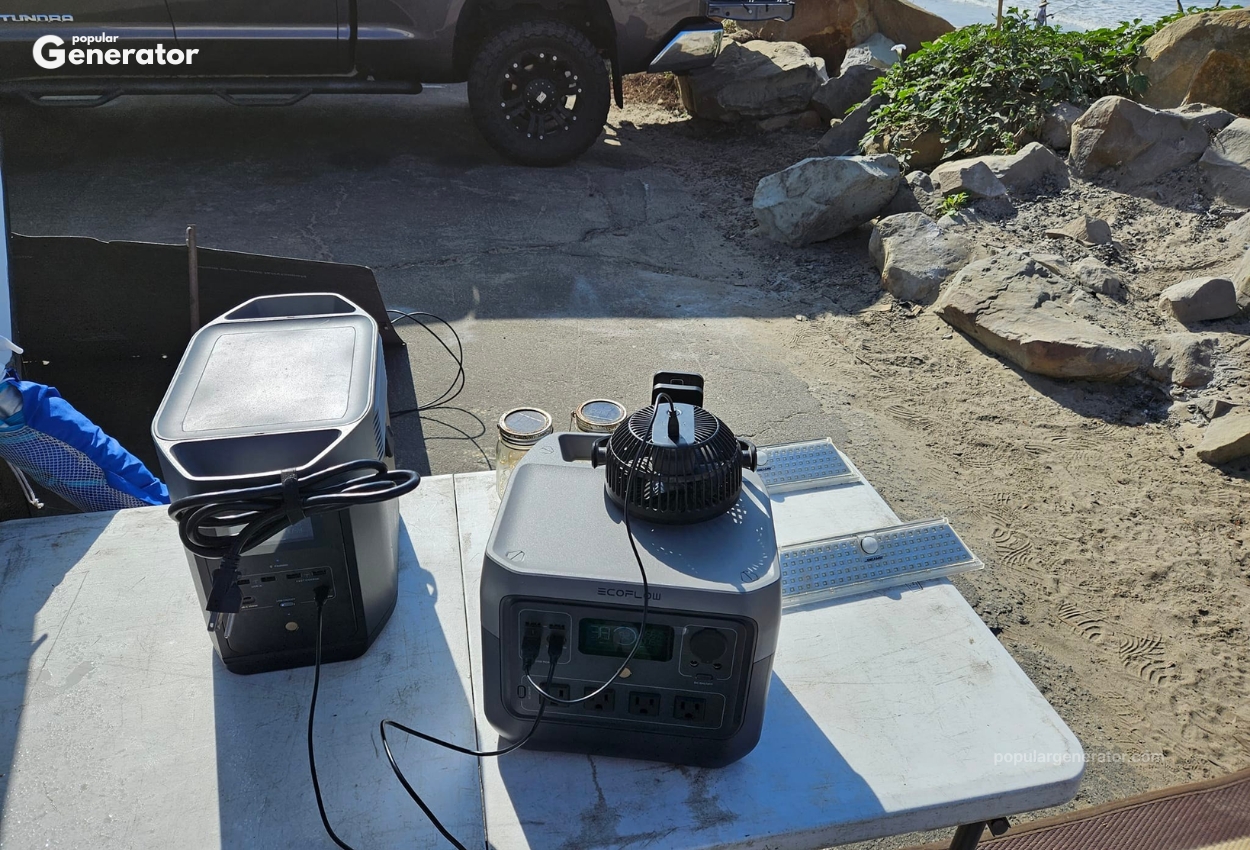
This is a completely different approach. No engine, no fuel, no noise. For light users, it is hard to beat the convenience.
You can run lights, charge devices, power a laptop, and even handle small appliances without any sound at all. That alone makes it appealing in quiet campgrounds. Charging is fast, and you can pair it with solar if you want more independence.
But here is the reality. It is not a full replacement for a gas generator if you plan to run AC or heavy loads. It works best as a supplement or for minimalist setups.
What You Can REALLY Run on a Small RV Generator
This is where most guides start stretching the truth. On paper, a generator might look like it can handle everything at once. In reality, it comes down to how loads stack up in real use, especially during startup. If you don’t respect that, you’ll be dealing with constant overload trips.
Let’s keep it honest and practical.
- With a 2000W inverter generator, you are in the essentials zone. You can comfortably run your lights, a fan, and charge your laptop or phone without any issues. You might get away with a small appliance for a short time, but you will need to turn other things off. This setup works best when you keep your usage simple and consistent.
- Step up to a 3000W generator, and things start to feel a lot more usable. Now you can run your basic setup and still have enough headroom to use a microwave or coffee maker without shutting everything else down. It gives you flexibility, but you still need to be aware of what is running at the same time.
- At around 3500W, you are finally in a position where running an RV air conditioner becomes realistic, especially if you have a soft start installed. The generator can handle the startup surge much more reliably, which is where smaller units usually fail. You can keep your essentials running while the AC is on, as long as you are not stacking too many heavy loads together.
Generators do not fail because of running watts, they fail because of starting loads and poor timing. If you try to run everything at once just because the numbers say you can, you will hit the limit fast.
FAQs
Q: What is the best generator size for a small RV?
For a small RV (under 20–25 ft), the best generator size is typically 2,000 to 3,000 watts for basic needs, or 3,000 to 4,000 watts if you need to run an air conditioner, microwave, or multiple appliances simultaneously. Inverter generators are recommended for better fuel efficiency and lower noise levels.
Inverter generators are recommended for better fuel efficiency and lower noise levels.
Q: What is the quietest generator for a small RV?
Need a quiet generator for camping in an RV? The quietest generators for small RVs are inverter generators, with top models operating between 50–60 dB, roughly the sound level of a normal conversation. The Honda EU2200i is widely considered the industry standard for quiet, portable power. Other top, ultra-quiet options include the Yamaha EF2200iS, Cummins Onan P4500i, and Generac GP2500i.
Q: Are small RV generators safe for electronics?
Inverter generators are safe for sensitive electronics (laptops, TVs, phones), while traditional generators may damage them due to “dirty” power.
- Clean Power: Inverter generators use advanced electronics to convert raw AC to DC, then back to stable AC, producing low Total Harmonic Distortion (THD).
- Voltage Regulation: They automatically adjust engine speed to match power demand, ensuring a steady, safe voltage output.
Inverter generators produce clean, stable, true sine wave electricity (similar to home outlets). Traditional generators produce inconsistent, high-harmonic, voltage-heavy power that can cause issues.
Q: Do I need an RV-ready generator with a 30 amp outlet?
Yes, an RV-ready generator with a 30-amp (TT-30R) outlet is highly recommended for a 30-amp RV. This allows you to plug your RV directly into the generator to run all appliances, including the air conditioner, without adapters. A generator with 3,000–4,000 watts is ideal, while 2,000W can work for limited, non-AC use.
Popular options include the Champion 3400-Watt Dual Fuel, Predator 3500, or similar models, which offer the necessary 30-amp output.
Q: What is the most reliable generator for small RV use?
The most reliable and popular generator for small RVs is the Honda EU2200i, widely praised for its durability, quiet operation, and portability. It is a 2,200-watt inverter generator ideal for powering basic RV essentials, with the option to parallel two units for higher power needs.


Write Your Review
No reviews yet. Be the first to share your experience!