

Power outages are no longer rare events.
Storms hit harder, grids are more fragile, and when the lights go out, you quickly find out what actually matters in your home.
A reliable backup generator is not about convenience. It is about keeping food from spoiling, staying connected, and maintaining basic comfort when the power is gone for hours or even days.
What Is a Backup Generator and When Really Need One?
They can be portable or stationary (standby), and run on gasoline, diesel, natural gas, or LP gas, with prices ranging from a few hundred dollars to thousands of dollars, depending upon your needs and your choice of generators.
A backup generator is a device that automatically or manually provides electrical power to your home, business, or facility when the main power grid fails or goes out.
How it works:
When the generator detects a power outage, it kicks in to supply electricity to some or all of your electrical systems. It typically runs on fuel like natural gas, propane, or diesel.
Common types:
- Standby generators – A more long term solution would be the installation of a stationary generator. A standby generator is hooked up to an external fuel source, such as a natural gas line, and can provide continuous power. (Some portable devices can also be fueled from an external fuel source, and can provide extended run time, too.) The biggest difference between portable and stationary generators are the connection and activation.
- Portable generators – You’ll need to refill the tank several times a day if the power disruption in your area lasts more than a few hours. Plus, you’ll need to consider the availability of fuel in a long term outage. In hurricane prone areas, gasoline is in extremely short supply before, during, and after the storm, and this shortage can last days or even weeks.
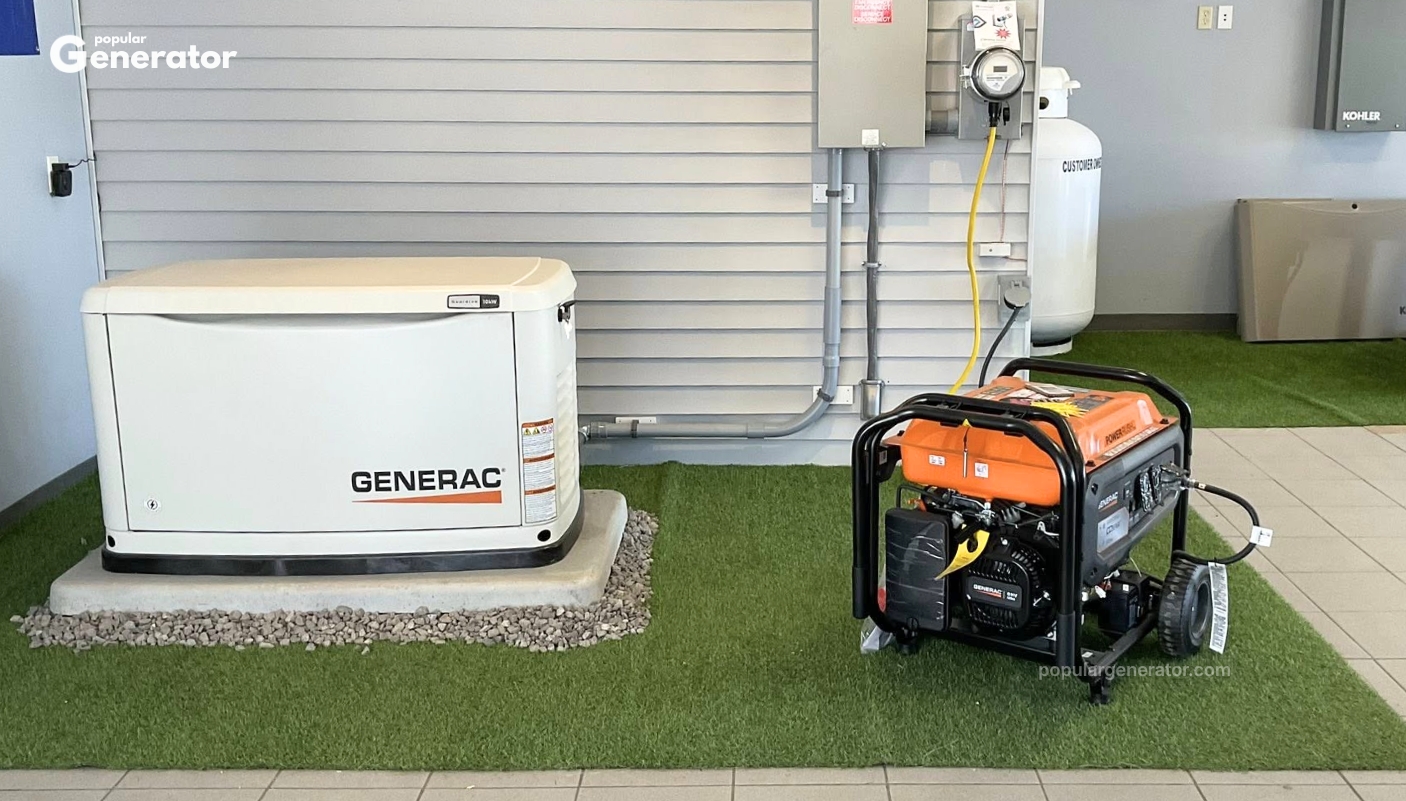
A portable generator must be rolled out of your garage or other storage area, filled with fuel or hooked up to the external fuel source, manually started, and connected to the loads. A permanent, stationary generator, on the other hand, starts at around $2,100.00, and can start immediately because it is already connected to the wiring in your home and to the external fuel source.
Most automatic systems have an auto transfer switch that senses the outage, isolates your electrical wiring or designated emergency circuits from the grid, and starts the generator. Then when power is restored, the generator connects your home back to the grid, and shuts itself down. The typical transfer time is 10-20 seconds, and you don’t even have to be home to start and stop it. A permanent, stationary generator will normally power the whole house, too.
Convenience, run time, and power level available make a permanent, stationary generator the best option, especially in the event of a long term, or more frequent power disruption. And, while it is generally more expensive to install, it will also add value to your home.
Quick Comparison of the Best Backup Generators




Choosing the Right Fuel for Your Backup Generator
There are a couple of other things you’ll want to consider when you select a generator for your home, with your choice of fuel being perhaps the most important. During certain natural disasters, such as hurricanes and tornados, certain fuels may not be readily available, most notably gasoline, LP gas, and at times, even natural gas. Fortunately, most residential generators are bi-fuel, and can run on both natural gas and LP gas, with a minor adjustment to convert from one fuel to another. It helps to understand the most common fuel types used today and what each one is realistically good for.
- Gasoline
- Propane (LP gas)
- Natural gas
- Diesel
- Dual-fuel and tri-fuel generators
If your home is supplied with natural gas, this makes the bi-fuel natural gas/LP gas unit your best choice. If natural gas is not supplied in your area, you also have the option of the installation of a large propane tank to power your generator, as well.
Installation and Wiring
Most portable, gas or diesel powered, generators for limited, temporary use are easily rolled out, started up, and you simply plug in the appliances you wish to run. However, if larger unit, or a stationary generator is your choice, you will definitely want to have it installed professionally by a licensed electrician and the natural gas connected by a professional or a representative for your local utility company.
Remember, regardless of how mechanically inclined you might be, the most important issues are safety and dependability, therefore, have your system connected by the proper professionals!
Regardless of how mechanically skilled a homeowner may be, generator installation is not a do it yourself project when permanent wiring or fuel connections are involved. Safety and dependability are the most important considerations. Having the system installed by trained professionals helps protect your home, your equipment, and the people who rely on the generator during a power outage.
How We Test Backup Generators
We test backup generators under real world conditions, focusing on how they actually perform during power outages rather than relying on manufacturer specifications alone. Our goal is to evaluate reliability, usability, and performance in situations that reflect everyday home use.
- We do not rely on manufacturer specs or lab numbers that look good on paper but fall apart in real life. Every backup generator we recommend is tested the same way an actual homeowner would use it during a power outage.
- First, we run real household loads, not just light bulbs or empty outlets. Each generator is tested with appliances people actually care about when the power goes out, including refrigerators, window or central air conditioners, microwave ovens, routers, and basic lighting. This shows us how the generator behaves when loads cycle on and off, especially when motors kick in.
- Next, we measure noise at realistic distances. Instead of standing right next to the generator, we measure sound levels at typical placement distances from the house. This gives a more honest idea of how loud the unit will feel during overnight use, not just what the brochure claims.
- We also test continuous runtime under load. Generators are run for extended periods to see how long they can realistically operate on a full tank or connected fuel source. This matters during long outages where refueling may not be convenient or even possible.
- Another critical step is starting performance under heavy load. We intentionally start generators while major appliances are already connected to see how well they handle surge demands. Weak generators stumble here, while well built units start cleanly and stabilize quickly.
- Finally, we look at ease of use for non technical users. Not everyone wants to troubleshoot voltage meters or complex control panels in the dark. We evaluate how easy it is to start the generator, connect loads, read indicators, and perform basic operation without technical knowledge.
This testing approach keeps things honest. If a generator performs well in these conditions, it will perform well when it actually matters.
FAQs About Backup Generators
1. How long can a backup generator run?
That depends on the fuel type, load, and generator size.
- Portable gasoline generators usually run 6 to 12 hours on a full tank at moderate load.
- Propane units can run much longer if connected to a large tank.
- Natural gas generators can run continuously as long as the gas supply is available.
In real world use, heavier loads like air conditioners or well pumps will shorten runtime noticeably.
2. Do I need a professional to install a backup generator?
For small portable generators, no professional installation is required as long as you are plugging appliances directly into the unit. However, for standby or larger backup generators that connect to your home’s electrical panel, a licensed electrician is essential.
If the generator uses natural gas or a large propane tank, fuel connections should also be handled by qualified professionals. This is about safety, code compliance, and long term reliability.
3. How many watts should I buy?
The safest way to size a backup generator is to start with the essentials you truly need during an outage, then work up from there. In real use, wattage needs usually fall into clear ranges:
- 3,000 to 4,000 watts: Enough for very basic needs like a refrigerator or freezer, internet router, phone chargers, a few lights, and small electronics. This works for apartments or short outages where comfort is not the priority.
- 5,000 to 7,500 watts: Covers most essential household loads. You can typically run a refrigerator, freezer, lights, TV, internet equipment, and occasionally a microwave or small window air conditioner. This range fits most homeowners who just want to stay functional during outages.
- 8,000 to 10,000 watts: Suitable if you need to run heavier loads such as a well pump, sump pump, larger air conditioner, or multiple appliances at the same time. This is where surge capacity becomes important.
- 10,000 watts and above: Designed for whole house backup or near whole house coverage. These generators can handle central air conditioning, electric water heaters, and multiple major appliances simultaneously, depending on load management.
Choosing a generator that is too small is one of the most common mistakes homeowners make. Surge loads from motors and compressors add up fast, and undersizing almost always leads to frustration during real outages.
4. Can a generator damage electronic devices?
Yes, poorly regulated generators can cause voltage fluctuations that may harm sensitive electronics.
This is most common with older or low quality models. Inverter generators and modern standby units produce much cleaner power and are much safer for TVs, computers, and networking equipment. Using quality extension cords and avoiding overloads also reduces risk. If electronics matter, power quality should not be an afterthought.





Write Your Review
No reviews yet. Be the first to share your experience!