






Top-Rated RV Solar Generators
- Best Overall: Anker SOLIX F3800 3840Wh, LiFePO4 Batteries Portable Power Station
- Best High-Capacity/Premium: EF ECOFLOW DELTA Pro 3 Portable Power Station
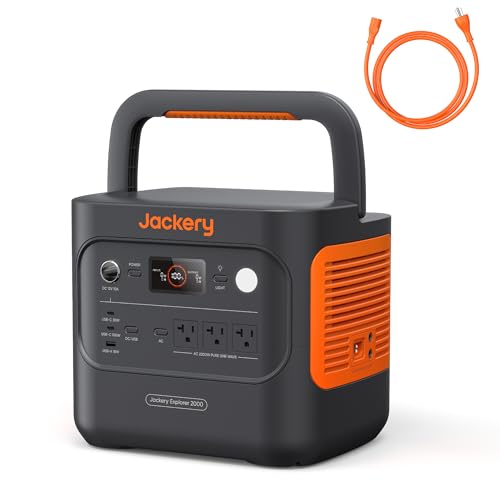
- Best for Modular Power: Jackery Explorer 2000 Portable Power Station
- Best for Mid-Range: BLUETTI AC200L Solar Generator Kit (2 100W Solar Panels)
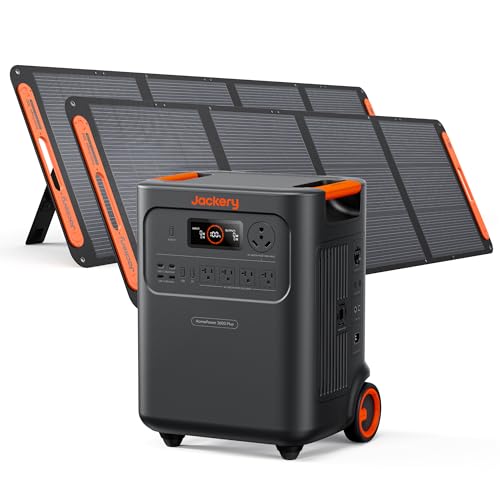
- Best for Heavy Duty/Off-Grid: Jackery Power 3600 Plus Portable Power Station
- Best for AC/Appliances: BLUETTI Solar Generator AC200L with 200W Solar Panel
- Best for Budget: Goal Zero Yeti 1000 Portable Solar Generator for RV
Having been associated with the RV industry for 12 hours now, and being an outdoorsman, I am witnessing a bloom in the power station industry. A lot of people are switching to portable solar power generators for RV instead of battling with the complex installation of lithium batteries and loads of solar panels.
Travelers seek a portable, compact, and lightweight one-stop for all types of solutions that can cover their daily life energy needs. Stick around and read the complete article, maybe it will help in your outdoor journey.
How Much Power Do Solar Generators Need for an RV?
One of the biggest mistakes people make when choosing a solar generator for an RV is focusing only on battery capacity. Capacity matters, but what really determines whether a generator can handle your RV is the combination of output power (watts) and battery capacity (watt-hours).
RV appliances can draw a surprising amount of power, especially when several devices run at the same time. To understand what size solar generator you need, it helps to start with the basic relationship between energy, power, and time.
E = P \times t
In simple terms, the energy your generator uses depends on how much power the device draws and how long it runs. A microwave that pulls 1000 watts for 10 minutes consumes far less energy than a refrigerator running continuously for hours.
1. Typical power use inside an RV
Most RV setups include a mix of small electronics and higher-power kitchen appliances. Here’s a rough idea of what common RV equipment typically consumes:
| Appliance | Average Power |
|---|---|
| RV refrigerator | 100 – 400 W |
| Laptop | 50 – 100 W |
| LED lights | 10 – 20 W each |
| Coffee maker | 800 – 1000 W |
| Microwave | 800 – 1200 W |
| RV air conditioner | 1500 – 2000 W |
If you’re running only lights, laptops, and charging devices, a relatively small solar generator can handle the load. But once you add appliances like a microwave or coffee maker, the power requirements increase quickly.
2. Minimum solar generator size for most RV trips
For most standard RV trips, a solar generator with a capacity of 2,000Wh to 3,000Wh and an output of 2,000W or more is the recommended minimum, suitable for running lights, fridges, and charging devices.
A unit in this range can comfortably run typical RV appliances such as:
- A refrigerator
- Lights
- Laptops and phones
- A coffee maker or microwave (one at a time)
For short trips or weekend camping, a 1,000Wh unit may suffice, while extended off-grid stays often require
3. Power needs for larger RV setups
Large RVs (30–40 ft) with 30-amp or 50-amp electrical systems require much more power because they often run multiple high-wattage appliances like air conditioners, microwaves, and residential refrigerators. In most cases, a solar generator with around 5,000 – 8,000W of output is needed to handle these loads comfortably.
Battery size also becomes important for longer off-grid stays. For larger RV setups, a system with at least 5,000Wh of battery capacity is usually recommended to provide enough energy for daily use without draining the battery too quickly.
4. RV Air Conditioners
Running a typical 13,500 BTU RV air conditioner requires a fairly powerful solar generator. In most cases, you’ll need at least 2,000 – 3,000W of inverter output and a battery capacity of around 1500Wh – 3000Wh, often paired with a soft-start device to handle the startup surge.
For longer off-grid use, keeping that battery charged usually requires 1,500 – 2,000W of solar panels. Because AC units consume so much power, many RV travelers use solar generators for everyday appliances and rely on shore power or a traditional generator when running air conditioning.
Review In-depth the Best Solar Generators for RVs
For RV travel, a solar generator can replace noisy fuel generators and provide reliable electricity throughout the trip. The following models stand out for their ability to recharge from solar panels while still powering essential RV appliances on the road.
Best Overall Solar Generators for RVs

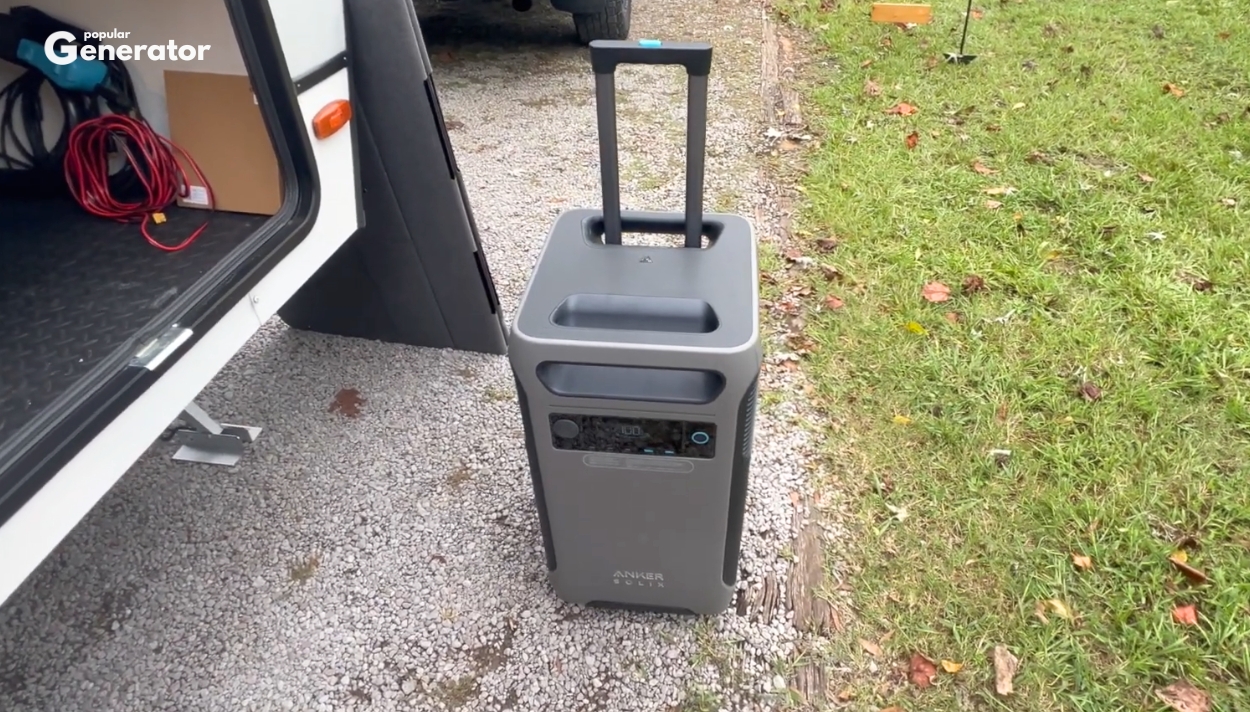
If you’re trying to run an RV without relying on gasoline generators, the SOLIX F3800 is one of the few portable solar stations that actually feels capable of doing the job. The unit packs a 3840Wh LiFePO4 battery and a strong 6000W inverter, which is enough for many real RV loads.
In practice that means you can run things like a refrigerator, induction cooktop, lighting, laptops, and even short bursts of air conditioner use without the system feeling overwhelmed.
One thing that stood out when using a system in this class is how stable the inverter power feels. Sensitive electronics such as laptops, Starlink internet terminals, and camera batteries run without any flicker or voltage issues.
That’s important for RV travelers who rely on electronics every day.
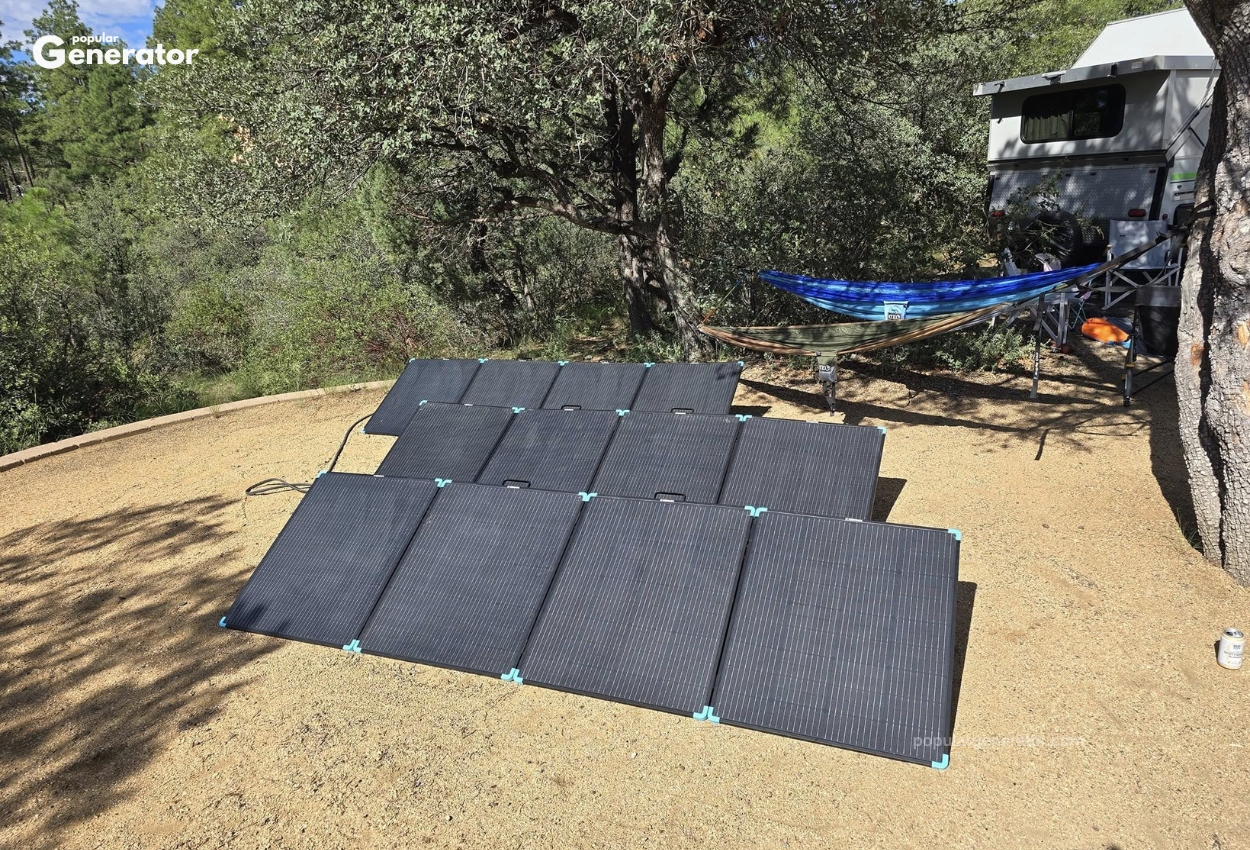
Solar input is another big advantage here. With enough panels connected, the station can absorb a large amount of solar energy during the day.
On a sunny day, you can realistically bring back a big portion of the battery while still running lights and charging devices in the RV.
The unit is heavy, but the wheel design makes moving it around a campsite manageable.
Best High-Capacity Generators for RVs
Ecoflow Delta 1300 is slightly on the portable side which is always a good thing for RV or travel trailer users.
It is one of the most popular and positively reviewed portable solar-powered generators for RV that can easily a small fridge, a 13,500 BTU AC, LED lights, laptops, cellphones, coffee makers, an oven, and other appliances with its whopping 1800 running watts, and 3300 surge watts, and a massive 1260Wh battery.
One of the main selling points for me was the X-stream fast charging technology which comes in handy.
A variety of AC and DC ports are also appreciable if you want to run different appliances on the road.
Delta 1300 solar generator features one of the best BMS on the market. It doesn’t eat any extra charging just to stay ON which is a big plus.
I like the compact and portable design as well. It weighs 30.9 pounds which is not huge for a 1260Wh solar generator. With its low center of gravity, it doesn’t need support to stand still. I can easily put it in the back of my truck.
It features the following ports.
- X6 AC outlets.
- X2 USB-A outlets.
- X2 fast charging ports
- X2 USB-C outlets (60W)
- DC 13.6V port
I loved the LCD on the front control panel. Instead of telling percentage, it tells how many minutes and hours are left on the device which gives a lot of clarity. It also tells battery stats, incoming and outgoing power, and error codes.
There are three ways you can charge this portable power station. Solar, AC wall outlet, and Car outlet.
Using 400W solar input, the device took only 7.1 hours to completely charge using Rockpal SP003 100W solar panels.
I was a little disappointed with only 400W solar input for an 1800W solar generator. Ecoflow should improve the input solar to 700 or 800W. It will increase the charging speed.
Delta 1300 features X-stream fast charging technology. Through the AC wall outlet, it takes less than an hour to charge from 0 – 80%. From 0 – 100%, it takes 1 hour and 40 minutes. I have tested this many times.
You can purchase this unit for its charging prowess alone.
Using a 12V DC car port, Delta 1300 takes 14 hours to fully charge. I normally use and charge this unit whenever I go on a camping trip to the woods. I charge my drone and camera batteries and power a mini-cooler off of it during the drive.
Ecoflow Delta 1300 will be able to run the following devices according to my tests.
- 60w Laptop: 23 hours. 32 charges
- Power saver light: 37 hours
- 600w Coffee maker: 55 cups
- 120W Freezer: 10 to 17 hours
- 1600 Hair dryer: 1 to 3 hours
- 110W TV: 7 to 8 hours
- 500W blender: 2 to 2.5 hours
- 65W projector: 11 to 13 hours
I conducted a little Load Test on 3 different occasions after using it for 6 months.
- Load of 1790 watts and the power station didn’t shut off.
- I increased the load to 1810 watts, and the device was still ON.
- Increased the load to 1830 watts and then finally, the overload alarm went ON.
I have taken Ecoflow Delta pro with me in my RV many times as a backup power source during night camping, I have been able to run everything I want it to run without any problem.
The battery doesn’t drain easily, and the huge capacity allows me to my power my 13,500 BTU AC when I am stationary. I believe this is a perfect unit for an RV.
The shelf life is around 12 months with 800+ cycles.
The only complaint I have is the arrangement of the ports. The inputs and USBs are on opposite sides. Forget about putting it in the corner. It messes up the cable arrangement.
- Huge capacity. Ideal for RVs.
- X-stream fast charging. 0 to 80% in 1 hour.
- Very portable. Ideal for confined spaces.
- LCD shows minutes and hours on the screen.
- 800+ cycles. 12 months shelf life.
- Loaded with AC/DC outlets
- Only 400W solar input
- Bad arranged on input ports and USBs
Best for Modular Power
Jackery Explorer 1500 is the elder brother of the explorer 1000 with 50% more battery capacity and 80% more power output. I have used it for Overlanding, car camping, truck camping, and RV for an extended period to gather data for this review.
The thing that impressed me the most is the simplicity and reliability of this product. It is plug-and-play with no fuss.
It offers 1800 running watts and a whopping 3600 surge watts. The battery capacity is 1534Wh. You can power any appliance at 120V.
Out of all Jackery power stations, this Explorer 1500 has the fastest charging (3 to 4 hours).
All the goodies and cables are provided in a quality neoprene bag. The quality and feel of Jackery’s staff are second to none.
The design is the same as other Jackeries. It weighs 15kg which is not heavy at all. Orange stuff on the side is your vents. Rubber feet at the bottom are installed to prevent the unit from slipping.
The dimensions are compact and portable. I haven’t faced any problem so far in terms of space saving.
I like the LCD. It displays battery stats, incoming and outgoing power, and how many hours are left on the device which is always helpful.
The control panel always features physical buttons for AC and DC power. If you want to switch to DC, just press the button and you are good to go.
The only problem I see is the fewer AC and DC outlets. For an expensive unit, they at least should’ve provided more USB-As and Cs.
There are 3 charging options. Using two AC bricks, the device can accept as much as 500W to fully charge. It will take around 3.1 to 3.2 hours to fully charge this device.
A lot of people are by thinking that Jackery Explorer 1500 can accept 260W of AC input from their AC charging brick. Actually, you have to use two charging at the same time to get the 500W input.
400W solar input will take 4.1 to 4.2 hours. You can’t use your own panel using an MC4 adapter. You can only use Solarsaga panels which sucks unless you are a DIY guy like me.
From the 12V car port, Jackery 1500 will take around 15 hours to fully charge. This option is only suitable for long road trips. Otherwise, it will take ages to charge it if you are on a road for a day or two.
Before taking it to the road, I conducted a load test. The device gave 1798 running watts after giving it a load of 1500W heater, and 300W heat lamp.
Later, I increase the load to 2000W, Jackery Explorer 1500 was able to provide 1989W before it shut off.
Jackery Explorer 1500 will run the following appliances.
|
Appliances |
Running Time |
|
Mini-cooler |
21.4 hours |
|
PS4 console |
63 hours |
|
Coffee maker |
71 minutes |
|
Electric stove |
67 minutes |
|
Microwave Oven |
65 minutes |
|
Refrigerator (RV) |
18 hours |
|
TV |
22 hours |
So jackery 1500 offers 500 cycles at 80% and it has all the typical safety features. I like that I have been able to power everything under or at 1800 running I wanted it to.
Its performance is solid. Nothing about this unit feels cheap or a pushover. The battery holds the charge pretty, and the BMS doesn’t eat the battery just to stay ON.
Trust me I am a terrible user of these power stations. I abuse them in every possible way. I did the same with my explorer 1500. So far it hasn’t disappointed me.
Reliability and Versatility
Quick charging using double AC bricks
More than 80% efficient inverter
Ideal for truck camping and RVs
Fewer outlets
You can’t use your panels
Best for Mid-Range
The BLUETTI AC200L is one of those solar generators that sits right in the middle of the market but still delivers a lot of capability. It combines a large battery capacity with around 2400W inverter output, which makes it suitable for most RV electrical needs.
When used in an RV setup, generators in this class typically run things like portable refrigerators, LED lighting systems, fans, routers, and charging stations without any issue. The inverter power is stable enough that electronics like laptops and drones charge safely.
Solar charging also works well here. With the included solar panel kit, the battery can slowly refill throughout the day while the RV continues drawing power. For travelers who spend multiple days camping without hookups, that solar recharge becomes extremely valuable.
Best for Heavy-Duty
If the goal is running an RV almost entirely from solar power, the Jackery Explorer 3000 Plus starts to feel much closer to a real off-grid power system. With roughly 3000Wh of battery capacity and strong inverter output, it can support larger appliances than typical portable stations.
In real camping setups, generators in this category can handle appliances such as microwaves, coffee machines, induction cooktops, and sometimes even RV air conditioners depending on startup requirements. When paired with several solar panels, the system can recharge enough energy during the day to keep the RV running through the evening.
Despite the large capacity, Jackery still designed the station to remain portable. Wheels and handles make it possible to move around campsites or load into vehicles without too much trouble.
Best for AC & Appliances (30 Amp Ready)
For RV travelers who rely on electric cooking or climate control equipment, the BLUETTI AC200L offers enough inverter strength to support heavier appliances. The 2000W-plus inverter output allows it to run devices that smaller power stations struggle with.
In real use this becomes noticeable when powering things like electric kettles, induction cooktops, portable heaters, or small air conditioners. The inverter provides clean power that remains stable even when multiple devices are connected.
The included solar panel also makes the system practical for off-grid travel. During sunny days, the battery can recharge steadily while the RV continues to use electricity. For campers trying to reduce dependence on fuel generators, setups like this make solar power far more realistic.
Best Budget
Goal Zero Yeti 1000 may not be the most powerful power station on the list, but due to its reliable performance and many DC outlets, it is considered a fantastic unit for RVs and Camping.
I take a lot of videography equipment with you in your RV like me, you will be able to charge most of them off of this little beast thanks to its 1200 rated watts, 2400 surge watts, and 983Wh battery capacity.
Compared to Goal zero 1000x which has a 1500W inverter, goal zero 1000 has a 1200W inverter. Other than that, both are identical.
Its design is compact and portable with a flat top with a low center of gravity. Your charger and cables will go into the hidden door at the top to save space.
The casing is made of rugged aluminum which makes it prone to wear and tear on the road.
Goal Zero 1000 features the following ports on the front panel:
Goal Zero Yeti 1000 control panel
- X2 USB-A ports (output): 5V, 2.4A, 12W max.
- X1 USB-C port: (output): 5 to 12V, 3.0 18 max.
- X1 USB-C PD 60W fast charging port (input/output): 5 to 20V, 3.0A, 60W max.
- X2 120V AC ports (output, since wave): 60HZ, 120VAC, 10A
- X1 regulated 12V port: 12V, 15A, (180W)
- X3 6mm ports (output): 50 20V, 3.0A, 60 max)
Like other top-of-the-line solar generators for RV, Goal zero 1000 also has 3 charging options. Solar, wall, and 12V car charging.
It can accept a maximum of 300W and the device takes about 4 to 4.3 hours to completely charge. I normally use Nomad 100W solar panels with this unit.
My complaint is 300W is a bit low for a 1200W solar generator, I hope they improve it in the future.
It takes about 120W AC from the wall outlet. The device takes around 8.9 to 9 hours to charge completely.
From the 12V car input, it will take around 9.1 to 9.2 hours to fully charge.
You will be able to run the following devices off of Goal Zero Yeti 1000.
- Fridge: 15 to 18 hours
- Laptop: 17 to 20 hours
- Camera: 50 to 55 hours
- Drone: 15 to 17 hours
- Electric grill: 14 to 16 hours
- Drill: 12 to 14 hours
- Extremely Low discharge rate
- Affordable price
- Efficient inverter
- 3 charging options
- Compact and Portable
- An efficient MPPT charge controller
- No built-in Wi-Fi
- Limited Ac outlets
How Many Solar Panels Need for an RV Solar Generator?
Once you’ve chosen a solar generator for your RV, the next practical question is how many solar panels you actually need to keep it charged. A lot of people assume one panel will handle everything, but in reality the number of panels depends on two main things: the battery size of your generator and how quickly you want it to recharge during the day.
Solar panels don’t produce their rated power all day long. Even in good weather, most RV setups only get about 4 – 6 hours of strong sunlight per day. That means your solar array needs enough capacity to recharge the battery within that limited window.
A helpful way to think about it is that the larger the battery capacity, the larger the solar input you’ll need to refill it each day.
| Generator Capacity | Recommended Solar Panels | Estimated Full Recharge Time* | Best Use Case |
|---|---|---|---|
| 1000Wh | 200–400W | 3–6 hours of good sunlight | Weekend RV trips, charging devices, lights |
| 2000Wh | 400–800W | 4–6 hours of strong sun | Typical RV camping, fridge, microwave, electronics |
| 3000Wh+ | 800–1200W | 5–8 hours depending on sun | Extended off-grid RV travel or full-time RV living |
*Recharge time assumes good sunlight conditions (about 4 – 6 peak sun hours).
Solar panel requirements scale directly with battery size. Smaller solar generators can recharge with just a couple of portable panels, while larger RV systems often require a full solar array on the roof or multiple folding panels. For most RV travelers, pairing a 2000Wh generator with 400 – 800W of solar panels provides a good balance between charging speed and portability.
FAQ
Q: Can a solar generator power an RV?
A solar generator can power many of the essential appliances in an RV. Most mid-size systems can easily run lights, charge phones and laptops, power a refrigerator, and operate small kitchen appliances like a coffee maker or microwave.
However, larger appliances such as RV air conditioners or electric water heaters require much higher power. Running those devices usually requires a high-capacity solar generator with a strong inverter and a large battery bank.
For most RV travelers, a 2000Wh solar generator with around 2000W of output is enough to handle everyday power needs while camping off-grid.
Q: Can a solar generator run an RV air conditioner?
In some cases, yes, but it depends heavily on the generator’s power output. Most RV air conditioners require 1500–2000 watts of continuous power and may need even more during startup.
To run an RV AC unit reliably, you typically need:
- At least 3000W inverter output
- A large battery capacity (3000Wh or more)
- Sufficient solar panels to recharge the system
Because of the high power draw, many RV owners still rely on shore power or a traditional generator when running air conditioning for long periods.
Q: How long will a solar generator power an RV?
The runtime depends on the battery capacity and the total power being used. A larger battery will naturally run appliances longer.
For example, a 2000Wh solar generator might power a combination of lights, a refrigerator, and small electronics for several hours or even most of the day if energy usage is moderate. Adding solar panels allows the battery to recharge during daylight, extending runtime significantly.
Q: Can you charge a solar generator while driving an RV?
Yes, many solar generators can be charged while driving. Most units support car charging through a 12V outlet, which allows the battery to slowly recharge during travel.
While car charging is usually slower than wall or solar charging, it still helps recover some power between stops. Some RV owners also install DC-to-DC chargers to improve charging speed while driving.


Write Your Review
No reviews yet. Be the first to share your experience!