



Best Solar Generators for Power Tools: Top Picks for Job Sites in 2025
Quick Picks
- Jackery HomePower 3600 Pro Max – delivers true 4000W 120V/240V output so you can run a table saw and a drill press at the same time without tripping any limits.
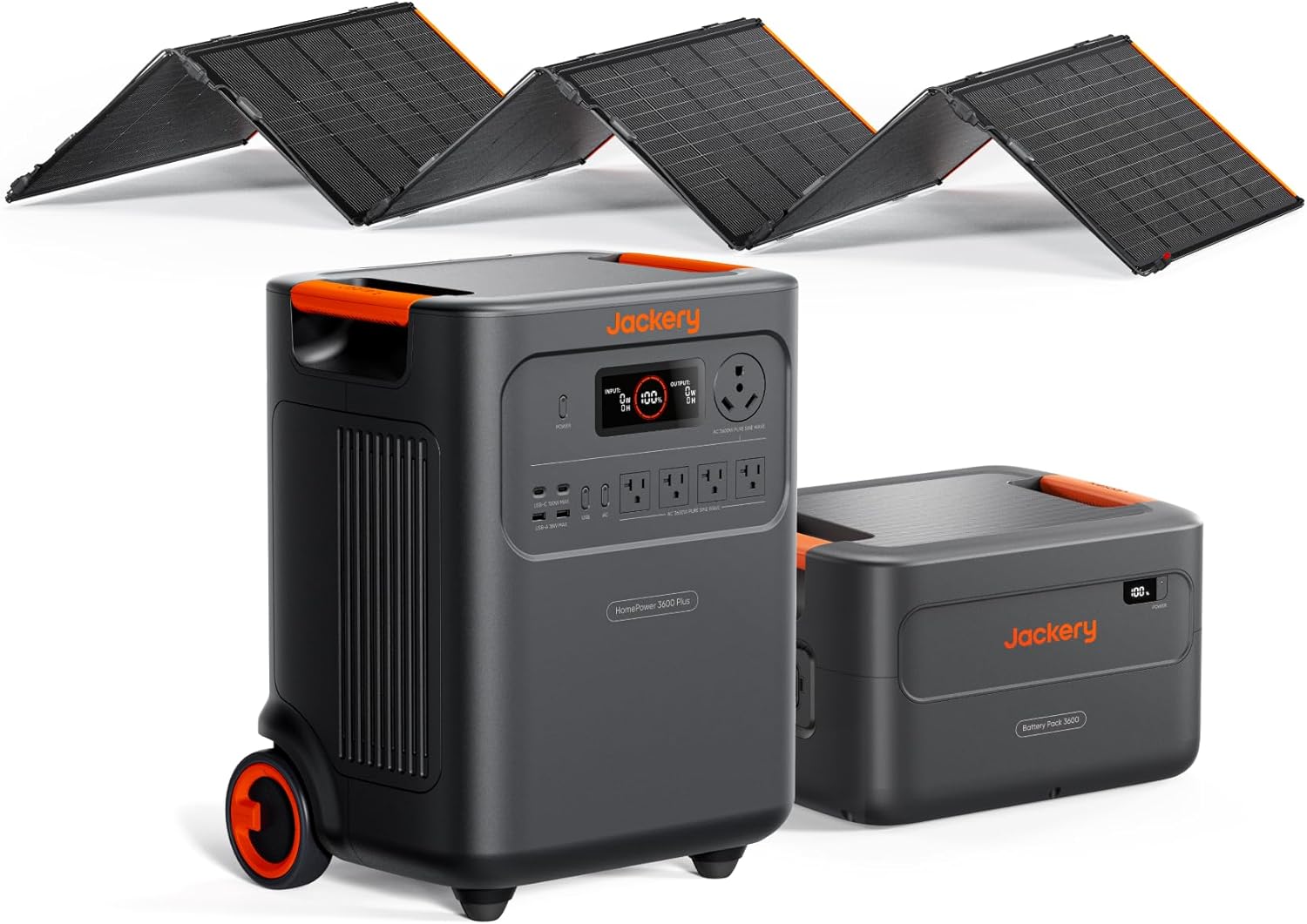
- Jackery HomePower 3600 Plus + Extra Battery + 2x 200W Solar Panels – the dual-battery bundle gives you 7168Wh of capacity to power a full crew through an eight-hour shift on solar alone.
- EcoFlow DELTA 3 Ultra Plus + 2x 400W Solar Panels – the 7200W surge rating means hard-starting compressors and worm-drive saws spin up without hesitation.
- EcoFlow DELTA 3 Max + 500W Alternator Charger – recharges quickly through your truck alternator between shifts so the battery is full every morning with zero grid access needed.
- Jackery HomePower 3600 Plus + Extra Battery + 500X Solar – the built-in smart transfer switch makes it a seamless drop-in for any site where you need instant failover power.
- Jackery Solar Generator 5000 Plus (with Protective Cover) – at 7200W continuous 120V/240V output, this is the single unit that can run every corded tool on a residential build simultaneously.
Running power tools on a job site without access to shore power has always meant hauling a gas generator, dealing with fumes, topping off fuel cans, and listening to engine noise all day. Solar generators have changed that equation entirely. Today’s high-capacity lithium iron phosphate units can deliver the same wattage as a mid-size gas machine, charge back up from roof-mounted or ground-deployed panels while you work, and operate with zero exhaust indoors or in enclosed spaces like garages, basements, and unfinished interiors. For contractors, remodelers, and serious DIY builders, a quality portable generator for job site use no longer has to mean a combustion engine.
The challenge is choosing the right capacity. Power tools are among the most demanding loads any generator faces, not because of their running wattage, but because of startup surge. A 15-amp circular saw drawing 1800W at full load can spike to 4500W or more during the first half-second of startup. A shop compressor can surge to three times its rated running draw. Miss that window and you get a tripped outlet, a stalled motor, or worse, a damaged tool. The solar generators reviewed here were selected specifically because their surge ratings and continuous output numbers are adequate for real job site workloads, not just charging laptops and running lights.
What to Look for in a Solar Generator for Power Tools
Surge wattage is the number that matters most. Every electric motor, including the ones inside your circular saw, drill press, miter saw, and air compressor, draws two to three times its rated running wattage for the first moment it starts. A unit rated at 2000W continuous may only offer 4000W peak surge, which sounds like plenty until you try to start a 3-horsepower compressor that needs 5500W on startup. Always compare the peak surge rating of the generator against the startup demands of your heaviest tool, not just your most-used one.
Continuous output of 2000W or more is the practical minimum. A 10-inch table saw running a rip cut through hardwood can draw 1800W to 2200W under load. If you are running that tool alongside a dust collector or a second outlet for a drill, you need a unit that can sustain 3000W or more without throttling or shutting down. All six units in this guide meet or exceed that threshold. For builders who want to understand how these units compare to larger whole-home backup options, our guide to large solar generators covers the higher-capacity tier in more detail.
Runtime per charge determines whether you get through a full day. A 2000Wh battery running tools at an average draw of 1500W gives you roughly 1.2 hours of work before you need a recharge. That is fine for a quick project but completely inadequate for a full day on site. The best options here start at 3000Wh and several offer 5000Wh to 7000Wh configurations, which is enough for six to eight hours of realistic mixed-tool use when combined with solar input during the day.
Portability vs. capacity is the core tradeoff. A 5000Wh LFP battery weighs significantly more than a 2000Wh unit, and moving it around a job site requires a hand truck or a dedicated cart. Some contractors prefer to leave a large unit in their truck bed and run a heavy-gauge extension cord to the work area. Others want the smallest unit that can handle their tools. Both approaches are valid, and the right answer depends on whether you are working in one location all day or moving frequently between rooms or floors.
The Best Solar Generators for Power Tools: Reviews
Jackery HomePower 3600 Pro Max
The HomePower 3600 Pro Max is built around a 3584Wh lithium iron phosphate battery pack and delivers a full 4000W of continuous AC output on both 120V and 240V circuits. That dual-voltage capability matters on job sites where larger tools like table saws, dust collectors, and larger air compressors require 240V. The unit handles surge loads smoothly, making it capable of starting hard-starting motors without the voltage sag that trips breakers on lesser units. LFP chemistry also means the battery tolerates partial charging cycles and high temperatures better than older NMC chemistries, which is relevant when the unit is sitting in a truck bed on a hot summer afternoon.
For a framing crew, this unit can run a worm-drive saw, a reciprocating saw, and a corded drill in rotation throughout the day without running low by midafternoon, especially if you have even two solar panels adding input while you work. The 4000W output ceiling is high enough that you can run a table saw and a shop vac at the same time, which is a practical real-world test most job site setups need to pass. The form factor is manageable for a single person with a hand truck, and the interface is clean enough to monitor state-of-charge at a glance.
Best for: Contractors who need true 240V output for larger stationary tools and want a single-battery unit with maximum continuous wattage.
Jackery HomePower 3600 Plus + Extra Battery + 2x 200W Solar Panels
This bundle pairs two HomePower 3600 Plus batteries for a combined 7168Wh of LFP storage, then adds a pair of 200W foldable solar panels to create a genuinely self-sustaining job site power system. The extended capacity changes the math on all-day runtime dramatically. At a realistic average draw of 1200W from rotating tool use, you have nearly six hours of battery-only runtime and the two 200W panels can add another 80-100Wh per hour under good sun, extending that further into the evening.
The 3600W continuous output rating covers virtually every corded tool in a typical contractor’s kit, and the surge handling is sufficient for compressor startups and saw motor engagement. The two solar panels fold flat for transport and can be propped facing south on the ground or leaned against a wall, making them practical even on sites where there is no good rooftop access. This is the kind of setup that makes a multi-day remote project genuinely feasible without any grid access or fuel deliveries.
Best for: Multi-day remote job sites or renovation projects where the crew needs all-day power and wants to recharge entirely from sunlight between sessions.
EcoFlow DELTA 3 Ultra Plus + 2x 400W Solar Panels
The DELTA 3 Ultra Plus brings 3072Wh of LFP capacity paired with a 3600W continuous output rating and a 7200W surge ceiling, which is the highest peak surge figure in this roundup. That 7200W surge number means even the most challenging motor startups are handled cleanly. A 3-horsepower air compressor that spikes to 5500W on startup is well within margin. A worm-drive saw that pulls 4000W on initial engagement is not even close to the limit. For anyone who regularly starts heavy compressors or large benchtop tools, this headroom is the practical difference between a frustrating half-day and a productive full one.
The two 400W solar panels included in this bundle push 800W of solar input in good conditions, which is enough to meaningfully extend runtime and potentially provide a full recharge overnight if you park with the panels facing south. EcoFlow’s app integration lets you monitor power draw and solar input in real time, which is useful for diagnosing which tools are eating the most capacity. Builders who also want a unit they can bring on a camping trip or use as an RV backup will find that our guide to solar generators for RVs covers EcoFlow models in that context as well.
Best for: Contractors running large compressors, heavy-duty saws, or any tool with a difficult startup surge that has tripped other units.
EcoFlow DELTA 3 Max + 500W Alternator Charger
The DELTA 3 Max takes a different approach to the recharging problem by bundling a 500W alternator charger rather than solar panels. This is a smart configuration for contractors who drive to a new site each morning, because the unit recharges through the truck’s alternator during the commute and continues charging in the truck bed throughout the day if you run a cable from the cab. At 500W input, an hour of driving can add 400-500Wh to the 2048Wh battery, and a two-hour round trip commute is enough to recover most of what a morning’s worth of tool use consumed.
The unit’s 3400W output leverages EcoFlow’s X-Boost technology, which optimizes power delivery to ensure tools receive clean, stable power even when draw fluctuates. The 2048Wh capacity is the smallest in this group, but for a solo contractor or a small two-person crew doing finish work, trim carpentry, or electrical rough-in, it is adequate for a full day if the alternator is keeping it topped off. The DELTA 3 Max is also one of the more compact and lighter units here, making it genuinely portable rather than a two-person lift.
Best for: Solo contractors or small crews who drive to their site daily and want the alternator charging to eliminate any dependency on solar access or grid outlets.
Jackery HomePower 3600 Plus + Extra Battery + 500X Solar
This configuration combines the same 7168Wh dual-battery platform from the HomePower 3600 Plus bundle with the 500X solar panel, which delivers more input per panel than the 200W options in the smaller bundle. The result is a high-capacity system with faster solar recovery, which matters on sites where you cannot easily spread out multiple panels. The built-in smart transfer switch is the distinguishing feature of this configuration: it allows the unit to act as an uninterruptible power source that shifts seamlessly between solar input, battery power, and an external source without any manual switching or tool interruption.
For a site foreman managing multiple tools and a crew, having power that does not blip during a source transition means tools never unexpectedly stop mid-cut, computers do not lose unsaved drawings, and measurement equipment stays live. The 3600W continuous rating is consistent with the other HomePower 3600 units, and the LFP chemistry ensures the dual-battery system can handle deep cycling day after day without capacity loss. This is a meaningful consideration for anyone who plans to use the same unit on site for a full construction season. Those who also need backup power at home after hours may find our coverage of solar generators for well pumps relevant for off-grid or outage scenarios.
Best for: Site managers who need seamless power transitions, high total capacity, and faster solar recovery from a single panel footprint.
Jackery Solar Generator 5000 Plus (with Protective Cover)
The Solar Generator 5000 Plus is the highest-output unit in this guide and it earns that position with a 5040Wh LFP battery and a 7200W continuous output rating on both 120V and 240V circuits. That combination means you can run a 10-inch table saw, a 5-horsepower shop compressor, a dust collector, and a corded angle grinder all at the same time without approaching the output limit. This is not a theoretical scenario for a busy framing or cabinet shop crew: it is the kind of simultaneous tool use that happens constantly and that smaller units cannot sustain.
The included protective cover is a thoughtful addition for job site use, where the unit may be sitting in a dusty garage, on a concrete slab, or near sawdust and construction debris. The cover protects the ports and display without impeding access during operation. At 5040Wh, this unit will power a two-person crew running moderate tools for a full eight-hour day with runtime to spare, and the 240V output means it is ready for any tool upgrade without needing a separate adapter or a higher-capacity unit. For anyone looking at this tier of output, our guide to large solar generators provides additional context on how this unit fits the broader high-capacity market.
Best for: Full crews, cabinet shops, or any job site application where multiple high-draw tools run simultaneously and maximum output is the top priority.
“I switched from a gas generator to a solar setup about two years ago and the honest truth is I wish I had done it earlier. The noise alone was making my days miserable. Now I can work inside a finished basement with a circular saw and a shop vac running and there are no fumes, no cords to a window, no fuel to haul. The battery lasts all day for my typical work load and charges back up overnight. The upfront cost felt high but I have not bought a drop of gasoline for the job site since.”
“The thing contractors do not think about until it bites them is startup surge. I used to spec units based on running wattage and then wonder why my compressor kept tripping the outlet. Once I started looking at peak surge ratings and bought a unit with real headroom above my heaviest tool, all those problems went away. Now my rule is: find your biggest startup draw, double it, and make sure the generator beats that number with room to spare.”
Frequently Asked Questions
Can a solar generator run a table saw all day?
Yes, with the right capacity. A standard 10-inch table saw draws between 1500W and 2200W under load, and a solar generator rated at 3000W or more continuous output can sustain that without throttling. For all-day operation, you need enough battery capacity to cover your average draw for the full shift, which means 3000Wh at minimum for a solo operator doing intermittent cuts, and 5000Wh or more for continuous heavy use. Solar input during the day helps extend runtime further. All six units in this guide can run a table saw; the difference is how long they can sustain it and what else you can run at the same time.
Is a solar generator safe to use indoors on a job site?
Yes. This is one of the primary advantages solar generators have over gas-powered units. There is no combustion, no carbon monoxide output, and no fuel vapor. You can operate a solar generator in a basement, a garage, an unfinished interior, or any enclosed space without ventilation requirements. Gas generators must never be used indoors or near open windows due to CO poisoning risk, which creates real practical constraints on a job site. A solar generator eliminates those constraints entirely, and that alone is a significant quality-of-life and safety improvement for contractors working in enclosed spaces.
Final Verdict
For most contractors and serious DIY builders, the right solar generator for power tools comes down to two questions: how much total capacity do you need for a full day’s work, and how heavy is your hardest-starting tool. If you are running a single-person kit with a circular saw, a drill, and an occasional compressor, the EcoFlow DELTA 3 Max with the alternator charger is a compact and practical choice that recharges on the road. If you are managing a crew with multiple tools running simultaneously, the Jackery Solar Generator 5000 Plus or the 7168Wh dual-battery bundles are the units that will not leave you watching a low-battery warning mid-afternoon.
Every unit here is built on lithium iron phosphate chemistry, which matters for job site durability. LFP batteries handle heat, partial cycles, and frequent deep discharge far better than older lithium chemistries, and they are rated for thousands of full charge cycles. That means a solar generator you buy today should still be delivering close to its original capacity five or more years from now, which changes the long-term economics considerably compared to gas generators that need maintenance, fuel, and eventual engine replacement. The no-fumes, no-noise, no-fuel-run benefits are immediate, but the durability and total cost of ownership advantages compound over time.


Write Your Review
No reviews yet. Be the first to share your experience!