




Quick Picks: Best Portable Generators for Power Tools
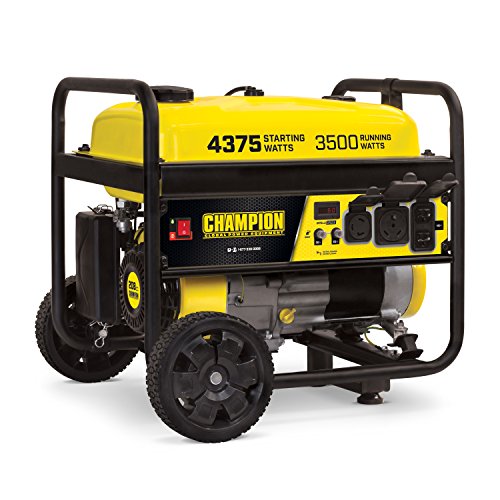
- Best Overall for Job Site: Champion 4375W with CO Shield – reliable 4375W output, CO Shield safety shutoff, electric start, handles all standard power tools simultaneously
- Best Mid-Range Workhorse: Champion 100522 4375W – established 4375W platform with RV-ready outlet, trusted across construction and contractor use
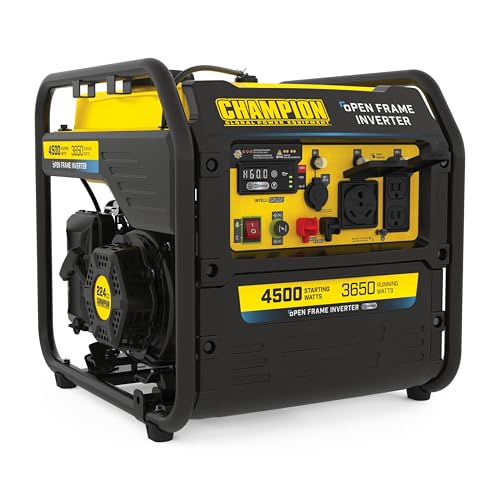
- Best Open Frame Inverter: Champion 4500W Open Frame Inverter – inverter quality at 4500W in an open frame design, better power quality for sensitive tool electronics
- Best High-Output Inverter: Champion 4500W RV Ready Inverter – enclosed housing, 4500W inverter quality, electric start for professional power tool setups
- Best High-Wattage Conventional: Westinghouse WGen5300s 6600W – maximum surge capacity for table saws, air compressors, and simultaneous multi-tool operations
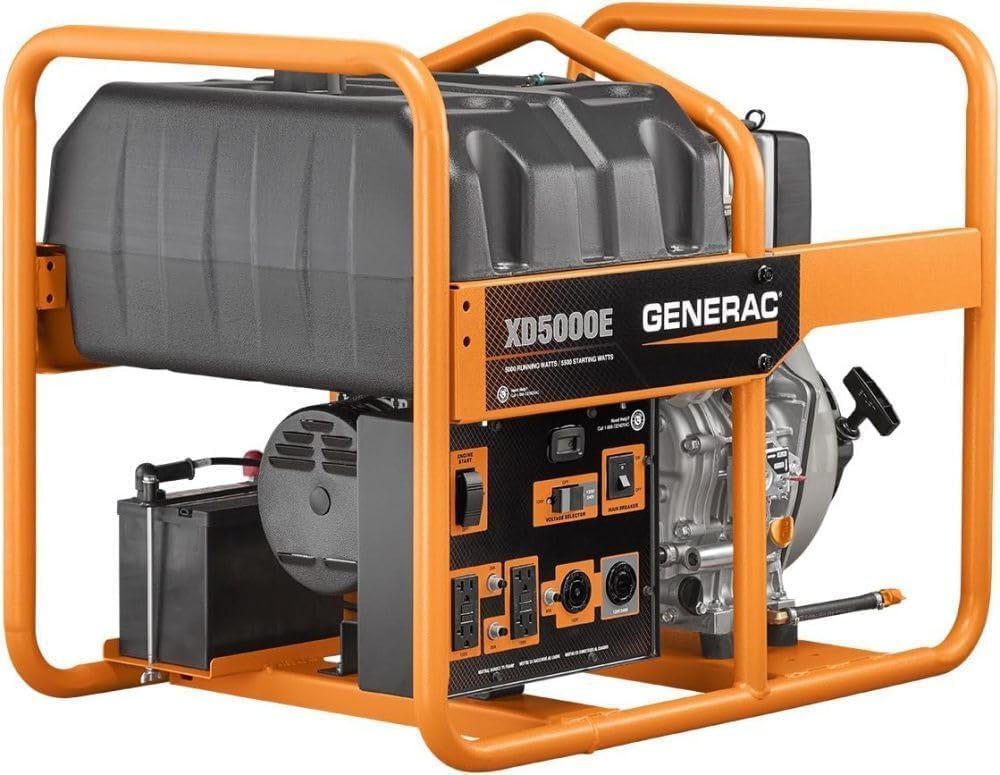
- Best for Professional Contractors: Generac XD5000E 5000W Diesel – diesel fuel advantage for extended job site use, long runtime between fills, appropriate for permanent job site installations
Power tools on a job site have a different power requirement profile than most generator applications. The primary concern is not power quality – most power tools use brushed universal motors or induction motors that run adequately on conventional generator output without the pure sine wave requirement of sensitive electronics. The primary concern is surge wattage. A 10-inch table saw rated at 1800 watts running draws 4000-6000 watts when the motor first starts under load. An air compressor rated at 1200 watts running draws 3000-4000 watts at startup. A generator that cannot deliver this surge wattage will trip its overload protection the moment a tool starts under load.
The practical approach for job site generator sizing is to identify the highest-surge tool in the setup – usually the table saw or air compressor – and ensure the generator’s peak wattage exceeds that tool’s startup surge by at least 20%. Then add the running wattage of all simultaneously operating tools to the running watt total. A job site running a table saw (1800W running, 4000W surge), circular saw (1400W running), and shop vacuum (750W running) needs a generator with 6000+ surge watts and 4000 running watts. This capacity requirement drives job site generators larger than most residential backup applications.
The most common job site generator sizing mistake is matching the generator to running wattage rather than startup surge. A 3500W generator that runs the table saw perfectly when it is already spinning will fail every time the saw starts under load. Size for the surge, not the running draw – your generator’s peak wattage must handle the highest single-tool startup surge, not just the combined running wattage.
Power Tool Wattage Reference
Table saw (10-inch): 1800-2000W running, 4000-6000W startup. Circular saw (7.25-inch): 1200-1800W running, 2400-4200W startup. Miter saw (10-inch): 1800-2400W running, 3600-5000W startup. Air compressor (2HP): 1500-1800W running, 3000-5000W startup. Angle grinder (4.5-inch): 750-1200W running, 1500-2400W startup. Shop vacuum (6-gallon): 750-1200W running, 1500-2000W startup. Reciprocating saw: 600-1200W running, 1200-2400W startup. Drill press: 400-800W running, 1600-2400W startup. For a broader comparison of generator options for construction and contractor use, see the construction generator guide.
Best Portable Generators for Power Tools – Reviewed
Champion 4375W Generator with CO Shield
The Champion 4375W generator with CO Shield is the updated version of Champion’s established 4375W job site platform with the addition of the CO Shield automatic carbon monoxide detection and shutoff system. At 4375 peak watts and 3500 running watts, it starts and runs a 10-inch table saw with ample surge headroom, operates a 2HP air compressor at startup, and runs multiple smaller tools simultaneously within its continuous capacity. Electric start eliminates the physical pull-start effort at job site temperatures ranging from winter cold to summer heat. Multiple 120V 20A and 30A outlets provide connection points for a typical contractor setup.
The CO Shield shutoff is a meaningful safety addition for job site use in partially enclosed spaces – garages under renovation, basements, and enclosed worksite structures where CO can accumulate when the generator is positioned too close to the work area. Champion’s service network supports warranty and out-of-warranty service across most of the US and Canada, important for a generator that runs hard at job sites. For the combination of adequate surge capacity, safety features, and accessible servicing, the Champion 4375W with CO Shield is the balanced job site generator choice.
Best for: General contractor and remodeling work with table saw, compressor, and circular saw as primary loads, job sites in enclosed or semi-enclosed structures where CO monitoring adds safety, anyone building a new contractor generator kit.
Champion 100522 4375W – The Established Job Site Workhorse
The Champion 100522 is the predecessor model to the CO Shield update – the same core 4375W platform that has accumulated thousands of hours of contractor use across the country. At 4375 peak watts and 3500 running watts with an RV-ready 30A outlet, electric start, and Champion’s standard configuration of 120V and 240V outlets, it covers the standard job site power profile. For contractors who have owned Champion generators previously, the 100522 represents a known platform with predictable maintenance requirements and readily available parts.
The 240V outlet expands the generator’s capabilities to 240V power tools – larger table saws, compressors, and air handling equipment that operate more efficiently at 240V. For job sites where 240V tools are part of the regular equipment inventory, this outlet configuration is the practical advantage of a 4000W+ conventional generator over most compact inverter options. The generator’s runtime at full job site load on a standard tank covers a complete workday with one refueling stop.
Best for: Contractors already familiar with the Champion 4375W platform who want continuity of parts and service, job sites with 240V tool requirements, general contractor work where the CO Shield premium is not required.
Champion 4500W Open Frame Inverter – Clean Power for Modern Tools
Modern cordless power tool charging stations, variable-speed grinders with electronic controls, and precision router speed controllers all perform better on pure sine wave inverter power than conventional generator output. The Champion 4500W Open Frame Inverter Generator delivers inverter-quality pure sine wave at 4500W capacity in an open-frame design that reduces cost compared to fully enclosed inverter housings while maintaining the power quality benefits of inverter output. For job sites mixing traditional power tools with electronics-dependent modern tools, the inverter output protects both categories.
The open-frame design means this generator runs louder than enclosed inverter models at comparable loads – the trade-off is lower cost at the same wattage and power quality. For job sites where noise is less constrained (commercial construction, rural renovation, industrial environments), the open-frame inverter hits the right balance of power quality, capacity, and price. At 4500W, it handles the same job site tool load as the conventional 4375W Champion models, with the additional benefit of safer operation for electronics-connected equipment.
Best for: Job sites mixing traditional power tools with modern electronics-sensitive equipment, contractors who want inverter quality at 4500W without paying the enclosed housing premium, commercial and industrial environments where noise constraints are less critical.
Champion 4500W RV Ready Inverter – Enclosed Quiet Inverter for Mixed Job Sites
The Champion 4500W RV Ready Inverter is the enclosed-housing version of Champion’s 4500W inverter platform – quieter than the open-frame model, with the 30A RV outlet for high-amperage distribution panel connection. For contractors who work in residential neighborhoods where generator noise affects neighbor relations, or who bring the generator inside an enclosed job site trailer, the enclosed inverter’s noise reduction is the practical advantage over open-frame designs of comparable wattage. The pure sine wave output covers all power tools and sensitive electronics on the same generator without concern about power quality differentiation.
The 4500W capacity handles table saw startup with comfortable margin and runs multiple simultaneous mid-size tools at approximately 70-80% of running watt capacity – a sustainable continuous duty range for an enclosed inverter design. Electric start and remote key fob operation are standard features. For contractors who are already running Champion equipment and want the quieter enclosed inverter option at the 4500W class, this model fills that position in the lineup.
Best for: Residential construction and renovation in neighborhoods where generator noise creates client and neighbor relations concerns, contractors who want enclosed inverter noise levels at 4500W capacity, anyone who uses a 30A power distribution panel on the job site.
Westinghouse WGen5300s 6600W – Maximum Surge for Demanding Tool Combinations
Certain job site configurations demand more surge wattage than a 4375-4500W generator can reliably deliver: a large 12-inch sliding miter saw starting alongside a running compressor, a 3HP table saw at heavy cut startup, or simultaneous operation of two full-size 10-inch saws. The Westinghouse WGen5300s at 6600 peak watts and 5300 running watts provides the surge headroom that these demanding combinations require. At 5300 running watts, it also handles more simultaneous tool operation than 4375W generators allow – running a table saw, compressor, and two circular saws concurrently at approximately 90% of running watt capacity.
The higher wattage class at this price tier is a conventional generator design (not enclosed inverter), which means higher noise output and standard sine wave output rather than pure sine wave. For traditional power tool job sites without electronics-sensitive equipment, this trade-off is acceptable in exchange for the surge capacity and running wattage that demanding tool combinations require. The GFCI-protected outlets and multiple outlet configurations match the standard job site multi-tool connection profile.
Best for: Heavy-duty job sites with large saws (12-inch miter, 3HP table saw) or multiple simultaneous high-draw tools, contractors who have maxed out 4375W generators and need the next capacity tier, commercial construction where maximum tool runtime per day is the priority.
Generac XD5000E 5000W Diesel – Professional Contractor Durability
Diesel generators occupy a different position than gasoline generators for job site use. Diesel fuel provides approximately 15-20% more energy per gallon than gasoline, meaning longer runtime between refueling stops on a given tank size. Diesel engines have longer service intervals and are built for continuous duty cycles that exceed what gasoline portable generators are designed for. The Generac XD5000E at 5000 running watts is designed for extended job site use where the generator runs from job start to job end every working day – a duty cycle that gasoline generators handle but do not excel at over years of daily service.
For professional contractors whose generator is a primary income-generating tool that runs every working day, the diesel engine’s extended service intervals and fuel efficiency translate to lower operating cost over the life of the equipment. Diesel fuel is also available at commercial fuel locations across job site territories and is not subject to the ethanol content issues that affect some gasoline engines in certain regions. The 5000W output covers the full standard contractor tool load with adequate surge headroom for all single-tool startup scenarios within that capacity class. For a broader look at contractor and job site generator options, the job site generator guide covers the full spectrum.
Best for: Professional contractors who run the generator every working day and prioritize long-term operating cost and reliability over initial purchase cost, job sites in regions with consistent diesel fuel availability, commercial contractors who want diesel engine durability at the 5000W class.
Job Site Generator Safety
Never Run Indoors or in Enclosed Spaces
CO poisoning from job site generator use occurs when the generator is placed inside a structure under construction – a garage, basement, or building under renovation – for weather protection or because the operator wants the outlet access nearby. Generator exhaust contains lethal CO concentrations that accumulate in enclosed spaces within minutes. Position the generator outdoors with the exhaust directed away from any door, window, or air intake. At minimum 20 feet from any occupied workspace. Use a properly rated outdoor extension cord of sufficient gauge to reach the work area from that safe outdoor position.
Ground the Generator Properly
Job site generators are required by OSHA regulations to be properly grounded when used in commercial construction. Most modern portable generators use a floating neutral design that does not require an external ground stake for GFCI-protected outlet use. For generators connected to a job site distribution panel or in situations where external grounding is required, consult the generator manual and the site’s electrical requirements. GFCI protection – available on most modern generators’ 120V outlets – provides the primary shock protection for outdoor wet-condition power tool use.
FAQs
Do power tools need a pure sine wave generator?
Traditional power tools with brushed universal motors (circular saws, drills, jigsaws, most routers) run on conventional generator output without issue. Modern variable-speed power tools with electronic speed control, brushless motor controllers, and precision servo-driven tools perform better and last longer on pure sine wave inverter output. For a job site mixing traditional and modern tool categories, inverter output is the safest choice for all equipment. For a job site using exclusively traditional brushed tools, conventional generator output is adequate.
Can I run a table saw and air compressor on the same generator?
Yes, with appropriate generator sizing. A 10-inch table saw (1800W running, 4000W surge) and a 2HP compressor (1500W running, 3500-4500W surge) cannot start at the same moment – but in practice they rarely do. If you need to start the table saw while the compressor is running, the combined load is approximately 1800 + 1500 = 3300W running plus the saw’s 4000W startup surge = 7300W total at startup. A 6600W peak generator handles this; a 4500W generator may not. For operations that stagger tool starts rather than starting simultaneously, a 4500W generator handles both tools reliably.
How should I size a generator for a job site?
List all tools that will run simultaneously in the worst-case scenario. Add their running wattages together for the total running load. Identify the highest-surge single tool (usually the table saw or large compressor). The generator’s peak wattage must exceed that tool’s startup surge by at least 20%. The running watt capacity must exceed the total simultaneous running load. Add 15-20% buffer to both numbers for safety and to avoid running the generator at maximum capacity continuously.
Final Verdict
For most contractor job sites with standard tool combinations, the Champion 4375W with CO Shield provides the right balance of surge capacity, safety features, and service accessibility. The CO Shield addition over the older Champion model is a worthwhile upgrade for anyone working in enclosed or semi-enclosed job site environments.
For job sites with demanding tool combinations that exceed 4500W peak requirements, the Westinghouse WGen5300s at 6600W peak provides the surge headroom needed for simultaneous large tool operation. For professional contractors running the generator every workday, the Generac XD5000E Diesel offers the operating efficiency and durability appropriate for a daily-use commercial tool investment.


Write Your Review
No reviews yet. Be the first to share your experience!