

The good news? Once you understand how much power you actually need, choosing the right generator becomes much easier.
In this guide, I’ll walk you through the best RV generators, what size makes sense for your setup, and how to avoid common buying mistakes.
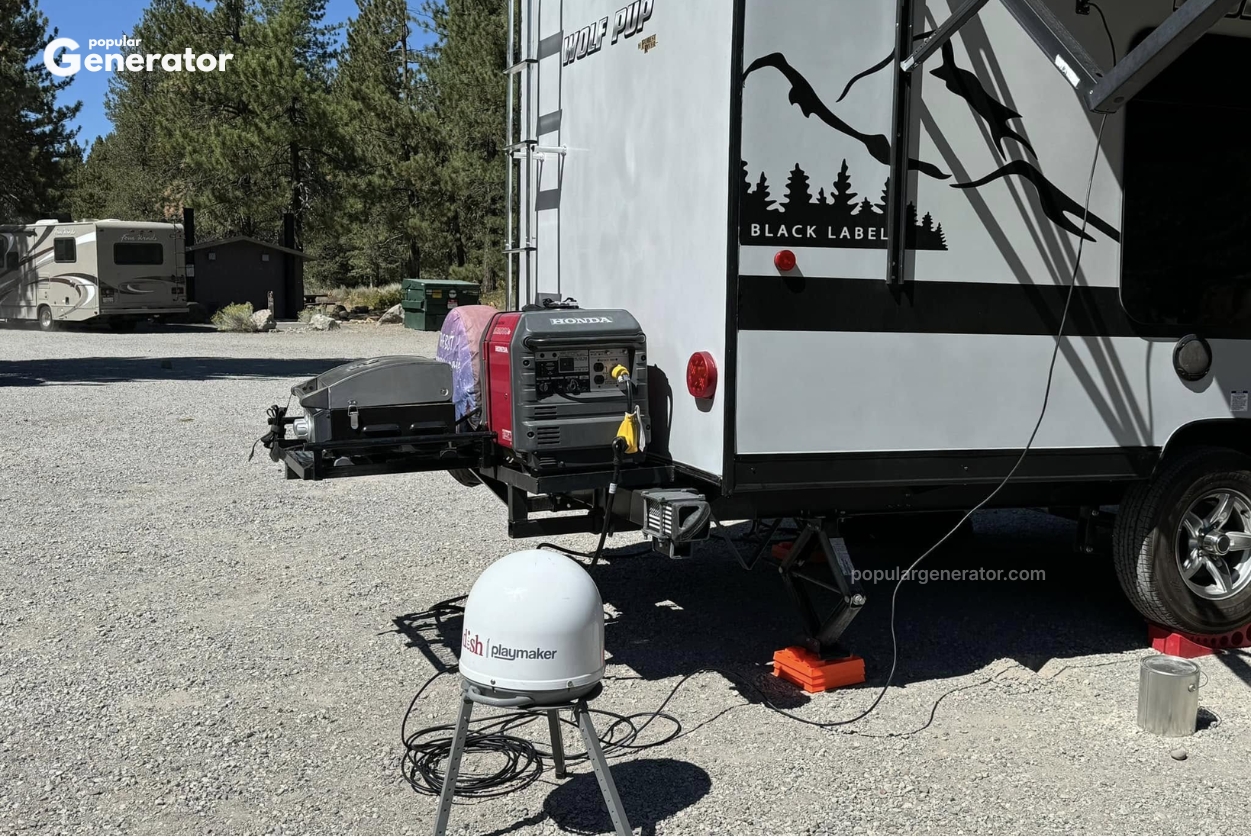
What Size Generator Do You Need for an RV?
RV generator size depends on your AC units and power needs: 2,000–3,000W for smaller trailers (basic needs), 3,000–4,000W for 30-amp systems (one AC), and 5,000–8,000W+ for 50-amp systems (dual ACs). Inverter generators are recommended for quiet, efficient power.
Quick Generator Sizing Guide
- Small (Pop-ups/Teardrops): 1,500–2,000 watts.
- Mid-Size (Class B/C, <30′ TT): 2,800–4,000 watts.
- Large (Class A, 5th Wheels): 5,500–8,000+ watts.
How Quiet Should an RV Generator Be?
When choosing the best RV generator, noise level is just as important as wattage, especially if you plan to stay at public campgrounds.
Campground Noise Limits (Usually Under 60 dB)
Most campgrounds require generators to operate at 60 decibels (dB) or lower at a certain distance (typically 20–25 feet). Anything louder may violate campground rules, especially during quiet hours.
To give you context:
- 50–55 dB → Normal conversation level
- 60 dB → Acceptable campground range
- 70+ dB → Loud vacuum cleaner
If your generator exceeds 65–70 dB, it may disturb nearby campers and potentially get you complaints.
Inverter Generators
Inverter generators are favored for RVs because they provide a quiet, fuel-efficient, and clean power source suitable for sensitive electronics. Their advanced technology allows them to run at variable speeds, significantly reducing noise compared to traditional generators.
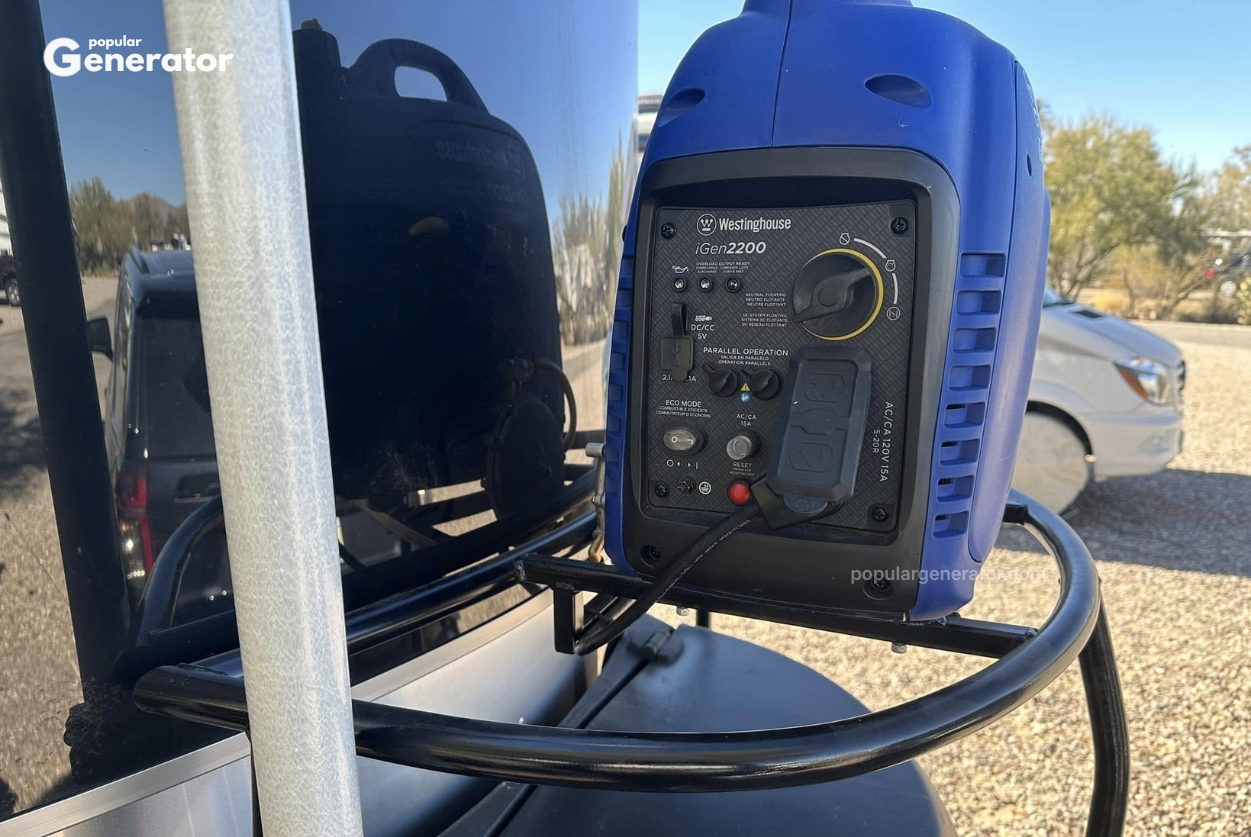
The primary reason inverter generators are quieter is their ability to adjust engine speed based on power demand, unlike conventional generators that run at a constant high speed (around 3600 RPM) regardless of the load.
- Variable Engine Speed: The engine automatically throttles up or down to meet the exact power requirements, meaning it often runs at a lower, quieter RPM when demand is low (like charging a phone or running lights). This is more efficient and creates far less noise than a fixed-speed engine running at full tilt.
- Enclosed Design & Sound Dampening: Most inverter generators feature a fully enclosed acoustic housing made with sound-absorbing materials and a specially designed exhaust system, which further muffles engine noise and vibration.
- Decibel Levels: Inverter generators typically operate between 50 and 60 decibels (dBA) at a quarter load, comparable to a normal conversation or moderate rainfall. Conventional generators, by contrast, can be as loud as a vacuum cleaner or chainsaw, often producing 70-90+ dBA.
Gas vs Propane vs Dual Fuel for RV Use
When considering the fuel options for RV use:
- Gas
- Propane
- Dual fuel
Each has its own advantages and disadvantages that cater to different needs and preferences.
Gasoline tends to be the most readily available fuel source, making it convenient for those who may frequently travel to various locations. It often powers internal combustion engines, providing a straightforward and efficient means of mobility. However, gasoline may not be as efficient for heating or cooking within the RV.
Propane, on the other hand, offers a significant advantage in terms of energy efficiency and versatility. It can be used for heating, cooking, and refrigeration, which makes it particularly valuable for off-grid camping or extended stays in remote areas. Propane tanks are relatively easy to refill and provide a consistent energy source, although it may require more management concerning safe storage and proper ventilation.
Dual fuel systems, which can use both gas and propane, combine the benefits of both fuel types. This flexibility allows RV owners to switch between fuels based on availability or personal preference. However, these systems can be more complex to maintain and operate, and they may incur higher initial costs. Ultimately, the choice between gas, propane, and dual fuel should be based on individual travel habits, intended use, and personal comfort with the associated maintenance requirements.
Quick Comparison Table (Above the Fold)




How to Choose the Right RV Generator
Choosing the right RV generator requires calculating total power needs, focusing on the starting wattage of heavy appliances like air conditioners. Select a quiet inverter model (under 60dB) with sufficient fuel capacity and portability for your camping style. A 3,000–4,500-watt generator generally suits 30-amp RVs, while 50-amp rigs need higher capacity, ensuring a 20% power buffer.
1. Calculate Your Power Needs (Wattage)
Before buying an RV generator, you need to answer one simple question:
How much power will you actually use at the same time?
Many RV owners either underestimate their needs (and overload the generator) or overspend on more power than they’ll ever use. Here’s how to calculate it the smart way.
Step 1: List What You’ll Run
Start by writing down the appliances you realistically plan to use together, such as:
- Air conditioner
- Microwave
- Coffee maker
- Refrigerator
- TV
- Hair dryer
Now check each appliance for two numbers:
- Running watts → the power it needs to keep running
- Starting watts (surge watts) → the extra power needed when it first turns on
Motors (like AC units and fridges) require much higher starting watts. That’s usually what determines your generator size.
For example:
- 13,500 BTU RV AC → 1,500 running watts / 3,000 starting watts
- Microwave → 1,000 running watts
- RV fridge → 600 running watts
- TV → 150 running watts
Step 2: Add the Running Watts
Now think realistically, what will be on at the same time?
Let’s say you’re running:
- AC
- Microwave
- Fridge
- TV
Add up their running watts:
1,500 + 1,000 + 600 + 150
= 3,250 running watts
That’s your base load.
Step 3: Account for the Biggest Startup Surge
Here’s where many people make a mistake:
You don’t add all starting watts together.
Instead, use this simple rule:
- Take the highest single starting wattage (usually your AC)
- Then add the running watts of everything else
Step 4: Add a Safety Buffer (Very Important)
Generators shouldn’t run at full capacity all the time. That leads to:
- Overheating
- Higher fuel consumption
- Shorter lifespan
Add about 20% extra capacity for safety.
2. Choose Between Inverter vs. Conventional
Inverter Generators: Recommended for RVs. They produce “clean” power safe for sensitive electronics (laptops, TVs), are much quieter, and more fuel-efficient.
Conventional Generators: Generally louder, heavier, and best for high-demand, non-sensitive tools, but less common for modern RV camping.
3. Consider Fuel Type
Gasoline: Most common, easy to find, but requires carrying extra, flammable fuel.
Propane (LP): Cleaner burning, readily available, can connect to the RV’s main propane tank, but lower fuel efficiency.
Dual-Fuel: Offers the flexibility to switch between gas and propane, which is ideal for varying, long-term trips.
4. Key Features for RVers
Noise Level: Look for models with 60 dB or lower, especially for campgrounds.
Portability & Weight: Ensure it fits your storage space and is manageable to move (check for wheels and handles).
RV-Ready Outlets: Choose models with a built-in 30-amp or 50-amp RV plug for easy connection.
Electric Start: Provides convenience compared to pull-starting.
5. Sizing for Common RVs
- Small Trailers/Pop-ups: 1,000–2,000 watts.
- 30-Amp RVs (with 1 AC unit): 3,000–4,500 watts.
- 50-Amp RVs (with 2 AC units): 6,000–12,000 watts.
FAQs – RV Generator Wattage & Sizing
1. How many watts do I need for an RV generator?
Most RVs need between 3,000 and 4,000 watts for basic use. If you plan to run an air conditioner along with other appliances, you may need 4,000 to 6,000 watts, depending on your setup.
2. Can a 3,500 watt generator run an RV air conditioner?
Yes, a 3,500 watt generator can usually run a 13,500 BTU RV air conditioner, as long as it has enough starting (surge) watts. Installing a soft start kit can make startup easier and reduce strain.
3. What size generator do I need for a 30 amp RV?
A 30-amp RV requires a generator with 3,000 to 4,000 watts (running/rated) to comfortably power a single air conditioner (AC), refrigerator, converter, and lights simultaneously.
While a 30-amp system can technically handle 3,600 watts (120V x 30A), a generator in the 3,200–3,500W range is ideal for optimal efficiency and to handle AC start-up surges without overloading.
4. What size generator is needed for a 50 amp RV?
For a 50-amp RV, a generator with 5,500 to 8,000 running watts is typically sufficient to run dual air conditioners and appliances.
While a 50-amp system can technically handle up to 12,000 watts, most users rarely need this much power and find a 6,000 to 7,000-watt inverter generator to be a more efficient, quieter, and portable solution.
5. Do I need to add starting watts and running watts together?
Yes, you must account for both, but you do not simply add all starting watts to all running watts.
To size a generator or inverter correctly, sum all running watts for your devices, then add only the highest single starting wattage (surge) among them.
This ensures the generator can handle the initial, high-power surge of a motor starting while others are already running.
6. Should I add extra capacity to my generator size?
Adding a small buffer of 10-20% extra capacity to your generator is recommended to handle power surges and future equipment additions. However, significant oversizing leads to poor fuel efficiency, higher operating costs, and potential engine damage from running at low loads. A 20% safety margin allows for inrush current when large appliances like AC units start.
- Optimal Sizing: The best performance comes from running a generator at 50-75% of its maximum capacity.
- Safety Buffer: A 20% cushion prevents overloading when starting appliances.
- Why Not to Over-Size: Excessively large generators burn more fuel per kilowatt produced, wasting money.
- Engine Health: Running diesel generators at too low a load causes “wet stacking” (carbon buildup).
Recommendation: Calculate your total needed wattage for essentials, then add a 15-20% safety buffer to determine the ideal size.


Write Your Review
No reviews yet. Be the first to share your experience!