




Quick Picks: Best 5000 Watt Dual Fuel Generators
- Best Overall 5000W Dual Fuel: Champion 7500W Dual Fuel, 7500W running, CO Shield, 30A outlet, wheel kit, strong value
- Best Quiet 5000W Dual Fuel: Champion 4500W Wireless Inverter, 61 dBA, wireless remote, inverter quality for sensitive electronics
- Best Heavy-Duty 5000W: DuroMax XP6500EH 6500W Dual Fuel, electric start, dual voltage 120/240V, 8125W peak
- Best Budget 5000W Dual Fuel: Westinghouse WGen6000DF, 6000W continuous, remote start, transfer switch ready
- Best for Home Backup: FIRMAN H05752 5700W Dual Fuel, 5700W running, extended run time, transfer switch capable
Five thousand watts is the wattage where a generator stops being a convenience item and starts being infrastructure. At this output level you are covering a central AC window unit, a full refrigerator, a microwave, and multiple outlet loads simultaneously. That requires a generator you can depend on through a three-day outage or a full camping season.
The 5000-watt dual fuel class attracts a specific type of buyer: someone who has looked at the 2000-3000 watt options, calculated their actual load, and realized the math does not work. A single 13,500 BTU AC draws more than 1,500 watts running; add a refrigerator and microwave and a 2000W generator is at capacity before anything else turns on. At 5,000 watts, you have genuine headroom.
Dual fuel capability adds an important dimension at this wattage. A 5000-watt generator running at 50% load burns through gasoline at a meaningful rate – roughly half a gallon per hour. Over a three-day power outage, that adds up to 36 gallons of gasoline. Having propane as an alternative fuel source, especially for owners who already keep a large propane tank for heating or cooking, changes the refueling calculus significantly. For additional perspective on the full 5000W generator category, our complete 5000-watt generator guide covers gas-only options alongside dual fuel models.
8 Best 5000 Watt Dual Fuel Generators: Reviews
1. Westinghouse iGen4500DF 4500-Watt Super Quiet Dual Fuel Inverter Generator
Starting with a question that many buyers in this category ask: is there an inverter-quality dual fuel generator that approaches 5000 watts without the noise penalty of an open-frame design? The Westinghouse iGen4500DF is the closest answer at the lower end of this wattage class. At 4,500 watts peak and under 52 decibels at 25% load, it is one of the quietest dual fuel generators in the 4500-5500W range by a significant margin.
Remote electric start is standard, the TT-30R 30-amp RV outlet is there for direct trailer connections, and the inverter output keeps total harmonic distortion low enough for any sensitive electronics in an RV or home office. The trade-off against conventional open-frame generators in this class is the premium in initial cost for the inverter design, which Westinghouse offsets with a three-year warranty and reliable parts availability.
Best for: Buyers who prioritize quiet operation and inverter-quality power in the 4500W range for RV or home use.
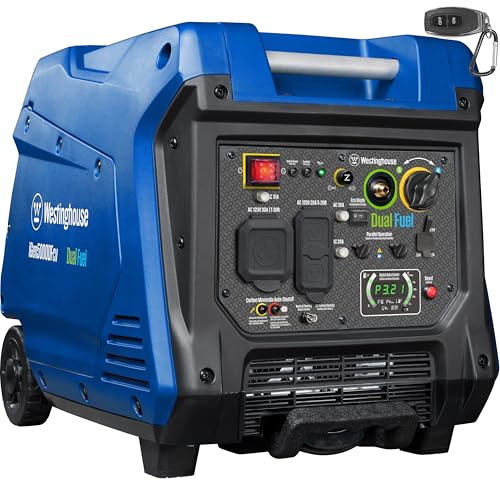
2. Westinghouse iGen5000DFc 5000-Watt Super Quiet Dual Fuel Inverter Generator
Step up to the full 5000-watt inverter option and the iGen5000DFc picks up where the iGen4500DF leaves off. Same inverter architecture and quiet operation profile, same remote start and RV-ready outlets, but with 500 more watts of available output that makes a real difference when the startup surge from an air conditioner arrives simultaneously with a refrigerator cycling on.
The wheel kit is a practical inclusion at this weight class. A 5000-watt inverter generator is not a unit you carry by hand across a campsite or through a garage to the backyard – the wheels matter for real-world setup. Westinghouse’s data panel shows output load, runtime hours, and fuel level in one view, which helps with fuel planning over a multi-day outage.
Best for: Home backup or premium RV use where inverter-quality 5000W output and quiet operation are both requirements.
3. Pulsar PG5000BiSRCO 5000-Watt Dual Fuel Inverter Generator
The Pulsar PG5000BiSRCO entered this market with a straightforward value proposition: 5000-watt inverter output with CO sensor and remote start at a cost below the Westinghouse iGen5000DFc. That proposition holds. For buyers who want the inverter-quality output and CO safety features without the premium nameplate cost, the Pulsar delivers functionally comparable daily performance.
The built-in CO sensor triggers automatic shutdown if carbon monoxide levels reach unsafe concentrations – a feature that becomes increasingly standard in this wattage class but still differentiates from models that omit it. The TT-30R 30-amp outlet connects directly to most RV shore power cords, and the remote start handles the convenience factor that most users in this class expect.
Best for: Value-focused buyers who need 5000W inverter performance with CO protection and remote start.
4. DuroStar DS5000DX 5000-Watt Dual Fuel Generator with CO Alert
DuroStar (DuroMax’s companion brand for value-positioned generators) built the DS5000DX around two priorities: CO Alert safety and a realistic price point for the 5000-watt dual fuel category. The CO Alert system is the same automatic shutdown technology DuroMax uses across their lineup – it detects carbon monoxide buildup and shuts the generator down before levels become dangerous, which matters for a generator that might run near a garage, shed, or parked RV.
At 5,000 watts peak and 4,000 watts running, this is a conventional open-frame design rather than an inverter. Noise level is higher than the Westinghouse inverter models above – typical for open-frame generators in this class – but output-per-dollar is better. Electric start handles the startup convenience, and the dual fuel selector switches between gasoline and propane operation.
Best for: Buyers who want CO Alert safety and 5000W output at the lowest practical price point in this category.
5. DuroMax XP5500EH 5500-Watt Dual Fuel Generator
The extra 500 watts in the XP5500EH’s output is not marketing math – it translates to a meaningful load buffer when you are running a 15,000 BTU AC alongside a standard refrigerator and microwave. The 5,500-watt running output on gasoline and 5,000 watts on propane gives this generator capacity that some buyers specifically look for when their load calculations come in just above what a 5,000-watt model can handle continuously.
DuroMax’s reputation in the portable generator market is built largely on this wattage tier. The XP series has accumulated enough field time with homeowners and contractors that reliability feedback is consistent and well-documented. Electric start, dual fuel selector, and a control panel with all standard outlets and a 30-amp twist-lock combine the expected features without unnecessary additions.
Best for: Home backup and job site use where consistent 5500W output and DuroMax’s reliability track record are the priorities.
6. DuroMax XP5500HX 5500-Watt Dual Fuel Generator
Where the XP5500EH is a known quantity from DuroMax’s classic lineup, the XP5500HX represents a newer iteration with updated engineering. Both deliver 5,500 watts on gasoline, but the HX version reflects DuroMax’s current generation of components – updated carburetor design, revised fuel delivery system, and the HybridX technology designation that DuroMax applies to their latest dual fuel implementations.
If you are deciding between these two DuroMax models, the HX is typically the better buy at comparable pricing due to the newer engineering. The EH remains available and well-supported, particularly in markets where the HX version is harder to source locally. Either provides the same core function with proven DuroMax durability.
Best for: Buyers specifically wanting DuroMax’s latest-generation 5500W dual fuel design with updated engineering.
7. Champion Power Equipment 5000-Watt Tri Fuel Portable Generator
Tri fuel capability is worth explaining: the Champion 5000W tri fuel generator runs on gasoline, propane, or natural gas. For the natural gas option you need a conversion kit and a fixed natural gas supply line, which limits the natural gas mode to permanent or semi-permanent installations. In portable use, it operates as a dual fuel unit – gas or propane – with the natural gas option as an additional capability rather than a primary feature.
The reason to consider this over a strictly dual fuel model is that if you also have natural gas service at home and want the generator as both a portable unit and a stationary emergency backup connected to your home’s gas line, the tri fuel design covers both use cases with a single purchase. Champion’s CO Shield automatic shutdown and electric start are standard. At 5,000 watts peak and 3,850 watts running, the output tier is in the lower end of this class.
Best for: Homeowners who want both portable dual fuel operation and the option to connect to natural gas service at home.
8. FIRMAN H05752 5700-Watt Dual Fuel Portable Generator
FIRMAN’s H05752 steps above the 5000-watt class to 5,700 watts running and 7,125 watts peak – numbers that qualify it for heavy-duty home backup and commercial-leaning job site use. The 240V outlet expands the load options beyond what single 120V outlets can cover, useful for well pumps, larger HVAC systems, or power tools that require 240V operation.
CARB certification makes this one of the few higher-output dual fuel generators available for use in California and other emissions-regulated states, which is a practical differentiator for buyers in those markets who need more than 5000 watts. The 30-amp 120/240V outlet also covers direct RV connection for setups requiring the additional amperage. For a broader view of home backup generators at this output tier and above, we compare options across fuel types separately.
Best for: California users and buyers who need 5700W output with 240V capability and CARB compliance in a dual fuel package.
How to Choose a 5000-Watt Dual Fuel Generator
Inverter vs. Open-Frame at 5000 Watts
The inverter vs. open-frame decision is more consequential at 5000 watts than at 2000 watts because the price gap is larger and the noise difference is more significant. An inverter generator at 5000 watts costs noticeably more than a comparable open-frame model. The noise difference is real: 52-58 decibels for inverters versus 68-75 decibels for conventional open-frame generators. For home backup use where the generator runs for extended periods near sleeping areas, the noise difference matters more than at a job site. For pure backup function with cost as the primary concern, open-frame delivers more output per dollar.
Propane vs. Gasoline for Extended Outages
Gasoline storage is limited practically to around 50 gallons before shelf life and storage safety become issues. A 5000W generator at 50% load burns approximately 0.5 gallons of gasoline per hour – about 12 gallons per day. Three days of continuous operation needs 36 gallons. For extended outages, propane in a large tank (100-500 gallons, installed or rented) is a more practical fuel source for sustained operation. The dual fuel generator category exists largely because of this extended-outage scenario.
Starting Method and Convenience
At 5000 watts, a generator’s weight means most owners do not want to manually pull a recoil starter repeatedly if it does not catch on the first pull. Electric start at this wattage class is important enough that models without it are becoming rare. Remote start adds another layer of convenience for RV use and home setups where the generator is stored at some distance from the living area.
Frequently Asked Questions
Will a 5000-watt dual fuel generator power a whole house?
It will power the essential circuits of a typical home during an outage – refrigerator, lights, device charging, a window AC unit or a single central HVAC zone, and a microwave – but not everything simultaneously. A fully powered home typically requires 10,000-20,000 watts to run all circuits at once. At 5000 watts you are selecting which circuits to power rather than running everything.
How long will a 5000W generator run on a 20-pound propane tank?
A 20-pound propane tank holds roughly 4.7 gallons of propane by weight. A 5000W generator at 50% load (2500 watts) consumes approximately 0.4-0.5 gallons of propane per hour. At that load, a 20-pound tank lasts roughly 9-11 hours. At full 5000W load, runtime drops to approximately 5-6 hours. A 100-pound tank at the same 50% load provides 45-55 hours of runtime.
Is a 5000W generator enough for a 50-amp RV?
A 50-amp RV service supports up to 12,000 watts. A 5000W generator connected through a 50-amp outlet (using an appropriate adapter) provides up to 5000 watts to the RV, covering one large AC unit and basic appliances but not running two AC units simultaneously. For a 50-amp RV at full load, the 8000-10000W generator class is the appropriate sizing.
Final Verdict
For buyers who prioritize quiet operation, the Westinghouse iGen5000DFc delivers 5000W inverter-quality output at a quiet 52 decibels with remote start and wheel kit included. The Westinghouse iGen4500DF is the lower-cost entry point to the same inverter architecture at 4500 watts.
For maximum output per dollar, the DuroMax XP5500HX delivers 5500 watts on the brand’s latest-generation dual fuel platform. The FIRMAN H05752 is the choice for California users and anyone who needs 240V capability and CARB compliance with dual fuel output above 5000 watts.





Write Your Review
No reviews yet. Be the first to share your experience!