



Best Solar Generators for RV Air Conditioner in 2026
Quick Picks
- Best RV Kit: Bluetti Apex 300 + Hub D1 RV Kit – 2,764Wh, 3,840W, Anderson DC ports
- Best Capacity: Jackery Explorer 3000 Pro – 3,072Wh, 3,600W, 7,200W surge
- Best Solar Bundle: Jackery Solar Generator 3000 PRO + 100W Panel
- Best for Extended Off-Grid: EcoFlow DELTA Pro + Extra Battery – 7,200Wh, 3,600W
- Best 240V Option: Bluetti Apex 300 + AC Cable – 2,764Wh, native 240V output
- Best High-Surge: Bluetti AC300 + B300K + 350W Panel – 6,000W surge
Powering a rooftop RV air conditioner from solar is the holy grail of off-grid camping comfort – and it is now achievable with the right solar generator setup. A standard 13,500 BTU RV rooftop AC unit pulls about 1,300W when running and demands 2,000-3,000W at startup when the compressor kicks on. That startup surge is the barrier most solar generators cannot clear. Every generator in this roundup can deliver it.
RV air conditioning creates a unique power challenge that differs from running a window unit at home. The generator is typically inside the RV or in the storage bay, heat and humidity affect performance, and the system needs to run for hours at a time rather than just briefly. You also need to plan around solar recharging: a 3,000Wh battery running a 13,500 BTU AC at 1,300W gives you only about 2.3 hours. That means solar recharging during the day is not optional – it is essential for meaningful off-grid AC use. For a full overview of 30-amp capable systems, see our 30-amp solar generator guide.
The six generators here represent the realistic options for RV rooftop AC use: they all deliver 3,000W or more of output, have adequate surge capacity, and carry enough battery to make a real dent in cooling a hot RV. Each one approaches the problem slightly differently, and the right choice depends on your RV setup, how many solar panels you can mount, and how many hours per day you plan to run the AC.
A 13,500 BTU RV rooftop AC unit is the most common size found in Class A, Class C, and travel trailers. It draws approximately 1,300W when running and can spike to 2,800-3,000W at startup. Any solar generator you choose for RV AC use must have a surge rating above 3,000W – ideally 4,000W or higher – to start the unit reliably on a hot day when the compressor is working against high head pressure.
Top Solar Generators for RV Air Conditioner Use
Bluetti Apex 300 + Hub D1 RV Kit – Best Purpose-Built RV Setup
The Bluetti Apex 300 + Hub D1 RV Kit is designed from the ground up for RV use. The Hub D1 adds Anderson DC ports, pass-through charging, and RV-specific connectivity that makes integrating this unit into an existing RV electrical system straightforward. At 2,764Wh and 3,840W continuous output, it has the power to run a 13,500 BTU rooftop AC without strain, and the Anderson ports allow direct connection to RV battery systems and solar charge controllers for flexible integration.
The 3,840W continuous rating is meaningfully higher than the 3,000W minimum you need for RV AC, which matters in practice. Running at 60-70% of rated capacity instead of 90%+ means the inverter runs cooler and more efficiently, extends the lifespan of the unit, and leaves headroom for other simultaneous loads like a refrigerator or microwave. At 1,300W of AC draw, the 2,764Wh battery sustains the rooftop unit for about 2 hours before needing solar or grid input. With 400-600W of roof-mounted panels feeding the Apex 300, daytime AC use becomes genuinely sustainable.
What sets the RV Kit apart from buying the Apex 300 alone is the Hub D1’s ability to manage multiple power inputs and outputs simultaneously – solar panels, the vehicle alternator, and shore power can all charge the station while the AC draws from it. For full-time RVers or extended off-grid stays, this system integration capability is worth the premium. Our off-grid living solar generator guide covers similar high-integration setups for cabins and tiny homes.
Best for: Full-time RVers, complex electrical integration, those with existing RV solar setups
Jackery Explorer 3000 Pro – Best Capacity-to-Weight Ratio for RV AC
The Jackery Explorer 3000 Pro (also sold as the HomePower 3000) delivers 3,072Wh and 3,600W continuous output with a 7,200W surge rating that is more than double what any standard 13,500 BTU RV AC demands at startup. That surge headroom means the unit starts the AC without hesitation even under adverse conditions – high ambient temperature, multiple simultaneous loads, or a compressor that has been sitting hot. For RV users, this reliability margin matters more than the spec sheet figure.
The 3,600W continuous rating means you can run the 13,500 BTU AC at 1,300W while simultaneously operating other RV loads: a 12V compressor fridge at 45W, a few LED circuits at 50W, and a phone or laptop charging add maybe 150W more – total load around 1,550W, well within the 3,600W rating. The 3,072Wh battery sustains that combined load for roughly 1.9 hours on battery alone. Solar input is the key multiplier: the Explorer 3000 Pro accepts up to 1,000W of solar, meaning a three-panel 300W array on the roof provides meaningful daily recharge between AC cycles. For more options in this class, see our large solar generator roundup.
Jackery’s interface and app integration make monitoring consumption straightforward, which is genuinely useful when managing a limited battery budget in an RV. The unit is heavy – as all 3,000Wh+ stations are – but manageable with the integrated carry handles for moving in and out of a truck bed or storage compartment.
Best for: Weekend and seasonal RVers, buyers who prioritize surge headroom, truck camper and Class C use
Jackery Solar Generator 3000 PRO + 100W Panel – Best Complete Bundle
The Jackery Solar Generator 3000 PRO with 100W Panel is the ready-to-use bundle version of a proven 3,000W solar generator platform. At 3,024Wh and 3,000W output, it covers the 13,500 BTU RV AC requirement with no margin to spare on the output rating – but it covers it. The included 100W panel is a starting point rather than a complete solar solution; most buyers will add additional panels to build meaningful recharge capacity.
The value of the bundle is convenience: everything ships together, the panel connector is already matched to the generator, and setup takes about 15 minutes. For RVers who are new to solar power and want a single-purchase solution to evaluate before investing in a full roof panel installation, this bundle is a low-friction entry point. The 3,024Wh battery running a 13,500 BTU AC at 1,300W gives just over 2.3 hours per charge. The 100W panel adds roughly 70-80Wh per hour of good sun, extending that runtime by about 15-20 minutes of AC use per hour of solar – modest but better than nothing while you plan a full panel expansion.
Our Jackery solar generator guide covers the full lineup comparison if you are deciding between the 3000 PRO and other Jackery models. The 3000 PRO has a strong track record in the RV community and represents a well-tested platform for this demanding use case.
Best for: First-time solar RVers, buyers who want a complete bundled system, weekend camping
When calculating how long a solar generator will run your RV AC, remember to account for duty cycle. An RV air conditioner does not run 100% of the time – it cycles on and off to maintain the set temperature. In moderate conditions, a 13,500 BTU unit might run 50-60% of the time, effectively reducing the draw from 1,300W continuous to 650-780W average. A 3,000Wh battery with 50% duty cycle can sustain 3.5-4.5 hours of AC operation rather than the 2.3 hours calculated at 100% runtime. Plan conservatively but understand the real-world number is likely better than the worst case.
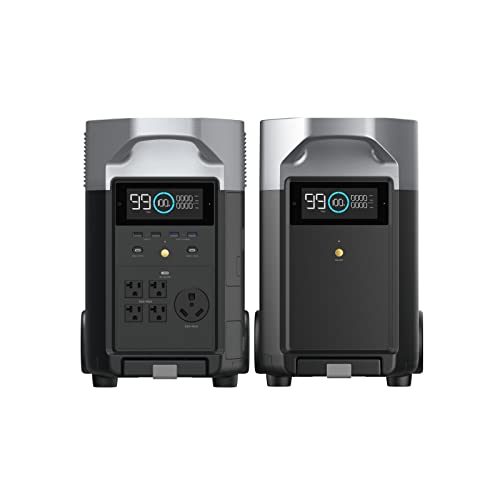
EcoFlow DELTA Pro + Extra Battery – Best for Extended Off-Grid Stays
The EcoFlow DELTA Pro + Extra Battery combination delivers 7,200Wh of total capacity with 3,600W continuous output – the most battery storage of any system in this roundup. At 1,300W of AC draw, this configuration runs the 13,500 BTU rooftop unit for approximately 5.3 hours before exhausting the combined battery. That is a meaningful difference from the 2-3 hour runtime of competitors and makes the DELTA Pro the clear choice for extended boondocking where solar recharge may be limited by weather or positioning.
The DELTA Pro’s 3,600W output handles the rooftop AC easily while leaving room for the full complement of RV loads. EcoFlow’s X-Stream charging technology also means wall-power recharge is fast when you do connect to shore power – useful at campgrounds where you have hookups for part of your trip. The extra battery module doubles the base 3,600Wh capacity and attaches cleanly to the base unit, keeping the footprint manageable despite the large capacity. EcoFlow’s ecosystem also includes a smart panel for integration with home and RV electrical systems.
The DELTA Pro + Extra Battery is the premium choice for those who prioritize runtime above all else. If your RV trips involve consecutive nights without shore power access, this configuration provides the buffer to handle unexpected cloudy days without anxiety. The trade-off is weight and cost relative to the 3,000Wh class competitors.
Best for: Extended boondocking, full-time RV living, buyers prioritizing maximum runtime buffer
Bluetti Apex 300 + AC Cable – Best for Native 240V RV Connectivity
The Bluetti Apex 300 + AC Cable configuration highlights the Apex 300’s native 240V output capability, which sets it apart from most solar generators in this class. While most RV AC systems operate on 120V, some larger RVs and certain high-efficiency rooftop units benefit from 240V supply. The Apex 300 delivers true 240V output without requiring an additional step-up transformer, which is a meaningful technical advantage for the right use case.
At 2,764Wh and 3,840W, the performance specs match the RV Kit version above. The difference is in the output configuration: the AC Cable version prioritizes 240V connectivity over the RV-specific DC ports of the Hub D1 model. For RVers with a 240V shore power connection or those running 240V appliances alongside the rooftop AC, this variant makes more sense. For standard 120V RV setups, the Hub D1 RV Kit (B0FJ1XXXGD) is the better-integrated choice.
The 2,764Wh battery running a 13,500 BTU AC at 1,300W sustains about 2 hours of operation. Solar charging brings the Apex 300 into the sustainable daily-use category: it accepts up to 1,200W of solar input, allowing a solid roof panel array to keep up with moderate AC use during sunny hours. The Apex 300’s LiFePO4 chemistry ensures the battery retains capacity through years of daily cycling – important for RVers who run this system regularly through long camping seasons.
Best for: RVers needing 240V output, dual-voltage setups, buyers with large rooftop panel arrays
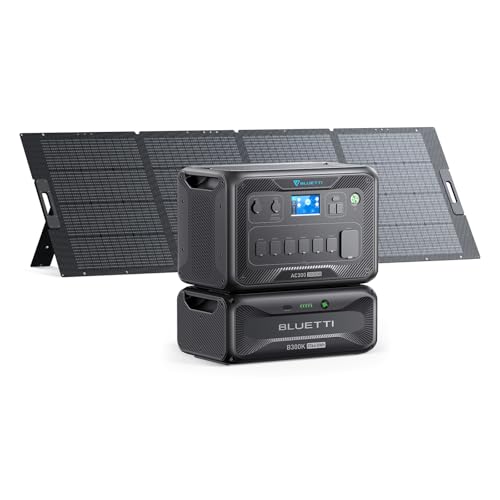
Bluetti AC300 + B300K + 350W Panel – Best High-Surge Option for Multiple ACs
The Bluetti AC300 + B300K + 350W Solar Panel brings a 6,000W surge rating that stands alone in this roundup. For RVers with a 15,000 BTU rooftop unit, a hard-starting older compressor, or a dual-AC Class A motorhome, this surge headroom provides a safety margin that the 3,600-4,000W surge competitors cannot match. The 350W panel included in this bundle is also the highest-wattage starting array, providing meaningful daytime recharge from day one.
The AC300 platform is modular: the B300K battery pack (2,764Wh) can be supplemented with additional packs up to a total of approximately 12,288Wh. For a Class A motorhome running a 13,500 BTU AC near-continuously, that expansion path makes the AC300 the only system here that can be scaled to genuine all-day operation. At the base 2,764Wh configuration, runtime on the rooftop AC comes to about 2.1 hours – similar to competitors. But the expandability and 6,000W surge rating distinguish it for demanding installations.
The 3,000W continuous rating is the lowest of the 3,000W+ group here (just meeting the threshold), but the 6,000W surge provides so much startup headroom that it reliably starts loads the continuous rating would suggest it cannot sustain long-term. For the most demanding RV AC scenarios, the AC300 system’s combination of surge capacity and expandability makes it the right long-term investment.
Best for: Large motorhomes, 15,000 BTU rooftop ACs, buyers planning future battery expansion
Frequently Asked Questions
Can a solar generator really run an RV air conditioner all day?
Yes, but only with adequate solar panel input. A 13,500 BTU RV rooftop AC draws about 1,300W running. To sustain that continuously from solar alone, you need about 1,500W of panel capacity (accounting for real-world efficiency losses). Most RVers mount 400-800W of rooftop panels, which covers 30-60% of the AC draw during peak sun hours. In practice, a system like the EcoFlow DELTA Pro with 7,200Wh and 800W of rooftop solar can run the AC from battery in the morning, recharge during midday, and run again in the afternoon – effectively providing most of a day’s cooling with no shore power. The key is matching battery size, solar input, and realistic expectations about daily sun hours in your location.
What size solar generator do I need for a 13,500 BTU RV air conditioner?
At minimum, you need a solar generator with 3,000W continuous output and 3,500W+ surge capacity, plus at least 2,000Wh of battery for meaningful runtime. Every generator in this roundup meets or exceeds that threshold. The practical minimum for comfortable operation with some margin for other loads is the Jackery 3000 PRO or Bluetti AC300 class – 3,000W output, 2,764-3,072Wh capacity, and 6,000-7,200W surge. For extended trips without shore power, the EcoFlow DELTA Pro’s 7,200Wh configuration is the more comfortable choice. Avoid solar generators rated below 3,000W continuous for rooftop AC use – they may start the unit on a cool morning but will fail during peak heat when the compressor demands maximum current.
Final Verdict
For most RVers, the Jackery Explorer 3000 Pro is the best balance of capacity, surge headroom, and portability. The 7,200W surge rating is the highest in this class and gives real-world confidence that the unit starts the AC reliably under any conditions. The 3,072Wh capacity provides meaningful runtime, and Jackery’s solar compatibility means a roof panel installation complements the system naturally.
Full-time RVers and those doing extended boondocking should look seriously at the EcoFlow DELTA Pro + Extra Battery. The 7,200Wh capacity is roughly double the competition and changes the runtime calculation from hours to most of a day, reducing dependence on perfect solar conditions. The Bluetti Apex 300 + Hub D1 RV Kit earns its place for buyers who want deep integration with their RV’s existing electrical infrastructure. Whatever you choose, pair it with as many rooftop solar panels as your RV can accommodate – battery capacity alone is not enough for all-day summer cooling.





Write Your Review
No reviews yet. Be the first to share your experience!