


Quick Picks: Best 300 Watt Solar Generators
- Best with X-Boost: EcoFlow RIVER 2 – 256Wh LiFePO4, 300W output with 600W X-Boost, charges from 0-100% in under 60 minutes from the wall
- Best Compact Design: Anker SOLIX C300 – 288Wh LiFePO4, 300W, GaN-efficient in the most compact form factor at this capacity class
- Best Output at 300Wh: Bluetti EB3A – 268Wh LiFePO4, 600W continuous output, highest AC output wattage of any station in the 300Wh class
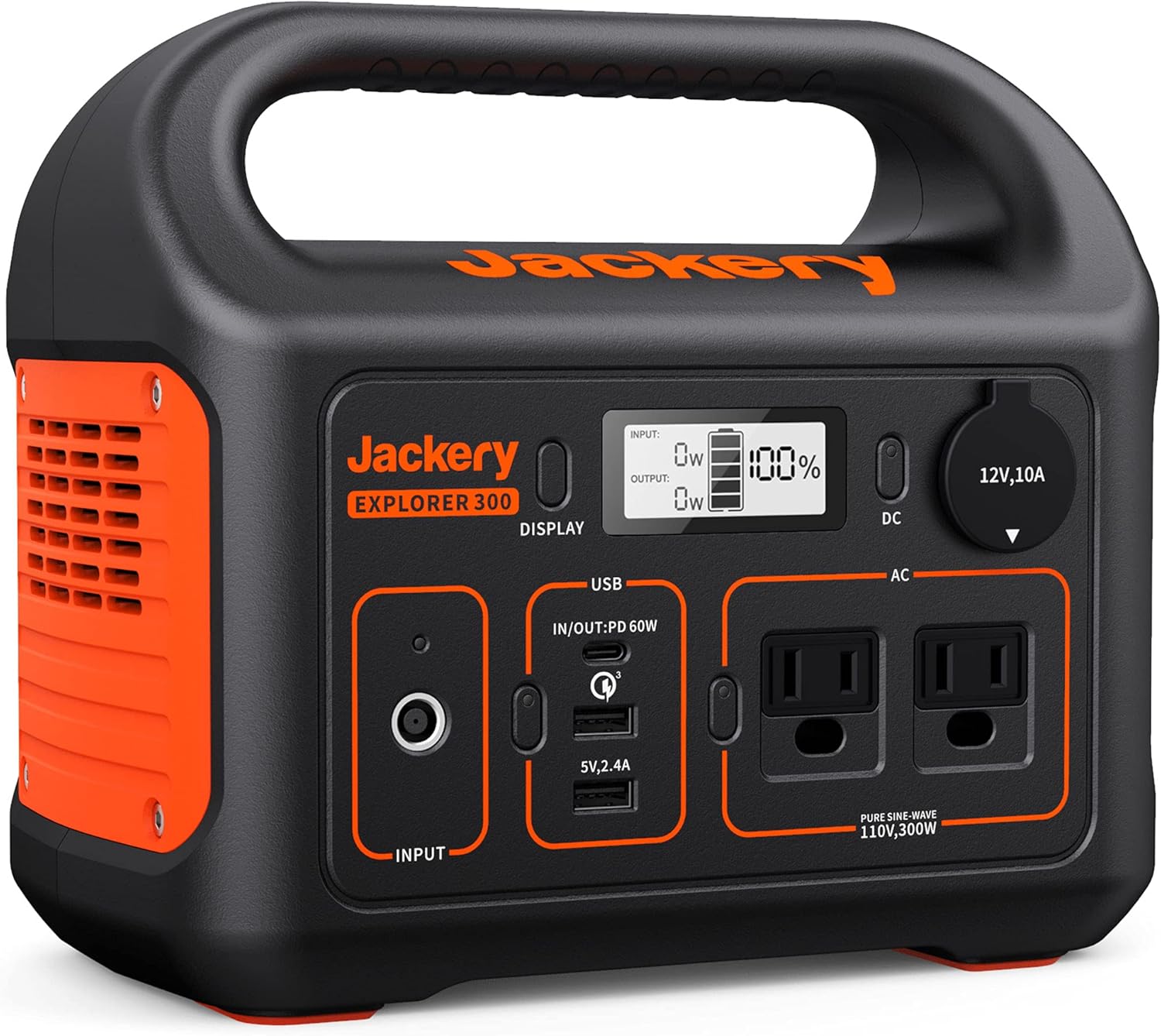
- Best Modern LiFePO4: Jackery Explorer 300 Plus – 288Wh LiFePO4 with 4000-cycle life, updated platform over the original 300
- Best Outdoor-Ready: Goal Zero Yeti 300 – 297Wh, water-resistant design, compatible with Goal Zero’s full panel ecosystem
- Best Proven Value: Jackery Explorer 300 – 292Wh, extensively reviewed original 300Wh station with deep real-world use data
The 300Wh solar generator class serves the most portable power needs: charging phones, tablets, laptops, and cameras on camping trips, powering a CPAP machine for one overnight stay, running a small fan or LED lights through the evening, or keeping medical devices operational during short power disruptions. At 300Wh, the station is light enough to carry in a backpack, small enough to fit on a table, and simple enough that no technical setup is required — plug in, charge the device, recharge the station.
The 300Wh class also has the most competitive pricing of any solar generator tier, which means the brands have had to differentiate on features beyond just capacity. The Bluetti EB3A at 268Wh with 600W output, the EcoFlow RIVER 2 with X-Boost technology, and the Anker SOLIX C300 with GaN efficiency all offer meaningful innovations in a capacity class where raw energy storage is not the differentiator — output capability, charging speed, and portability are. Buyers who understand these distinctions make significantly better purchasing decisions at the 300Wh tier than buyers who compare only the watt-hour number.
The most common disappointment with 300Wh solar generators comes from buyers who expected them to run appliances they cannot handle. A 300Wh station cannot run a full-size refrigerator overnight, cannot power a microwave for a meaningful cooking session, and cannot sustain air conditioning of any kind. It can charge every phone, tablet, and laptop you own multiple times, run a CPAP for one night, and power lighting and a small fan through an evening. Match the station to the actual use and the 300Wh class delivers excellent value.
What 300Wh Powers (and What It Does Not)
Can handle comfortably: smartphone charging (15-20 charges), laptop charging (3-4 full cycles), CPAP without humidifier one night (30-60W for 7 hours), LED lighting 8-10 hours, small portable fan all night, camera battery charging, drone battery cycles, mini projector 3-4 hours. Cannot handle: refrigerators, microwaves, air conditioners, hair dryers, or any appliance above 300W for more than brief moments. For power needs beyond these scenarios, the home backup solar generator guide covers the 1000Wh+ class.
Best 300 Watt Solar Generators – Reviewed
EcoFlow RIVER 2 – Fastest Charging 300Wh Station
The EcoFlow RIVER 2 at 256Wh is the fastest-charging station in the 300Wh class. EcoFlow’s X-Stream technology charges the RIVER 2 from 0 to 100% in under 60 minutes from a standard wall outlet — faster than any other 300Wh station available. For campers who leave a campsite early in the morning and want a fully charged station by the time they return that evening, or for travelers who have 45 minutes at a hotel outlet between activities, this recharge speed is the practical differentiator. X-Boost technology also enables appliances rated up to 600W to run from the 300W inverter, expanding the effective appliance compatibility beyond the output rating.
LiFePO4 chemistry provides 3000+ cycle rated life — roughly 8-10 years of daily charging. The RIVER 2 accepts solar panel input for outdoor recharging and supports EcoFlow’s full RIVER-compatible panel lineup. For buyers who prioritize fast wall charging speed for travel and emergency use alongside solar recharge capability, the RIVER 2 is the speed benchmark in the 300Wh class. The 256Wh capacity is the lowest on this list — buyers who need the full 288-300Wh should note the slightly smaller capacity versus the competition.
Best for: Travelers and day-trippers who need the fastest possible wall recharge between activities, CPAP users who want X-Boost to run the CPAP’s motor without triggering overload protection, EcoFlow ecosystem users who want the 300Wh entry point with ecosystem compatibility.
Anker SOLIX C300 – Most Compact 300Wh Engineering
The Anker SOLIX C300 applies Anker’s GaN power conversion technology to the 300Wh class, delivering 288Wh and 300W output in the most compact form factor available at this capacity. The GaN components reduce size and heat generation compared to conventional power electronics, making the C300 physically smaller than competing 300Wh stations with equivalent output. At 288Wh, it is one of the higher-capacity 300Wh stations on this list. Fast wall charging brings the C300 to full capacity quickly.
Anker’s warranty and customer support reputation provides a strong backing for a product in this price range where the cost of a problematic unit is significant relative to the product category. The SOLIX C300 is compatible with Anker’s solar panel lineup for outdoor recharging. For buyers who want the smallest possible 300Wh station for backpacking, travel, or tight storage spaces, and who value Anker’s build quality and customer service, the C300 is the compact class leader at this capacity.
Best for: Backpackers and travelers who need the smallest footprint at the 300Wh capacity, anyone who values Anker’s compact GaN engineering and customer support, buyers who want to maximize capacity per cubic inch of station size at the 300Wh tier.
Bluetti EB3A – Highest Output in the 300Wh Class
The Bluetti EB3A at 268Wh and 600W continuous AC output (1200W surge) is the highest-output station in the 300Wh capacity class by a wide margin — delivering twice the output wattage of most 300Wh competitors while maintaining a compact travel form factor. The 600W output enables appliances that other 300Wh stations cannot start: a small hair dryer at low setting (400-600W), a small electric grill at low setting, or a portable induction cooktop at the lowest power level. For campers who want to cook or use higher-draw devices from a compact station, the EB3A’s 600W output opens possibilities that 300W output stations close off.
The 268Wh capacity is the second-lowest on this list (just above the EcoFlow RIVER 2 at 256Wh), meaning the higher output comes at a slight capacity trade-off — a 600W appliance runs for approximately 25-30 minutes from a full charge. For charging and low-draw applications, the 268Wh is adequate. LiFePO4 chemistry provides the 3500-cycle longevity that daily cycling demands. For campers and outdoor users who want the highest appliance compatibility in a compact 300Wh station, the EB3A’s 600W output is the defining advantage no competitor matches at this capacity tier. For a broader look at Bluetti’s solar generator lineup, see the BLUETTI solar generator guide.
Best for: Campers who want to run higher-draw appliances (small hair dryer, induction cooktop at low setting) from a compact station, anyone who wants the widest appliance compatibility in the 300Wh class, buyers for whom output wattage matters more than maximum energy storage at this capacity tier.
Jackery Explorer 300 Plus – Modern LiFePO4 Platform
The Jackery Explorer 300 Plus is Jackery’s updated 300Wh station with LiFePO4 battery chemistry rated for 4000 cycles at 80% capacity retention — the highest cycle life of any station on this list. At 288Wh and 300W output, the core specifications match the class standard. The LiFePO4 upgrade over the original Explorer 300 (NMC chemistry, 500-800 cycles) is meaningful for buyers who use the station regularly: at daily cycling, the Explorer 300 Plus maintains usable capacity for 10+ years, while older NMC chemistry stations degrade significantly after 2-3 years of daily use.
Jackery’s SolarSaga panel compatibility extends to the Explorer 300 Plus with documented panel selection and recharge time data. A 100W SolarSaga panel recharges the 288Wh station in approximately 3-4 hours of direct sun — practical for daily camping recharge. For buyers who plan to use their 300Wh station regularly over many years rather than occasionally, the Explorer 300 Plus’s 4000-cycle LiFePO4 longevity is the correct investment at this capacity tier.
Best for: Regular users who want LiFePO4 longevity in a 300Wh station, Jackery ecosystem users who want the current-generation 300Wh platform over the original Explorer 300, campers who use the station frequently enough that cycle life affects total value over time.
Goal Zero Yeti 300 – Outdoor-Ready with Ecosystem Depth
The Goal Zero Yeti 300 at 297Wh stands out in the 300Wh class for its water-resistant construction and Goal Zero’s ecosystem depth. For outdoor use where rain exposure is possible — kayaking, hiking, beach camping, festival use — the Yeti 300’s weather-resistant design provides protection that most indoor-optimized 300Wh stations do not offer. At 350W output with 600W surge, it handles more demanding loads than the basic 300W output tier.
Goal Zero’s ecosystem integration connects the Yeti 300 to the full Boulder and Nomad panel lineup with documented compatibility. For buyers who are building a Goal Zero system and want the 300Wh entry point that integrates with their existing panels and accessories, the Yeti 300 is the correct ecosystem starting point. The water-resistant build adds durability for outdoor use cases that benefit from weather protection without a full waterproof rating. For a broader comparison of camping solar generators, see the camping power guide.
Best for: Outdoor users who want water-resistant construction for rain-exposure camping and water-adjacent use, Goal Zero ecosystem users who want the 300Wh tier with full panel compatibility, buyers who want a higher surge output (600W) in the 300Wh class for occasional higher-draw applications.
Jackery Explorer 300 – The Proven Original
The Jackery Explorer 300 is the original 300Wh station that established Jackery’s presence in the compact solar generator market. At 292Wh and 300W output, it covers all standard 300Wh applications — phone and laptop charging, CPAP one night, lighting and small fan — with the deepest pool of independent real-world reviews of any station in this class. For first-time solar generator buyers who want to start with a proven, extensively documented 300Wh station, the Explorer 300’s track record provides a level of confidence that newer models do not yet match simply due to time in market.
The Explorer 300 uses NMC battery chemistry (not LiFePO4), which means its cycle life (500-800 cycles at 80% capacity) is lower than the Explorer 300 Plus or EB3A. For occasional use of 1-3 times per month, this is adequate for many years of service. For frequent daily use, the Explorer 300 Plus’s LiFePO4 is the better investment. The Explorer 300 is often available at lower pricing than the current-generation Plus, making it a practical value choice for buyers whose primary use is occasional camping and outdoor trips.
Best for: First-time buyers who want the most proven and reviewed 300Wh station with years of independent real-world data, occasional campers who use the station a few times per month and do not need LiFePO4 longevity, buyers who want Jackery reliability at the most accessible pricing in the 300Wh class.
The most overlooked feature when buying a 300Wh solar generator is the solar input wattage limit. Most 300Wh stations accept 50-100W of solar input. A 100W panel in direct sun produces approximately 70-80W real-world, recharging a 300Wh station in approximately 4-5 hours. A station with a 50W solar input limit takes twice as long with the same panel. For daily camping solar recharge, choosing a station with a 100W solar input rating significantly improves the recharge schedule versus a 50W-limited alternative.
FAQs
Can a 300Wh solar generator run a CPAP?
Yes. A CPAP without humidifier draws approximately 30-60W depending on pressure settings. At 40W average, a 300Wh station provides approximately 6-7 hours of CPAP runtime — adequate for one full night of sleep. With a heated humidifier enabled, CPAP draw increases to 100-150W, reducing runtime to 2-3 hours. For CPAP users who use a humidifier, a 500Wh+ station is more appropriate for overnight coverage. Without humidifier, the 300Wh class covers one night reliably across all stations on this list.
How long does a 300Wh solar generator last on a charge?
Runtime depends entirely on the load: a 10W phone charger runs approximately 25-30 hours, a 50W laptop runs 5-6 hours, a 20W LED light runs 12-15 hours, a 40W CPAP runs 6-7 hours, a 300W appliance at maximum load runs approximately 45-55 minutes. Real-world runtime is slightly lower than theoretical calculations due to inverter efficiency losses (typically 85-90% efficient). Combining loads reduces runtime proportionally — running a laptop and charging a phone simultaneously at approximately 70W total gives approximately 3.5-4 hours.
What solar panel pairs best with a 300Wh station?
A 100W solar panel is the standard pairing for a 300Wh station. In 4-5 hours of direct sunlight, a 100W panel provides approximately 350-400Wh of energy — enough to fully recharge most 300Wh stations with some margin. Panels smaller than 100W recharge slowly (8-10 hours for a 50W panel). Panels larger than the station’s maximum solar input rating (typically 100-150W for 300Wh stations) waste panel capacity beyond the input limit. Check the specific station’s maximum solar input rating before selecting a panel to ensure the pair is efficient.
Final Verdict
For buyers who prioritize wall charging speed for travel and emergency use, the EcoFlow RIVER 2 charges in under 60 minutes — unmatched at this capacity. For the highest appliance compatibility in the 300Wh class, the Bluetti EB3A at 600W output handles devices that 300W output stations cannot start.
For long-term durability from daily use, the Jackery Explorer 300 Plus at 4000 LiFePO4 cycles is the best investment. And for outdoor environments where rain exposure is likely, the Goal Zero Yeti 300’s weather-resistant construction provides the protection that indoor-optimized competitors do not offer.




Write Your Review
No reviews yet. Be the first to share your experience!