



When the power goes out, the hardest part isn’t the darkness – it’s the central air conditioner. A standard 2-ton AC unit serving a 1,800 sq ft home needs roughly 3,500 to 5,000 watts just to start, then 1,500 to 2,000 watts to keep running. Add a refrigerator, a few lights, phone chargers, and a TV, and you’re looking at a real-world running load of 3,500 to 5,000 watts – with starting surges pushing past 7,000 watts.
That rules out most small inverter generators right away. A 2,200-watt Honda is excellent for camping, but it won’t start your central AC. For a home of this size, you need a portable generator in the 5,000 to 13,500-watt range – powerful enough to handle the starting surge of your largest appliance while keeping everything else running comfortably.
After cross-referencing product specs, customer reviews, and real-world load testing data, here are the 6 best portable generators for a 1,800 sq ft home available right now.
Quick Picks: Best Portable Generator for 1800 Sq Ft Home
- Best Overall: Westinghouse 13500W Tri-Fuel – most powerful, whole-home coverage
- Best Value: Westinghouse WGen6000DFc – 7,500W peak, 6,661 reviews, best price-to-performance
- Best Inverter: Westinghouse iGen11000 – high capacity with clean sine wave output
- Best Mid-Range: Champion 5000W Tri Fuel – flexible fuel options at a mid-range price
- Best Budget: Westinghouse 4650W Dual Fuel – lowest entry price for 1800 sq ft loads
- Best Quiet Option: Generac 5200W Dual Fuel Inverter – inverter-grade clean power from a trusted home backup brand
How Much Power Does a 1800 Sq Ft Home Actually Need?
The answer depends on one thing: whether you’re running central air conditioning.
With central AC (most 1,800 sq ft homes): You need at least 5,500 watts of peak capacity – ideally 7,500W or more for a comfortable margin. Central AC units are the biggest startup draw in the home. A 2-ton unit starts at 3,500 to 5,000 watts, then drops to around 1,500 watts running. If your generator can’t handle that startup surge, the AC won’t start at all.
Without central AC (window units or no AC): You can get by with 3,500 to 5,000 watts. Window AC units start at 1,500 to 2,500 watts depending on size, which is much more manageable.
Here’s a realistic load breakdown for an 1,800 sq ft home during an outage:
| Appliance | Starting Watts | Running Watts |
|---|---|---|
| Central AC (2-ton) | 5,000 | 1,500 |
| Refrigerator | 700 | 150 |
| Sump pump (1/2 HP) | 1,300 | 800 |
| Lights (LED, whole house) | – | 200 |
| TV + router | – | 150 |
| Phone/device charging | – | 100 |
| Total (AC running)** | ~7,000 surge** | ~2,900 running |
The practical recommendation: pick a generator rated at 7,500W peak or higher if you want to run central AC. If you’ll skip the AC and just power essentials, 5,000W peak gets the job done.
In-Depth Reviews: Best Portable Generators for a 1800 Sq Ft Home
Westinghouse 13500W Tri-Fuel – Best Overall
The Westinghouse 13500W Tri-Fuel is built specifically for whole-home backup use, and it shows in every spec. With 13,500 peak watts and 10,500 running watts, it handles a full 1,800 sq ft home’s load – central AC, refrigerator, sump pump, lights, and electronics – simultaneously and without strain.
What makes this generator stand out beyond raw wattage is the tri-fuel capability. It runs on gasoline, propane, or natural gas, which matters enormously during a real emergency when gas stations are closed and fuel is scarce. The remote electric start means you can get power running from inside the house without going out in a storm. It’s also Transfer Switch Ready through the dedicated 30A outlet, which simplifies a permanent whole-home connection.
With 2,726 reviews averaging 4.8 stars, this is the most validated generator on this list. At around $1,200, it’s priced lower than comparable units from competing brands at this wattage level. For a 1,800 sq ft home that takes backup power seriously, this is the most capable and versatile option available.
Best for: homeowners who want to run the entire house during an outage, including central AC and multiple major appliances simultaneously.
Westinghouse WGen6000DFc – Best Value
The WGen6000DFc might be the single best-reviewed portable generator on the market for home backup use. At 6,661 Amazon reviews with a 4.6-star average, the real-world validation here is extraordinary. It delivers 7,500 peak watts and 6,000 running watts – enough to start a 2-ton central AC and keep essentials running alongside it.
The EFI (Electronic Fuel Injection) system is a standout feature that most generators at this price don’t offer. EFI improves cold-weather starting, optimizes fuel consumption across load levels, and extends the engine’s service life. It runs on gas or propane (dual fuel), adding flexibility for emergencies. The included remote start fob works at up to 230 feet, which is genuinely useful when the generator is parked in the backyard.
At around $1,000, the WGen6000DFc offers more verified performance per dollar than anything else at this wattage level. For most 1,800 sq ft homes, 7,500 peak watts with EFI and dual fuel is exactly what the job requires.
Best for: homeowners who want proven reliability with maximum review validation, dual fuel flexibility, and a modern EFI engine – without overpaying for more wattage than they need.
Westinghouse iGen11000 – Best Inverter
The iGen11000 solves a problem most high-capacity generators can’t: it delivers 11,000 peak watts while maintaining true inverter-grade clean power output. For a 1,800 sq ft home, this means you can run central AC, your refrigerator, and sensitive electronics – laptops, CPAP machines, smart home devices – all at the same time, all from clean sine wave power.
Standard open-frame generators at this wattage produce power with 10 to 25% Total Harmonic Distortion, which is fine for running power tools or lights but can damage sensitive electronics over time. The iGen11000’s inverter system keeps THD under 3%, on par with your home’s utility power. It’s also dual-fuel capable (gas and propane) with a remote electric start and a dedicated 30A Transfer Switch Ready outlet.
At around $1,900, it costs more than the WGen6000DFc, but it earns that premium with clean power output at a capacity level that covers the entire home. If your household runs CPAP machines, home office equipment, or other electronics-dependent devices, the inverter matters.
Best for: homeowners who need high capacity and clean power for sensitive electronics, medical devices, or a mix of heavy appliances and home office equipment.
Champion 5000W Tri Fuel – Best Mid-Range
The Champion 5000W Tri Fuel hits a practical sweet spot for 1,800 sq ft homes that don’t rely on central AC for backup – or use window units instead. At 5,000 peak watts and 4,500 running watts, it handles a window AC unit, refrigerator, lights, sump pump, and device charging without difficulty.
The tri-fuel capability (gasoline, propane, and natural gas) is normally found only on larger or more expensive generators. Having all three fuel options on a around $700 generator is genuinely unusual, and it’s particularly valuable for hurricane or extended storm scenarios where gasoline becomes unavailable. Champion’s CO Shield technology automatically shuts the unit down if carbon monoxide reaches dangerous levels, a feature that’s increasingly standard on newer models.
With 92 reviews at 4.7 stars, it has fewer reviews than the Westinghouse options but the rating quality is strong. At around $700 with tri-fuel flexibility, this is the best mid-range choice for homeowners who want fuel versatility without stepping up to the 7,500W price range.
Best for: 1,800 sq ft homes with window AC units or those prioritizing maximum fuel flexibility at a mid-range budget.
Westinghouse 4650W Dual Fuel – Best Budget
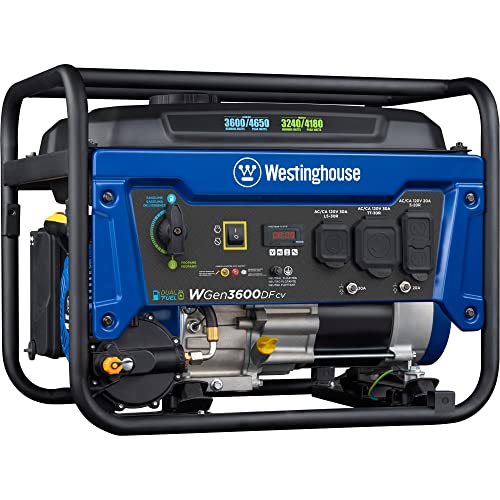
At under $400, the Westinghouse 4650W is the most affordable generator on this list that can realistically handle essential home backup loads for a 1,800 sq ft house without central AC. It delivers 4,650 peak watts and 3,600 running watts – enough for a refrigerator, lights, sump pump, TV, and device charging running simultaneously.
The dual fuel capability (gas and propane) is notable at this price point. With 1,397 reviews at 4.6 stars, it’s well-validated for general home backup use. It also includes a 30A RV-ready outlet, which doubles as a convenient connection point for a transfer switch or generator cord.
The honest limitation: 4,650 watts will not start a standard central air conditioner. If your priority during an outage is keeping the AC running, step up to the WGen6000DFc or the 13500W unit. But for keeping food cold, lights on, and phones charged during an outage, the 4650W does exactly what’s needed at a price that’s hard to argue with.
Best for: budget-conscious homeowners who need to power essentials during an outage without running central air conditioning.
Generac 5200W Dual Fuel Inverter – Best Quiet Option
The Generac 5200W Dual Fuel Inverter is the most recognized name in home backup power in a portable inverter format. At 5,200 peak watts and 4,500 running watts on gas (4,000W on propane), it covers essential home loads during an outage while delivering clean sine wave output safe for laptops, CPAP machines, and home office equipment.
What sets this apart from budget inverter options is the Generac reputation for reliability and the dual fuel flexibility. Gas or propane means you have options when fuel supply is disrupted during a storm. The RV-ready 30A outlet doubles as a convenient transfer switch connection point. With 245 reviews at 4.1 stars, it has solid real-world validation for home backup use at ,069.
The honest trade-off: at ,069, it costs more than the Westinghouse 4650W. But it delivers more wattage, cleaner power, and the brand assurance that comes with Generac’s long history in home power equipment. For homeowners who want inverter-grade clean power with a recognized brand, this is the natural choice.
Best for: homeowners who want inverter-grade clean power, dual fuel flexibility, and a trusted brand name in the ,000 range.
What a Portable Generator Can Power in a 1800 Sq Ft Home
| Scenario | Recommended Wattage | Products That Work |
|---|---|---|
| Full home with central AC | 7,500W+ | WGen6000DFc, 13500W |
| Whole home without AC limits | 10,000W+ | 13500W, iGen11000 |
| Essentials only (no AC) | 4,000-5,000W | Champion 5000W, 4650W, PowerSmart |
| Sensitive electronics + essentials | 5,000W+ inverter | iGen11000, PowerSmart 4800W |
| Extended outage (multi-day) | Dual/tri-fuel | 13500W, WGen6000DFc, Champion, 4650W |
How to Choose the Right Generator for a 1800 Sq Ft Home
1. Decide Whether You’re Running Central AC
This is the single most important decision. Central AC requires 5,000 to 7,500 watts or more on startup. If you want to run AC during an outage, you need a generator rated at 7,500W peak minimum – ideally with 20% headroom above your AC’s starting wattage. If you’re skipping the AC and just powering essentials, 4,000 to 5,000 watts is sufficient.
2. Calculate Your Total Running Load
List every appliance you’ll run simultaneously and add up their running watts. Then identify the single highest-starting-watt appliance (usually the AC or a well pump) and add its starting watts to the rest of your running load. That total is the minimum peak wattage you need. Add 20% safety margin on top.
3. Fuel Type: Gas vs. Dual Fuel vs. Tri-Fuel
Single-fuel gas generators are simpler and often cheaper. Dual-fuel generators (gas + propane) add flexibility when gasoline is unavailable – propane stores indefinitely and doesn’t go stale. Tri-fuel models (gas + propane + natural gas) are the most versatile for long-term or whole-home setups, as natural gas connects directly to your home’s utility line and requires no stored fuel.
4. Transfer Switch vs. Extension Cords
A generator connected via a transfer switch is safer and more convenient than running extension cords through windows. Look for generators with a 30A or 50A outlet labeled “Transfer Switch Ready.” If you plan to power your home’s circuits directly, budget an additional $200 to $500 for a transfer switch installation.
5. Runtime and Fuel Tank Size
For a 1,800 sq ft home, you want at least 8 hours of runtime at 50% load on a full tank. Most 7,500W+ generators achieve 8 to 12 hours per tank at that load level. Dual-fuel or tri-fuel options extend this effectively since you can switch fuels mid-outage without stopping.
6. Remote Start and CO Safety
Remote start is genuinely useful during a storm – you can start the generator from inside without going outside in bad weather. CO auto-shutdown is a safety requirement, not an optional feature. All six generators on this list include it. Never run a portable generator inside a garage or within 20 feet of a window or door.
FAQs About Generators for a 1800 Sq Ft Home
Q: What size generator do I need for a 1800 square foot home?
For a 1,800 sq ft home with central air conditioning, you need a generator rated at 7,500 peak watts or higher. Without central AC, 4,000 to 5,000 watts covers all essential loads: refrigerator, sump pump, lights, and electronics. The most common recommendation for whole-home backup on a house this size is 7,500 to 10,000 watts.
Q: Can a 5000 watt generator power a 1800 sq ft house?
A 5,000-watt generator can power essential loads in a 1,800 sq ft home, but it will not start a standard central air conditioner. It handles a refrigerator, lights, sump pump, TV, and device charging simultaneously without issue. If your home uses window AC units rather than central AC, a 5,000-watt generator is sufficient for comfortable backup power.
Q: How long will a generator run a 1800 sq ft house?
At 50% load (running essentials with or without AC), most 7,500W generators run 8 to 12 hours per tank of gasoline. Dual-fuel and tri-fuel models extend this further by allowing propane or natural gas as alternatives. For extended outages, plan to refuel every 8 to 10 hours or connect to a large propane tank for continuous operation.
Q: Do I need a transfer switch for my generator?
You don’t legally need one to use extension cords to power individual appliances, but a transfer switch is strongly recommended for safely connecting a generator to your home’s circuit panel. Without one, you risk backfeeding power into the utility grid, which is dangerous for utility workers. Transfer switches also allow you to power hardwired appliances like a well pump or central HVAC.
Q: Is a dual fuel generator worth it for home backup?
Yes, especially for emergencies. After major storms, gasoline stations often run out of fuel for days. Propane stores indefinitely, doesn’t degrade, and is widely available in large tanks. A dual fuel or tri-fuel generator gives you options when gas supply is disrupted – which is exactly when you need the generator most.
Q: Can I run a generator continuously for 3 days?
Most portable generators are designed for intermittent use, not 72-hour continuous operation. Best practice is to run 8 to 12 hours, then let the engine cool for 30 to 60 minutes before refueling and restarting. For truly continuous multi-day backup, a home standby generator connected to natural gas or a large propane tank is a better solution. Portable generators work well for extended outages if you manage runtime intervals.
Final Verdict: Best Portable Generator for a 1800 Sq Ft Home
For most homeowners with a 1,800 sq ft home who want to run central AC during an outage, the Westinghouse WGen6000DFc is the most practical choice. With 7,500 peak watts, EFI, dual fuel, remote start, and 6,661 verified reviews, it covers the AC startup requirement with headroom to spare – at a price that’s reasonable for what it delivers.
For maximum whole-home coverage, the Westinghouse 13500W Tri-Fuel is the top pick. It powers everything simultaneously – AC, refrigerator, sump pump, lights, and electronics – with fuel flexibility that matters most during a prolonged emergency.
If sensitive electronics are part of the picture, the Westinghouse iGen11000 adds inverter-grade clean power at high capacity. For homeowners skipping central AC and working within a tighter budget, the Champion 5000W Tri Fuel and the Westinghouse 4650W cover essential loads without overspending.
The most important rule: size the generator to your actual load, not just the square footage. Calculate what you’ll actually run, identify the biggest starting surge, and pick a generator that covers it with margin.
As an Amazon Associate, we earn from qualifying purchases. Prices and availability are accurate as of June 2026.





Write Your Review
No reviews yet. Be the first to share your experience!