


Quick Picks: Best Portable Battery Generator for Home
- Best Overall: EcoFlow DELTA Pro 3 – 4,096Wh, 4,000W output, whole-home capability
- Best Value: Jackery Explorer 2000 v2 – 2,042Wh, over 640 real-world reviews
- Best Solar Bundle: BLUETTI Elite 200 V2 – 2,048Wh with 200W solar panel included
- Best Compact: Anker SOLIX C1000 Gen 2 – 1,056Wh, 2,000W output in a carry-friendly size
- Best Budget: EcoFlow Delta 3 Classic – 1,024Wh starter capacity under $500
- Best High Capacity: GROWATT HELIOS 3600 – 3,600Wh for extended outage coverage
Why Choose a Battery Generator Over a Gas Generator for Home?
A gas generator is loud, requires stored fuel, produces carbon monoxide, and has to stay outside or in a ventilated space. During a winter storm or a multi-day outage, those constraints become serious problems. A battery generator eliminates all of them.
A battery generator produces zero emissions and zero noise – safe to run in a bedroom, kitchen, or living room without any ventilation requirement. That changes everything about how you use backup power at home.
The trade-off is capacity. Gas generators can run indefinitely as long as you have fuel. Battery generators hold a fixed charge – typically 1,000 to 4,000 watt-hours – and need to be recharged via wall outlet, car, or solar panels. For powering a refrigerator, lights, phones, a CPAP, and a TV through a 12 to 24-hour outage, modern battery generators are more than capable. For whole-home backup over multiple days, you need a large unit or a solar recharge setup.
The other major advantage: battery generators work instantly. No pulling a recoil start, no waiting for the engine to warm up. Press a button and power is available in seconds.
How to Read the Two Numbers That Matter: Wh and W
Every battery generator has two key specs that buyers confuse. Understanding both makes choosing the right model straightforward.
Watt-hours (Wh) = how much total energy the battery holds. Think of it as the fuel tank. A 1,000Wh unit holds roughly twice the energy of a 500Wh unit.
Watts (W) = how much power it can deliver at once. A 2,000W unit can run appliances that draw up to 2,000 watts simultaneously.
A practical example: a refrigerator draws around 150 watts running. A 1,500Wh battery generator can power it for roughly 10 hours (1,500 divided by 150). A CPAP machine draws 30 to 60 watts and can run 25 to 50 hours on the same unit. A 55-inch TV draws around 100 watts and runs for about 15 hours.
The watt limit matters for startup surges. A refrigerator compressor can spike to 700 watts on startup even though it only draws 150 watts running. Make sure the generator’s surge capacity covers your highest-draw appliance’s starting wattage.
In-Depth Reviews: Best Portable Battery Generators for Home
EcoFlow DELTA Pro 3 – Best Overall
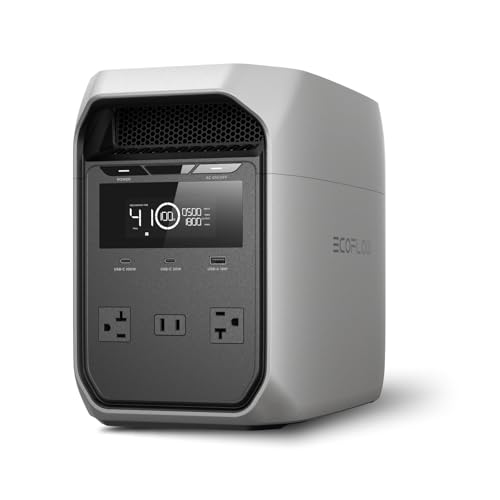
The EcoFlow DELTA Pro 3 is the most capable portable battery generator on this list for home use. At 4,096Wh of capacity and 4,000W of continuous AC output, it can power a central air conditioner, a refrigerator, a microwave, and several other devices simultaneously – the kind of whole-home coverage that previously required a gas generator.
What makes the DELTA Pro 3 particularly well-suited for home backup is its expandability. It connects to EcoFlow’s extra batteries to scale capacity up to 12kWh or more, and its solar input handles up to 2,600W, meaning a bank of solar panels can keep it charged through a multi-day outage. The LiFePO4 battery chemistry is rated for 4,000 full charge cycles before degrading to 80% capacity – a lifespan measured in decades of typical home use.
With 539 reviews at 4.4 stars and a price around $2,300, this is a serious investment. But for a family that wants genuine whole-home backup power without a gas generator, the DELTA Pro 3 delivers it in a unit that fits in a closet.
Best for: homeowners who want maximum capacity, whole-home coverage, and a long-term investment in battery backup that can expand with additional batteries.
Jackery Explorer 2000 v2 – Best Value
The Jackery Explorer 2000 v2 delivers 2,042Wh of capacity and 2,200W of AC output with over 640 verified reviews backing its performance. At around $750, it sits at a price point where the capacity-to-cost ratio is genuinely excellent for home essential backup use.
The Explorer 2000 v2 uses LiFePO4 battery chemistry rated for 4,000 cycles – the same chemistry found in units costing twice as much. It charges from zero to full in under two hours via wall outlet, which means if you get advance warning of a storm, a full charge is always achievable. The 2,200W output handles a refrigerator, a window AC unit, lights, and phone charging running together without issue.
For most households, 2,000Wh is the sweet spot: enough to run a refrigerator for 12+ hours, a CPAP all night, and keep every device charged through a standard power outage.
The Jackery app lets you monitor battery level, set charging limits, and track power draw from your phone – a useful feature for multi-day outage management.
Best for: homeowners who want proven, well-reviewed home backup performance at a mid-range price without overspending on capacity they won’t regularly need.
BLUETTI Elite 200 V2 – Best Solar Bundle
The BLUETTI Elite 200 V2 ships with a 200W solar panel included, making it the most immediately solar-ready option on this list. For home backup that might extend beyond one day, that matters: a 200W panel can add 600 to 800Wh of capacity per sunny day, extending runtime significantly without touching a wall outlet.
The unit itself delivers 2,048Wh of LiFePO4 capacity and 2,000W+ of AC output – enough for a refrigerator, lights, fans, a TV, and device charging running simultaneously. BLUETTI’s build quality is known for reliability in this category, and with 684 reviews at 4.7 stars, the Explorer 200 V2 bundle earns that reputation.
The bundle pricing works out to a meaningful discount versus buying the power station and panel separately. If you’re planning a solar recharge setup anyway, this is the most cost-effective starting point on this list.
Best for: homeowners who want solar recharge capability right out of the box, without sourcing a compatible panel separately.
Anker SOLIX C1000 Gen 2 – Best Compact
The Anker SOLIX C1000 Gen 2 packs 1,056Wh of LiFePO4 capacity and 2,000W of output into a form factor that’s noticeably more portable than the larger units on this list. At around $700 for the bundle with a 200W solar panel and 991 reviews at 4.6 stars, it’s one of the most validated options here.
The 2,000W output is the key number: it covers a refrigerator, window AC unit, TV, and device charging at once. The SOLIX C1000’s fast charging via wall outlet (0 to 80% in under an hour) makes it practical for keeping charged between outages or topping up quickly when power is restored. Anker’s build quality and after-sales support are among the strongest in this category.
The limitation compared to the Explorer 2000 v2 is capacity – 1,056Wh versus 2,042Wh. For a household running only essential loads, the difference is 12 hours of refrigerator runtime versus 24+ hours. For shorter outages, the size and handling advantage of the C1000 is worth considering.
Best for: homeowners who want a compact, highly portable battery generator with proven reliability and fast charging for shorter outages or apartments.
EcoFlow Delta 3 Classic – Best Budget
The EcoFlow Delta 3 Classic brings EcoFlow’s engineering to the under-$500 tier with 1,024Wh of LiFePO4 capacity and 1,800W of AC output. With 461 reviews at 4.7 stars, it has strong validation for its price point.
At 1,024Wh, it covers a refrigerator for about 6 to 7 hours, a CPAP machine all night, lights and device charging for a full day, or any single high-draw appliance for a meaningful stretch of time. The 1,800W output handles most essential home appliances except central AC and electric ranges.
EcoFlow’s fast charging is a standout feature even at this price: the Delta 3 Classic goes from empty to full in about 80 minutes via wall outlet. That means if you have a window of utility power during a rolling outage, you can fully recharge it quickly.
Best for: first-time battery generator buyers, renters, apartment dwellers, or anyone who needs capable home backup power for essential devices without exceeding a $500 budget.
GROWATT HELIOS 3600 – Best High Capacity
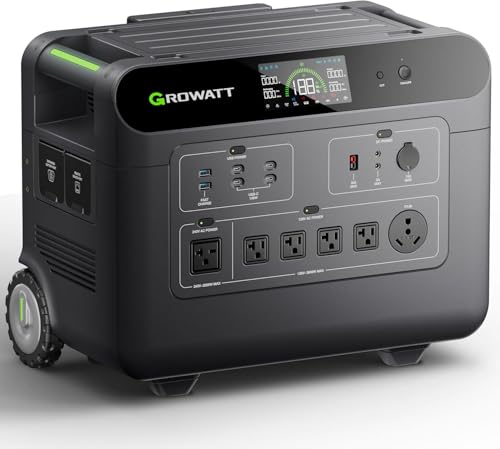
The GROWATT HELIOS 3600 offers 3,600Wh of capacity – the second largest on this list – at a price around $1,600. For households who need extended outage coverage without stepping up to the DELTA Pro 3’s price, this fills a meaningful gap in the lineup.
At 3,600Wh, it can power a refrigerator for over 24 hours, run a CPAP all night for three nights, keep a TV and lights running for two full days, or handle a combination of loads through a typical multi-day outage. The unit supports solar input for extended off-grid use and has a high AC output suitable for most home appliances.
With 91 reviews at 4.4 stars, it has less review validation than the Jackery or Anker options. But for buyers who need the capacity tier between 2,000Wh and 4,000Wh without paying DELTA Pro 3 prices, the HELIOS 3600 is the only option in this field that fits.
Best for: homeowners who need 2+ days of essential backup power and want to stay under $2,000, particularly for extended weather events or areas with unreliable grid power.
What a Home Battery Generator Can Power
| Appliance | Power Draw | 1,024Wh runs it | 2,000Wh runs it | 3,600Wh+ runs it |
|---|---|---|---|---|
| Refrigerator | ~150W | ~6 hrs | ~12 hrs | ~22 hrs |
| CPAP machine | ~45W | ~20 hrs | ~40 hrs | ~72 hrs |
| Window AC (5,000 BTU) | ~500W | ~2 hrs | ~4 hrs | ~7 hrs |
| LED lights (10 bulbs) | ~50W | ~18 hrs | ~36 hrs | ~65 hrs |
| 55″ TV | ~100W | ~9 hrs | ~18 hrs | ~32 hrs |
| Phone charging | ~20W | ~45 hrs | ~90 hrs | 3+ days |
| Microwave (intermittent) | ~1,000W | ~45 min | ~90 min | ~3 hrs |
| Laptop | ~60W | ~15 hrs | ~30 hrs | ~55 hrs |
How to Choose the Right Battery Generator for Your Home
1. Calculate Your Minimum Viable Capacity
List the appliances you must keep running during an outage and how long you need each to run. Add up the watt-hours required. A refrigerator running 12 hours needs about 1,800Wh (150W x 12 hrs). A CPAP running 8 hours needs about 360Wh. Add a margin of 20% for inefficiency losses, and you have your minimum capacity target.
2. Check the Watt Output Against Your Largest Appliance
The continuous watt output must exceed the highest-draw appliance you’ll run. A window AC unit starting at 1,500W requires a unit with at least 1,800W continuous output. A microwave drawing 1,000W needs at least 1,200W of output with surge capacity above that. Most units on this list deliver 1,800 to 4,000W, covering the full range of home essentials.
3. Decide on Recharge Strategy
If your outage is likely to last more than 24 hours, plan your recharge source. Wall outlet charging is fastest (1 to 2 hours for most units). Solar recharging is slower but works when grid power is unavailable – a 200W panel adds roughly 600 to 800Wh per sunny day. For extended outages, a unit that supports both wall and solar charging gives you the most flexibility.
4. LiFePO4 vs. NMC Battery Chemistry
All six generators on this list use LiFePO4 (lithium iron phosphate) chemistry, rated for 3,000 to 4,000 full charge cycles. That translates to 10 to 15 years of daily use – far longer than older NMC lithium batteries. LiFePO4 is also more thermally stable and safer indoors.
5. Size and Portability
Battery generators in the 1,000 to 2,000Wh range typically weigh 40 to 60 lbs and have a carrying handle. Units above 3,000Wh are heavier and often have wheels. If you need to move the unit frequently between rooms or store it in a tight space, the Anker SOLIX C1000 or EcoFlow Delta 3 Classic are the most manageable options on this list.
FAQs About Portable Battery Generators for Home
Q: Can a portable battery generator power a whole house?
A high-capacity unit like the EcoFlow DELTA Pro 3 (4,096Wh, 4,000W) can handle whole-home essential loads including a central AC, refrigerator, and multiple devices simultaneously. For complete whole-home backup over multiple days, you would need a unit with expandable battery capacity and a robust solar recharge setup. Standard battery generators in the 1,000 to 2,000Wh range cover essential appliances but not central air conditioning for extended periods.
Q: How long does a home battery generator last on one charge?
Runtime depends entirely on what you’re running. A 2,000Wh unit running only a refrigerator (150W) lasts about 12 hours. Running a refrigerator and a CPAP simultaneously (195W total) lasts about 9 hours. Adding a TV and lights (350W total) drops that to about 5 hours. The more devices you run, the faster the battery depletes.
Q: Is it safe to run a battery generator indoors?
Yes – this is one of the primary advantages over gas generators. Battery generators produce zero carbon monoxide and zero fumes. They can safely run in a bedroom, kitchen, or living room without any ventilation requirement. This is especially important for households with CPAP users, medical equipment, or residents who can’t easily move outdoors during an outage.
Q: How do I recharge a battery generator during an extended outage?
The fastest method is wall outlet charging when grid power is available, even briefly. Solar panels are the primary option when grid power is unavailable – a 200W panel adds roughly 600 to 800Wh per sunny day. Some units also accept input from a car’s 12V outlet or a DC source. For extended outages, pairing a battery generator with solar panels is the most self-sufficient setup.
Q: How many years does a battery generator last?
All units on this list use LiFePO4 chemistry rated for 3,000 to 4,000 full charge cycles before the battery degrades to 80% capacity. If you charge and discharge the unit once per month during outages and testing, that translates to 250 to 330 years of useful life at that usage rate. For daily use in an off-grid setup, 3,000 cycles at one cycle per day is about 8 years before any notable capacity loss.
Final Verdict: Best Portable Battery Generator for Home
For most households facing occasional power outages lasting 12 to 24 hours, the Jackery Explorer 2000 v2 delivers the best combination of capacity, output, review validation, and price. At 2,042Wh and 2,200W with over 640 reviews, it covers a refrigerator, CPAP, TV, lights, and device charging through a standard outage without running out of power before grid power returns.
For homeowners who want genuine whole-home backup capability or protection against multi-day outages, the EcoFlow DELTA Pro 3 at 4,096Wh and 4,000W is the only portable battery generator on this list that truly replaces what a gas generator provides – at a proportionally higher price.
Budget-conscious buyers should look at the EcoFlow Delta 3 Classic first. Under $500, with 1,024Wh, LiFePO4 chemistry, and fast charging, it delivers more real-world capability than its price suggests. For extended outages where solar recharge is part of the plan, the BLUETTI Elite 200 V2 bundle with the included 200W panel is the most complete ready-to-use package on the list.
The shift from gas generators to battery generators for home backup isn’t just about convenience – it’s about being able to run backup power where you actually need it: inside the house, next to your bed, without worrying about carbon monoxide, noise complaints, or running out of stored fuel.





Write Your Review
No reviews yet. Be the first to share your experience!