


Quick Picks: Best Portable Generators for Cold Weather
- Best Mid-Range Dual Fuel for Cold: Champion 4750W Dual Fuel – cold-start technology, propane runs cleaner in sub-freezing temperatures, electric start with reliable cold-weather ignition
- Best High-Output Dual Fuel: Champion 9375W Dual Fuel – handles whole-home heating appliance loads during winter storms, electric start, dual fuel for propane cold-weather advantage
- Best Heavy-Duty Winter Backup: Westinghouse WGen9500DF 12500W – highest output on this list for large homes with electric heat, dual fuel, GFCI protection for outdoor winter use
- Best Inverter Generator for Cold Weather: Westinghouse iGen4500DF – dual fuel inverter, cleaner power for modern electronics during winter outages, quieter than conventional generators
- Best Compact Dual Fuel Inverter: Generac 5200W Dual Fuel – Generac’s dealer network for winter service accessibility, dual fuel, inverter output for electronics protection
- Best Ultra-High Output: DuroMax XP13000EH – 13,000W on gasoline or propane, dual fuel for cold weather flexibility, handles even large electric heating loads
Cold weather is the hardest possible environment for a portable generator. Gasoline thickens in cold temperatures, making carburetor delivery inconsistent. Engine oil viscosity increases, raising the resistance the starter motor must overcome. Battery-powered electric starters lose capacity in the cold. And the moments when you most need the generator to start – during a winter ice storm with the power out at 2am – are precisely the moments when none of these systems are at their best. Cold weather generator selection requires specifically evaluating cold-start capability, fuel performance at low temperatures, and the heating system loads that winter outages place on the generator.
Propane has a significant advantage over gasoline in cold weather operation. Propane vaporizes reliably down to approximately -44°F (-42°C) and delivers consistent fuel atomization at sub-freezing temperatures where gasoline-fed carburetors struggle. Dual fuel generators that can run on either gasoline or propane give operators the flexibility to switch to propane specifically when temperatures drop below freezing, using gasoline for milder conditions when petrol is more convenient. Every generator on this list is dual fuel for exactly this reason.
The most common cold weather generator failure is not the generator itself – it is the oil. Standard 10W-30 oil thickens significantly below 32°F. For cold weather use, switch to a synthetic 5W-30 or 5W-20 oil before winter storage and before any expected cold-weather operation. Synthetic oil maintains viscosity across a wider temperature range, reducing starter motor load and enabling faster oil circulation at first start. Check your generator’s manual for the manufacturer’s cold weather oil recommendation.
Cold Weather Generator Considerations
Winter power outages are driven by ice storms, blizzards, and high wind events – all of which can knock out power for days rather than hours. The heating load during a winter outage is the dominant power requirement: electric furnaces draw 10,000-25,000 watts, electric baseboard heaters draw 750-2000 watts per zone, and well pumps (in homes with private water supply) draw 750-1500 watts. Gas furnaces with electric ignition and blower motors draw 500-800 watts. The generator must handle these heating loads for potentially 48-72 hours, making runtime and fuel logistics as important as raw wattage. For the full breakdown of generator options for home backup use, the home backup power guide covers sizing for whole-house scenarios.
Cold start performance should be tested before the winter season, not during the first winter storm. Run the generator monthly during winter months, even for 15-20 minutes, to verify it starts reliably, confirm the oil level and viscosity are appropriate for the temperature range, and keep the carburetor clean. A generator that has sat unused for six months on summer-grade oil at temperatures below 20°F is a generator that will fail to start when you need it most. For dual fuel models, storing with a full propane tank connected and the fuel selector in propane position simplifies cold-weather starting.
Best Portable Generators for Cold Weather – Reviewed
Champion 4750W Dual Fuel – Mid-Range with Cold-Start Engineering
The Champion 4750W Dual Fuel generator is built around the cold-weather use case with Champion’s Cold Start Technology – a carburetor and fuel delivery design optimized for low-temperature starting on gasoline, complemented by the propane switching option for extreme cold conditions. At 4750 peak watts on gasoline and 4275 on propane, it handles the most common winter residential loads: a gas furnace blower and ignition system (500-800W), a well pump (1000-1500W), a refrigerator (150-200W), lighting, and essential electronics simultaneously. The electric start with battery means no manual pull-starting in cold gloves at 2am.
The dual fuel design specifically addresses the cold-weather starting challenge: propane stored in a properly secured outdoor cylinder maintains its vaporization characteristics through sub-freezing temperatures where gasoline in a cold carburetor becomes reluctant to atomize properly. Switching to propane mode for winter operation and storing a 20-pound cylinder near the generator provides a reliable cold-start fuel source that gasoline alone cannot match below 20°F. The generator’s 0.72-quart oil capacity should be filled with synthetic 5W-30 before winter storage for best cold-weather starting performance.
Best for: Homes with gas heat and essential winter loads (well pump, refrigerator, lighting, electronics), homeowners who want dual fuel cold-weather flexibility at a mid-range wattage and price point.
Champion 9375W Dual Fuel – High Output for Heating-Heavy Homes
Homes with electric baseboard heating, electric heat pumps, or large zones of electric resistance heating face a different winter backup challenge than gas-heated homes. Electric heating draws far more wattage than gas furnace blower motors – multiple baseboard zones running simultaneously can draw 4000-8000 watts, and a central heat pump draws 3000-5000 watts. The Champion 9375W Dual Fuel at 9375 peak watts and 7500 running watts provides the output needed to run electric heating alongside other household loads without shedding circuits. The electric start with key fob remote operation means starting from indoors rather than in the snow.
The dual fuel capability at this wattage class is particularly valuable for winter use: propane stores cleanly in bulk tanks that many rural homes with electric heat already have installed for cooking or backup heating. A 100-gallon propane tank provides substantially more backup fuel than any practical gasoline storage scenario, extending the generator’s effective runtime during extended winter outages. For homes in regions prone to multi-day ice storm outages with electric heat, this combination of high wattage and large-volume propane capability is the practical winter backup solution.
Best for: Homes with electric baseboard heating or heat pumps, rural properties with existing bulk propane storage, regions with multi-day winter storm outage history requiring extended high-wattage backup.
Westinghouse WGen9500DF – Maximum Winter Home Backup
The Westinghouse WGen9500DF at 12,500 peak watts and 9,500 running watts represents the top end of practical portable generator sizing for whole-home winter backup. At this wattage class, the generator handles the combined load of electric heat, well pump, sump pump, refrigerator, lighting, and all essential electronics simultaneously – the complete winter outage load profile for a large home. The dual fuel design on a generator this size means access to bulk propane storage as the primary fuel source, which for a 48-72 hour winter outage is far more practical than accumulating and storing the equivalent volume of gasoline.
GFCI-protected outlets provide protection for outdoor connections in wet winter conditions where snow and ice create moisture exposure risk. The remote electric start with key fob operation is a comfort feature during winter that becomes a practical safety feature in severe conditions – starting and monitoring the generator without extended exposure in a blizzard or ice storm reduces the risk of a fall on ice while performing outdoor maintenance. For homes in the Northeast, Midwest, or mountain regions that have experienced multi-day winter power outages, this generator provides the wattage to maintain heating through the full duration of realistic worst-case scenarios.
Best for: Large homes in severe winter storm regions, anyone with electric heat who needs to maintain full heating capacity through a multi-day winter outage, properties with existing bulk propane storage.
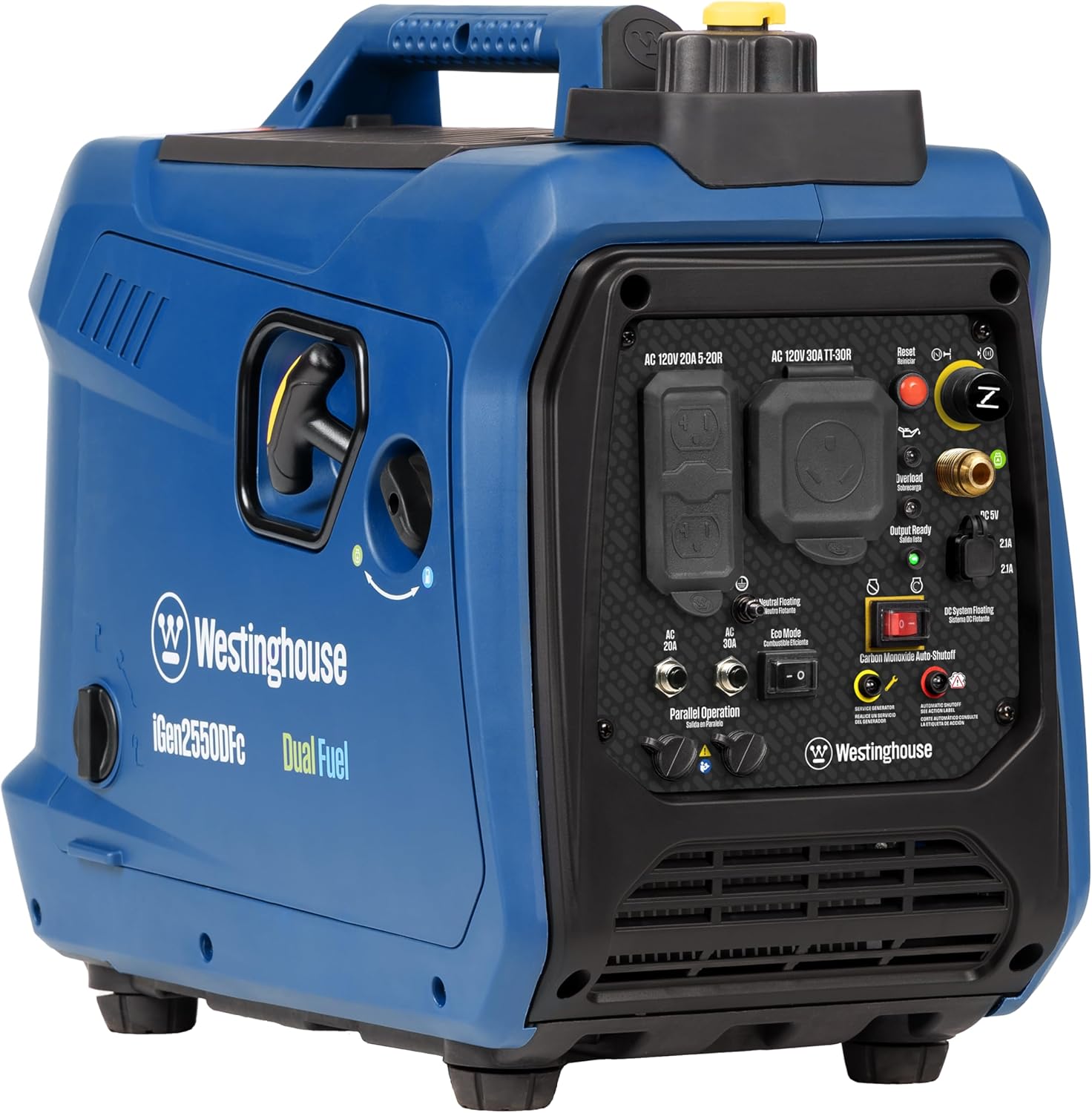
Westinghouse iGen4500DF – Quiet Dual Fuel for Electronics-Rich Homes
Winter outages in residential neighborhoods create a specific noise sensitivity: generator operation in a quiet winter landscape carries farther than summer conditions, and neighbors within hearing distance form opinions quickly about generators running at 3am. The Westinghouse iGen4500DF addresses winter outage use with dual fuel inverter technology – the clean quiet operation of an enclosed inverter generator combined with propane fuel switching for cold-weather starting reliability. At 5000 peak watts and 3700 running watts, it handles gas furnaces, well pumps, refrigerators, and all household electronics simultaneously.
Inverter generators are quieter than conventional generators of comparable wattage. At winter heating loads (typically 1500-2500W for gas-heated homes), the iGen4500DF operates at 50-55% of rated capacity – the load range where inverter generators run most efficiently and quietly. The engine throttles to match the load rather than running at fixed speed, which reduces noise during the long overnight periods when heating is the only significant active load.
The built-in 30A RV outlet connects directly to a properly installed interlock transfer switch, allowing the generator to power the home’s heating circuits without an adapter. For quiet residential neighborhoods where generator noise is a legitimate community concern during extended winter outages, the iGen4500DF balances adequate heating backup capacity with the noise profile that makes overnight operation neighborly.
Best for: Gas-heated homes where quiet operation during overnight outages matters, residential neighborhoods where generator noise is a community concern, anyone who wants inverter-quality clean power for sensitive electronics alongside heating backup.
Generac 5200W Dual Fuel – Backed by the Largest Service Network
Winter generator failures that occur during the outage they were bought to prevent are expensive in more ways than one. Generac’s advantage in the portable generator market is the density of its service and dealer network – more service locations in more cities and towns than any other portable generator brand. For the homeowner who wants winter backup power and also wants confidence that service is accessible if something goes wrong, the Generac 5200W Dual Fuel provides mid-range winter backup capability alongside Generac’s dealer infrastructure. Dual fuel propane capability addresses the cold-start reliability concern, and 5200 peak watts covers the standard gas-heated home winter load profile.
The Generac portable inverter design produces clean sine wave power that protects modern home electronics – smart home controllers, variable-speed HVAC electronics, and sensitive appliance control boards that react to power quality variations. For homes where smart home systems, home security systems, and electronics-dependent appliances are a significant part of the household infrastructure, inverter output quality matters even during a winter emergency. Generac’s nationwide dealer network also means spare parts and generator service are accessible in most populated areas of the US and Canada without shipping delays.
Best for: Homeowners who prioritize service network accessibility for generator maintenance and warranty support, gas-heated homes in areas with Generac service centers nearby, anyone who wants mid-range dual fuel inverter capability with established brand backing.
DuroMax XP13000EH – Maximum Output for Extreme Winter Scenarios
The DuroMax XP13000EH at 13,000 peak watts represents the maximum practical portable generator output for residential winter backup. At this wattage level, the generator can support electric heat pump systems, multiple electric heating zones, and a complete household load simultaneously – covering scenarios that even the Champion 9375W and Westinghouse WGen9500DF cannot fully address. The dual fuel design on a generator this size makes propane the practical primary fuel choice: 13,000 watts at moderate winter loads consumes gasoline at 1-2 gallons per hour, making a 10-gallon run a manageable 5-10 hour cycle that requires frequent refueling from stored containers. Propane stored in large tanks eliminates this constraint.
The electric start with battery provides reliable winter starts, and the EPA/CARB-compliant engine meets emissions requirements across all 50 states. At 13,000 watts, this generator crosses into territory typically served by permanently installed standby generators – the advantage of a portable unit at this wattage is the lower cost and flexibility to use it elsewhere, while the disadvantage is the physical size and weight that requires permanent outdoor parking or a generator cart for positioning. For very large homes, farms, or properties with high electric heating loads in severe winter storm regions, this wattage class is the appropriate specification.
Best for: Very large homes or properties with high electric heating loads, farms and rural properties with well pumps and multiple outbuildings to power simultaneously, extreme cold climate regions where maximum wattage backup is the practical requirement.
Cold Weather Generator Preparation Guide
Oil Change Before Winter
Switch to synthetic 5W-30 oil before temperatures drop below freezing. Standard multi-weight oil thickens in cold conditions, increasing starter load and reducing oil circulation at startup. Synthetic oil flows more freely at low temperatures, protecting the engine during the critical first seconds after a cold start. Change the oil in October or early November in cold-climate regions as part of annual generator winterization.
Fuel Storage for Winter Readiness
Gasoline stored for more than 30 days without fuel stabilizer begins to degrade. For winter preparedness, either use ethanol-free fuel with stabilizer added, rotate stored fuel regularly, or prioritize propane as the primary winter backup fuel. Propane has no storage degradation issues, making a full propane tank stored from the previous season still fully usable in a winter emergency. For dual fuel generators, keeping the propane tank connected and the selector set to propane during winter months simplifies cold-weather starting procedures. See the dual fuel generator guide for detailed propane storage and runtime calculations.
Battery Tender for Electric Start
Cold temperatures reduce the cranking capacity of lead-acid starter batteries. A generator left in a cold garage or shed for months without use may have a depleted battery that cannot start the engine. Connecting a battery tender to the generator’s start battery during winter storage maintains the battery charge and ensures reliable electric start performance when the generator is needed. Manual recoil start is always the backup, but a working electric start in cold weather is a practical comfort.
FAQs
What temperature is too cold for a portable generator?
Most portable generators are rated for operation down to approximately 14°F (-10°C) with standard gasoline and oil. Below that temperature, cold starting becomes unreliable without synthetic oil and propane fuel. Propane vaporizes reliably to approximately -44°F (-42°C), making propane-capable generators functional in virtually any temperature encountered in inhabited regions. For operation in extreme cold below 0°F (-18°C), synthetic oil, propane fuel, and a battery tender-maintained electric start battery are all important preparations.
Why is propane better than gasoline in cold weather?
Gasoline must vaporize to mix with air in the carburetor and combust. In cold temperatures, gasoline’s volatility decreases, making the vapor-air mixture lean and hard-starting. Propane is already in a vapor state when it exits the regulator, providing consistent fuel delivery regardless of temperature. Cold weather starting problems with gasoline generators are almost always fuel delivery issues – either the gasoline won’t vaporize properly in the carburetor or the cold oil is too thick to allow startup. Propane eliminates the fuel delivery problem entirely.
How should I safely run a generator during a winter storm?
Never run a generator indoors, in a garage, or in any partially enclosed space. Carbon monoxide accumulates rapidly in enclosed spaces and is not detectable by smell. During a winter storm, position the generator at least 20 feet from any door, window, or vent, with the exhaust directed away from the structure. Cover the generator with a proper generator tent or enclosure designed for operation in precipitation – running a generator in wet snow without protection can cause electrical shorts. Never use an ordinary tarp over a running generator. The home outage generator guide covers safe winter operation placement in detail.
Can I heat my generator to help it start in extreme cold?
Some operators use an engine block heater – a small electric heating element that plugs into a 120V outlet and heats the engine block – on generators used in extreme cold climates. These are available for specific generator models and can make cold starting more reliable below 0°F. A heated storage space is even more effective: a generator kept in a heated shed or garage starts far more reliably than one exposed to outdoor temperatures. Move the generator to outdoor safe placement only when needed for operation, not for storage.
Final Verdict
For most homes in cold-climate regions, the Champion 4750W Dual Fuel provides the right combination of cold-start capability, dual fuel flexibility, and wattage for gas-heated home winter backup. The propane option specifically addresses the cold-start reliability issue that makes gasoline generators uncertain at sub-freezing temperatures.
For homes with electric heat or very high winter loads, the Champion 9375W Dual Fuel and Westinghouse WGen9500DF step up to the wattage class that electric heating demands. And for residential neighborhoods where noise matters during extended overnight winter outages, the Westinghouse iGen4500DF provides dual fuel cold-weather reliability with the quieter operation profile of an inverter generator.




Write Your Review
No reviews yet. Be the first to share your experience!