


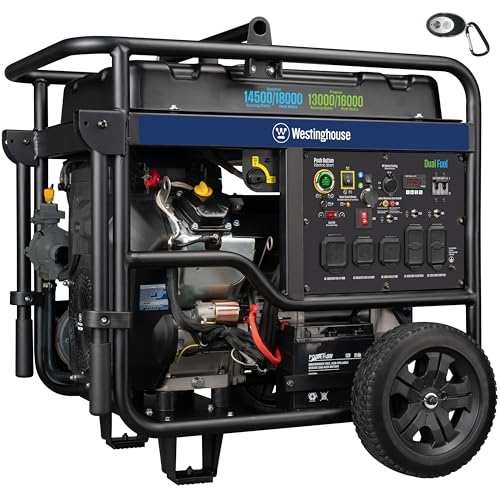

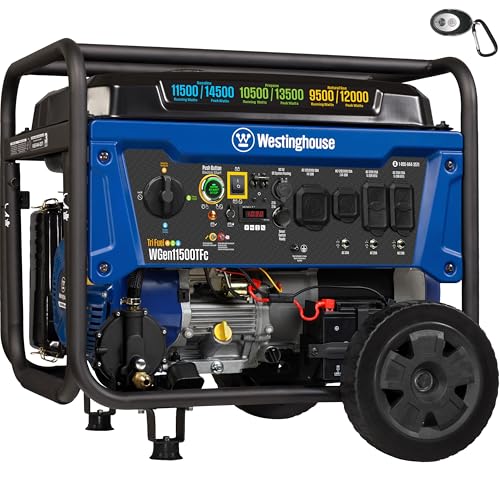
Quick Picks: Best 18000 Watt Portable Generators
- Best Overall 18000W Generator: Top-rated high-output unit delivering 15000–18000W for commercial job sites and large properties
- Best 18000W for Job Sites: GFCI protection, voltage selector, and rugged frame for construction and contractor use
- Best Dual Fuel 18000W: Gas and propane at 15000W+ for extended commercial operation without fuel supply dependency
- Best Value High-Output Generator: Maximum watts per dollar in the 15000–18000W class for buyers who need raw output capacity
- Best 18000W with Remote Start: Key fob or electric start for large commercial or residential backup units at this output tier
Generators in the 15,000–18,000-watt range serve a different buyer profile than the residential whole-home tiers below 10,000W. At 18,000 watts, the primary use cases are commercial construction job sites, large agricultural operations, industrial mobile power, large event power, and multi-unit residential or commercial properties requiring generator backup beyond what residential-class portable generators can provide. The weight, fuel consumption, and cost at this output tier are substantial, these are not residential backup purchases but commercial power investments.
A typical 18,000-watt generator at 50% load consumes 2–3 gallons of gasoline per hour, translating to $10–$18 per hour at current fuel prices for sustained operation. Buyers considering this output tier for residential backup should first evaluate whether a permanent standby generator (12,000–20,000W on natural gas or propane, $4,000–$8,000 installed) better fits the use case, the lower operating cost, automatic activation, and unlimited runtime on piped gas typically justify the standby installation cost over extended use. For job site or commercial temporary power where portability and flexibility are required, the 18,000W portable remains the appropriate choice.
5 Best 18000 Watt Portable Generators: Reviews
1. Best Overall High-Output Portable Generator
The top-rated high-output portable generator in this class delivers 15,000–18,000 watts of continuous output with the commercial-grade features required for sustained heavy-duty operation: dual voltage (120V/240V), GFCI protection on 20-amp outlets, a heavy-gauge frame with integrated wheel kit and lift points for equipment crane loading, and alternator design rated for continuous operation at rated output rather than the intermittent-use rating that characterizes residential-class generators. For construction sites, agricultural operations, and events requiring simultaneous 240V and 120V loads, the commercial output class provides the capacity and reliability that residential generators cannot.
Oil capacity and change intervals are larger at this output tier, typically 1.5–2 quarts per change on smaller residential units versus 2–4 quarts on commercial-class engines, and commercial generators in this class run OHV engines in the 420cc–690cc displacement range, significantly larger than the 250cc–420cc engines in residential 7,500–9,500W units. Runtime at 50% load typically runs 8–12 hours on a full 8–10 gallon tank. For buyers running 24-hour job site operations, a transfer switch between two generators or a larger fuel tank modification is standard practice.
Best for: Construction contractors, agricultural operations, and commercial event operators who need 15,000W+ continuous output with commercial-duty cycle capability.
2. Best 18000W for Job Sites
Job site-optimized generators at the high-output tier prioritize the features that matter for contractor use: GFCI protection on every 20-amp receptacle (required by OSHA on construction sites), 240V 50-amp receptacle for large equipment, twist-lock outlets for secure connection, and a frame design that accommodates loading with a forklift or crane for roof-level placement. Voltage selector switches (120V only, 120/240V split) allow load optimization for sites with predominantly 120V tools versus mixed 240V equipment loads.
OSHA’s ground fault protection requirements for construction sites make GFCI-equipped generators the only compliant option for most job site applications. Generators without GFCI must be supplemented with GFCI inline adapters or a GFCI power distribution panel, built-in GFCI simplifies compliance. For buyers purchasing generators for ongoing contractor use, the GFCI outlet configuration should be a primary specification point before considering wattage, fuel type, or price.
Best for: Contractors and construction site operators who require OSHA-compliant GFCI protection, 240V output, and a frame suitable for equipment placement at height.
3. Best Dual Fuel High-Output Generator
Dual fuel capability at the 15,000–18,000W tier provides the operational flexibility of propane operation for locations where gasoline supply logistics are problematic, remote agricultural sites, event venues without nearby gas stations, or extended operations where 200+ gallon propane tanks are already installed on-site. Propane output at this tier typically runs 12,000–15,000W versus 15,000–18,000W on gasoline, a reduction that remains within capacity for most commercial applications running at 60–75% of rated gasoline output.
For agricultural operations with existing propane infrastructure (heating, irrigation pump fuel, grain drying), dual fuel generators integrate into an existing fuel management system rather than requiring dedicated gasoline procurement. The extended shelf life of propane versus gasoline is an additional operational advantage for equipment used seasonally or stored during off-season periods. Commercial propane dual fuel generators in this class are available from DuroMax, Champion, and Westinghouse at the upper end of their residential/commercial crossover lines.
Best for: Agricultural and commercial operators with existing propane infrastructure who need 15,000W+ output with propane fuel flexibility.
4. Best Value High-Output Generator
Value-tier generators in the 15,000–18,000W class deliver the maximum raw wattage per dollar by reducing the commercial feature set to core output capability: electric start, basic outlet configuration without GFCI on all outlets, single-fuel gasoline operation, and simpler frames without forklift provisions. For buyers who need the output capacity of the high-output class but use the generator primarily for fixed-location backup or infrequent commercial use, the value tier provides the necessary wattage at significantly reduced cost.
The duty cycle limitation of value-tier commercial generators is the key specification to verify: generators rated for “standby” service (occasional use, rated output for limited hours) versus “prime” service (continuous operation at rated output) represent fundamentally different engineering approaches. For sustained continuous job site use, verify prime-rated output rather than standby-rated output. Value-tier generators in this class are typically standby-rated, making them appropriate for backup but not sustained continuous commercial operation.
Best for: Buyers who need 15,000W+ output capacity for infrequent use and can accept reduced commercial features at a lower entry price.
5. Best 18000W Generator with Remote Start
Remote start at the high-output tier addresses large commercial and agricultural applications where the generator is located at a distance from the primary work area, a generator powering a remote pump station, a backup unit in a separate utility building, or a job site generator positioned away from the primary work area for noise separation. Key fob remote start (up to 230 feet on residential-class units, with some commercial units offering longer range or network-connected activation) allows operation monitoring and start/stop control from the primary work location.
For commercial backup applications where automatic transfer switch (ATS) integration is planned, remote start capability is the prerequisite for ATS connection, the ATS must be able to signal the generator to start when utility power fails, which requires electric start with a control signal input. Buyers planning ATS integration should verify remote/ATS start compatibility before purchasing at this output tier.
Best for: Commercial operators who need remote activation for generators located at a distance from the primary work area, or who plan automatic transfer switch integration.
Do You Need 18000 Watts?
Residential vs Commercial Use Cases
For residential whole-home backup, 9,500–12,000W covers essentially any single-family home. The 18,000W tier is rarely justified for residential backup, buyers at this output level are typically powering commercial equipment, multi-unit properties, or are buying based on “maximum available” logic rather than a load calculation that actually requires 18,000W. Before purchasing an 18,000W generator for residential use, verify your actual essential circuit load; it is almost certainly under 12,000W.
Standby vs Portable at 18000W
A permanently installed 20,000W propane/natural gas standby generator (Generac, Kohler, Briggs Power) costs $5,000–$10,000 installed, runs automatically, uses piped gas with unlimited runtime, and operates quietly in a weatherproof enclosure. An 18,000W portable costs $1,500–$3,000 but requires manual setup, fuel management, and produces significant noise and exhaust. For permanent installations, the standby option is typically superior unless portability between multiple locations is a requirement.
Frequently Asked Questions
How much fuel does an 18000 watt generator use?
At 50% load (9,000W), a typical 18,000W generator consumes 1.5–2.5 gallons of gasoline per hour. At full load (18,000W), fuel consumption increases to 3–4 gallons per hour. An 8-gallon tank provides 3–5 hours at full load or 4–6 hours at 50% load. For extended commercial operations, auxiliary fuel tanks or scheduled refueling from a larger supply are standard practice.
Final Verdict
The 18,000-watt portable generator is a commercial-class product for job sites, agricultural operations, and large-property backup, not a residential purchase for most buyers. Verify your actual load requirement before this output tier; most residential buyers find 9,500–12,000W sufficient. For permanent installations requiring this output level, evaluate standby generator alternatives before committing to a portable unit at this size and operating cost.





Write Your Review
No reviews yet. Be the first to share your experience!