




Quick Picks: Best Propane Generators for Whole House
- Best Overall Whole-House Propane Generator: Westinghouse WGen9500DF, 9500W dual fuel with 50-amp outlet, remote start, and CO shutdown for complete home coverage
- Best High-Output Whole-House Propane Generator: 11500W+ for large homes with 5-ton AC and multiple simultaneous high-draw loads
- Best Quiet Whole-House Propane Generator: Lowest-noise option for residential neighborhoods with whole-home propane backup capability
- Best Tri-Fuel Whole-House Generator: Natural gas, propane, and gasoline for unlimited runtime from a piped gas connection
- Best Value Whole-House Propane Generator: Most affordable 9000W+ dual fuel option for whole-home coverage without premium features
Whole-house propane generator coverage requires a specific combination: enough output to run all essential circuits simultaneously (typically 7,500–12,000W depending on home size and AC system), a 30-amp or 50-amp outlet for manual transfer switch connection, and propane fuel capability for pre-staged backup supply. The Westinghouse WGen9500DF has become the de facto standard recommendation for this use case, not because it is the only option, but because it hits the right combination of 9,500W output, dual fuel, remote start, CO shutdown, and competitive pricing that make it the most complete whole-home propane backup package at a reasonable cost.
Whole-home coverage means running all essential circuits simultaneously: central AC, well pump, refrigerator, lighting, electric range, and appliances, not one at a time through manual load management. For a generator to enable this, it needs sufficient continuous output for the combined running load of all essential circuits, adequate surge capacity for the largest inductive load’s startup (typically the AC compressor), and a 30A or 50A transfer switch outlet for direct panel connection. A generator that meets output requirements but lacks transfer switch connectivity cannot power the whole home, it powers individual appliances via extension cords only. Our propane generators for home guide covers the full comparison at this output tier.
5 Best Propane Generators for Whole House: Reviews
1. Westinghouse WGen9500DF, Best Whole-House Propane Generator
The Westinghouse WGen9500DF is the standard whole-house propane generator recommendation for single-family homes up to 3,500 square feet. At 9,500W on gasoline and 8,500W on propane, it covers: 4-ton central AC (3,000W running), well pump (1,500W running), refrigerator (200W), electric range (one large burner, 2,400W), LED lighting (300W), and device charging (500W), 7,900W total, with 600W reserve on propane and 1,600W reserve on gasoline. The 230-foot remote key fob start activates the generator from inside the home. CO auto-shutdown provides safety for long-duration outage operation. The 30-amp L14-30 outlet connects to standard manual transfer switches; a 50-amp adapter enables L14-50 connection for full-panel transfer switches.
For whole-home propane backup, pre-stage a 100-pound propane cylinder (approximately 12–15 hours at 75% load on the WGen9500DF) before storm season. This covers the first day of most regional outages before gasoline supply normalizes, at which point the switch to gasoline takes under one minute. Two staged 100-pound cylinders extends propane coverage to 24–30 hours, sufficient for the initial period of any typical regional outage event. The WGen9500DF is detailed in our dual fuel generator comparison.
Best for: Homeowners who need complete whole-home essential circuit coverage at 9,500W with propane backup and remote start capability.
2. Best High-Output Whole-House Propane Generator
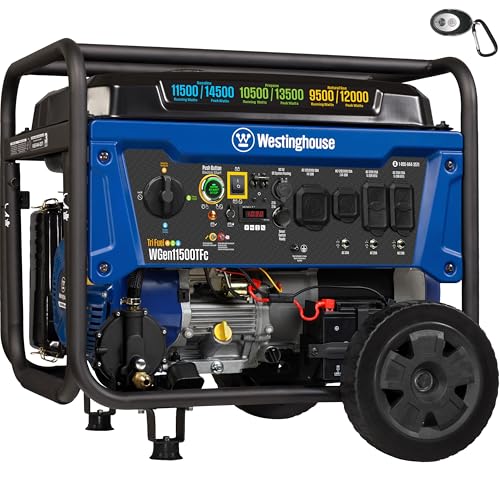
Homes with 5-ton central AC systems (3,500W running), electric water heaters, electric ranges, and well pumps all on the essential circuit require more than 9,500W for simultaneous whole-home coverage without load management. The Westinghouse WGen11500TFc (11,500W gasoline, 10,350W propane, tri-fuel) and comparable 11,000–12,000W dual fuel generators cover these large-home loads with margin. At 10,350W on propane, the WGen11500TFc handles the full large-home load profile: 5-ton AC (3,500W), well pump (1,500W), electric water heater element (2,000W), refrigerator (200W), half of an electric range (2,400W), and lighting/charging (500W), 10,100W total.
The propane output at this tier consumes 2.5–3 lbs of propane per hour at 75% load. A 100-pound cylinder provides approximately 33–40 hours of operation at 75% load, adequate for multi-day regional outage coverage from a single staged cylinder. For large homes with confirmed loads above 9,500W, the step-up to the 11,000–12,000W tier provides meaningful capacity margin that prevents the generator from running near its rated limit during peak summer AC operation.
Best for: Large-home owners with confirmed loads above 9,500W who need 11,000W+ propane output for complete whole-home essential circuit coverage.
3. Best Quiet Whole-House Propane Generator
For residential neighborhoods with HOA noise restrictions or where sustained generator noise during multi-day outages creates neighbor conflict, the quietest whole-house-capable propane generator is the appropriate choice. Inverter generators at 6,000W (62 dBA on propane) cover most homes’ essential circuits if the load calculation falls below 5,500W continuous. For the majority of homes that can operate essential circuits below 5,500W with some load management (running AC and electric range separately), a 6,000W quiet inverter generator provides whole-home coverage at half the noise of conventional alternatives.
A home at 3,500 sq ft with a 3-ton AC (2,200W running), well pump (1,000W running), refrigerator (200W), and lighting/charging (500W) totals 3,900W continuous, within the 6,000W inverter generator’s capacity with 2,100W of margin. Adding electric range use (2,400W for one burner) brings the load to 6,300W, which exceeds the 6,000W unit’s capacity. In this scenario, turning off the AC temporarily while cooking (the kitchen exhaust hood provides some cooling) keeps the total load within capacity. For buyers whose lifestyle permits this minor load management, the quiet inverter option makes extended outage cohabitation with neighbors significantly more harmonious.
Best for: Homeowners in residential neighborhoods with noise-sensitive contexts whose essential circuit load (with minor management) fits within 5,500–6,000W at the quietest available noise specification.
4. Best Tri-Fuel Whole-House Generator
The tri-fuel whole-house generator, running on natural gas, propane, or gasoline, is the definitive portable generator solution for homeowners with natural gas service. Natural gas line connection eliminates all fuel management: the generator draws from the home’s gas supply indefinitely, producing unlimited runtime without any tanks, cylinders, or fuel procurement. In most power outages, the natural gas infrastructure continues operating independently of the electrical grid, making natural gas the most reliable fuel source during electrical outages in areas with gas service.
The Westinghouse WGen10500TFc (10,500W gasoline, 9,500W propane, 8,500W natural gas) provides tri-fuel capability at a price premium over dual fuel alternatives. The natural gas connection requires a licensed plumber/gas fitter installation at the home, verify that the home’s gas line pressure (typically 7 inches water column for residential lines) is compatible with the generator’s specification before purchasing. For homeowners who invest in the installation, the long-term operating cost on natural gas is typically 20–40% lower than gasoline per kWh generated, and the operational convenience of unlimited runtime without fuel management makes the installation cost-justifiable for frequent outage use.
Best for: Homeowners with natural gas service who want unlimited whole-home runtime without any fuel management, accepting the installation cost of a gas line connection.
5. Best Value Whole-House Propane Generator
Value-tier 9,000–9,500W dual fuel generators provide whole-home propane coverage at the lowest entry price by reducing the feature set: electric start without remote key fob, fewer outlets, basic output monitoring, and limited or no CO auto-shutdown on some models. For homeowners who need whole-home propane backup capability on a constrained budget and can accept manual electric start activation during outages, value-tier units provide the necessary output and fuel flexibility at $700–$1,000, $400–$600 less than premium alternatives.
At the whole-home output tier, CO auto-shutdown is a meaningful safety feature rather than a convenience premium, whole-home generators run for extended periods during outages when household members are asleep. Verify whether the value option includes CO shutdown before purchase; if it does not, the safety tradeoff requires additional vigilance about generator placement (minimum 20 feet from any opening) during extended overnight operation. For buyers who prioritize cost and understand the safety implications of missing CO shutdown, value-tier whole-home generators deliver the necessary output adequately.
Best for: Budget buyers who need whole-home propane coverage at 9,000W+ and can accept electric start without remote key fob and reduced premium feature set.
Sizing a Propane Generator for Whole-Home Coverage
Essential Circuit Load Calculation
Add running watts: central AC (1,500–3,500W depending on size), well pump (750–1,500W), refrigerator (200W), lighting (200–400W), device charging (200–400W), and any other essential appliances. If the total falls below 7,500W, a 9,500W generator provides 25%+ reserve margin. If it exceeds 9,500W, step up to the 12,000W tier. For homes with 3-ton or smaller AC and no electric range on the essential circuit, most loads fall in the 4,500–7,000W range, comfortably within a 9,500W generator’s propane output of 8,500W.
Transfer Switch for Whole-Home Connection
A manual transfer switch ($150–$500 for the switch, $500–$1,500 for licensed installation) is required for whole-home generator connection. The transfer switch isolates the house from utility power and connects the generator to the essential circuit breakers in the main panel. Without a transfer switch, the generator can only power individual appliances via extension cords, not the whole home through its wiring. Transfer switch installation is a one-time investment that converts any portable generator into a proper whole-home backup system.
Frequently Asked Questions
How many gallons of propane does a whole-house generator use per day?
A 9,500W generator at 75% load (7,125W, a typical whole-home essential circuit load in summer) consumes approximately 1.5–2 lbs of propane per hour, or approximately 36–48 lbs (8.5–11.5 gallons) per day for 24-hour operation. At 12 hours per day of operation, consumption is 18–24 lbs (4.3–5.7 gallons). A 100-pound cylinder provides approximately 2–4 days of daily operation at this usage rate depending on load level.
Final Verdict
The Westinghouse WGen9500DF is the default recommendation for most whole-home propane generator buyers, its combination of 9,500W output, dual fuel, remote start, CO shutdown, and transfer switch outlets covers the complete whole-home backup requirement at a competitive price. For large homes above 3,500 sq ft with 5-ton AC, step up to the WGen10500TFc or WGen11500TFc. For homeowners with natural gas service, the tri-fuel configuration eliminates all fuel management permanently.




Write Your Review
No reviews yet. Be the first to share your experience!