




Quick Picks: Best Propane Generators for Home
- Best Overall Propane Generator for Home: Westinghouse WGen9500DF, 9500W dual fuel with remote start, the benchmark for whole-home propane backup
- Best High-Output Propane Generator for Home: 11500W+ tri-fuel for large homes with maximum essential circuit load demands
- Best Propane Generator for Whole-Home Backup: Transfer switch-ready with 50-amp outlet and CO shutdown for proper whole-home integration
- Best Tri-Fuel Propane Generator for Home: Gas, propane, and natural gas for permanent home backup with multiple fuel options
- Best Value Propane Generator for Home: Affordable dual fuel entry for homeowners who want propane capability without premium pricing
Propane generators for home backup solve the fuel supply problem that makes gasoline-only generators unreliable during major regional outages. When a hurricane, ice storm, or major winter storm hits, gas stations within 50 miles may be closed, out of fuel, or have multi-hour lines within 12–24 hours of the event. A 100-pound propane tank staged at home before storm season provides 15–25 hours of whole-home essential circuit operation, covering the critical first period of any outage before fuel supply normalizes. Propane also stores indefinitely without stability concerns, unlike gasoline which degrades in 3–6 months without stabilizer treatment.
The practical approach for home backup is a dual fuel generator: gasoline as the primary fuel for full-rated output (typically 5–8% more output on gas than propane), with propane staged as the backup supply for the initial outage period. This configuration provides full-output flexibility on gasoline for extended operation combined with the pre-staged propane security for the hardest early-outage hours. For homeowners with a natural gas line, a tri-fuel generator adds a third option that eliminates fuel management entirely. Our dual fuel generator guide covers the full comparison of gas/propane options.
5 Best Propane Generators for Home: Reviews
1. Westinghouse WGen9500DF, Best Overall Propane Home Generator
The Westinghouse WGen9500DF is the category standard for residential propane/gas home backup generators. At 9,500 watts on gasoline and 8,500 watts on propane, it covers whole-home essential circuit loads for most single-family homes, 4-ton AC, well pump, refrigerator, lighting, and appliances simultaneously. Remote key fob start from 230 feet enables outage activation from inside the house. CO auto-shutdown provides the critical safety feature for long-duration residential operation. Transfer switch-ready outlet panel with 30-amp and 120/240V connections integrates with standard manual transfer switches.
The propane connection accepts standard 20-pound BBQ tanks via standard POL fitting with an adapter, or 100-pound and larger tanks for extended backup supply. Switching between gasoline and propane takes under one minute and can be done while the generator is running. Westinghouse’s three-year residential warranty and nationwide service network support the long-term ownership scenario. For homeowners who want the most proven and well-supported propane home backup generator at this output tier, the WGen9500DF is the default recommendation. It’s covered in depth in our dual fuel generator comparison.
Best for: Homeowners who need the most proven 9,500W propane/gas home backup generator with remote start, CO shutdown, and Westinghouse service support.
2. Best High-Output Propane Generator for Large Homes
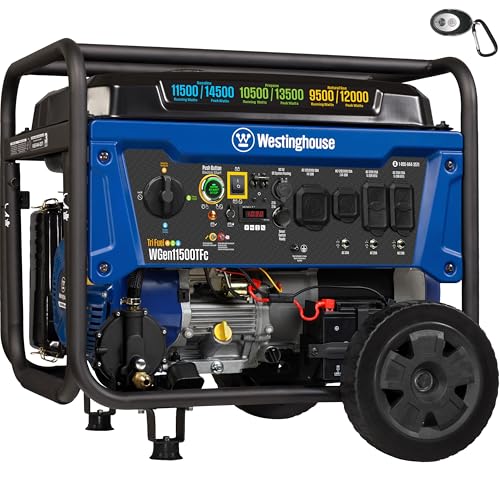
Homes with 5-ton central AC systems, electric water heaters, and electric ranges all on the essential circuit require more than 9,500W for simultaneous whole-home coverage. At this load level, 11,500W+ dual or tri-fuel generators provide adequate output with margin for peak loads. The Westinghouse WGen11500TFc (11,500W gasoline, 10,350W propane) and similar high-output tri-fuel models cover the largest residential loads while maintaining propane capability for pre-staged backup supply.
At the high-output tier, propane consumption increases proportionally, a 11,500W unit at 75% load consumes approximately 2.5–3 lbs of propane per hour, depleting a 100-pound tank in 33–40 hours of moderate-load operation. For homeowners who stage propane at this output tier, two 100-pound tanks (200 lbs total, approximately $100–$150 at fill) provides 65–80 hours of initial outage coverage at moderate load, adequate for any typical regional outage duration before fuel supply normalizes.
Best for: Large-home owners with confirmed loads above 9,500W who need propane capability at 11,500W output for complete whole-home essential circuit coverage.
3. Best Propane Generator for Whole-Home Backup
Whole-home backup-optimized propane generators prioritize the outlet configuration and features that make proper home integration practical: a 50-amp L14-50 outlet for full-panel transfer switch connection, outlet overload protection, CO auto-shutdown, and remote start for outage activation without approaching the running generator. At 9,500–10,500W, they cover the entire essential circuit panel, not just one or two critical circuits, enabling a homeowner to maintain normal essential circuit use during an extended outage without manual load management.
The manual transfer switch installation (typically $500–$1,500 by a licensed electrician) is the key investment that converts a portable propane generator into a whole-home backup system. Without a transfer switch, the generator connects to appliances one at a time through extension cords, functional for basic coverage but impractical for whole-home operation. For homeowners who plan to use their propane generator as a serious home backup system, the transfer switch installation is the necessary complement to the generator purchase.
Best for: Homeowners installing a manual transfer switch who need a 9,500–10,500W propane generator with 50-amp outlet, CO shutdown, and remote start for complete whole-home integration.
4. Best Tri-Fuel Propane Generator for Home
Tri-fuel generators for home backup add natural gas to the standard gas/propane configuration, enabling connection to the home’s natural gas line for unlimited runtime without any fuel management. For homeowners with natural gas service, the tri-fuel configuration is the most capable home backup option in the portable generator category: natural gas supply continues through most power outages (gas and electrical infrastructure operate independently), eliminating both fuel storage and fuel procurement requirements entirely.
The Westinghouse WGen10500TFc runs 10,500W on gasoline, 9,500W on propane, and 8,500W on natural gas, adequate for most large-home essential circuit loads on any fuel. The natural gas connection requires a licensed plumber/gas fitter installation and verification that the home’s gas line pressure matches the generator’s specifications (most residential gas lines at 7 inches water column are compatible). For homeowners who prioritize long-term convenience and fuel independence over initial cost, the tri-fuel configuration is the definitive residential backup generator configuration.
Best for: Homeowners with natural gas service who want unlimited runtime home backup with zero fuel management through natural gas connection plus propane and gasoline options.
5. Best Value Propane Generator for Home
Value-tier dual fuel generators at 7,500–9,000W provide propane capability for home backup at the lowest entry price by reducing the feature set to core functionality: electric start, basic outlet configuration, propane connection, and adequate output for most home essential circuit loads. For homeowners whose budget limits the generator purchase and who need propane capability more than premium features, value dual fuel options from Champion, DuroMax, and A-iPower provide functional propane backup at meaningful cost savings versus premium alternatives.
At the value tier, buyers should specifically verify propane output versus gasoline output, some value-tier dual fuel generators show a larger output reduction on propane (10–15%) versus premium units (5–8%). For whole-home backup where propane is the primary backup fuel, verify that the propane output rating is adequate for your essential circuit load before purchasing a value-tier unit based on the gasoline output rating alone.
Best for: Budget buyers who need propane capability for home backup and prioritize cost over premium features like remote start and app connectivity.
Propane Generator Buying Guide for Homeowners
How Much Propane Do You Need?
A 9,500W generator at 50% load (4,750W) consumes approximately 1.5–2 lbs of propane per hour, or 0.75–1 gallon per hour. A 100-pound propane tank holds approximately 23.5 gallons (about 100 lbs at 4.2 lbs/gallon). At 50% load, a 100-pound tank provides approximately 23–30 hours of runtime. For pre-storm staging: two 100-pound tanks ($100–$150 to fill) provides 46–60 hours of 50%-load operation, adequate for most multi-day regional outage events before gasoline supply normalizes.
Propane Tank Safety for Home Generators
Propane tanks must be stored outdoors, away from the house, in an upright position. The generator should be positioned at least 20 feet from any structure during operation, with the exhaust directed away from windows and doors. Never connect or disconnect propane tanks while the generator is running. Use only properly rated propane hoses and fittings (CSA-rated) for generator connections, standard BBQ hose fittings are adequate for 20-pound tanks but require a bulk adapter hose for 100-pound and larger tanks.
Frequently Asked Questions
Is a propane generator better than a gas generator for home backup?
Propane generators are better than gas-only generators for one specific scenario: when gasoline supply is disrupted during a major outage. Propane staged at home before the outage eliminates the fuel procurement problem. For day-to-day use with reliable gasoline supply, gas generators provide 5–8% more output and lower fuel cost per watt-hour. The dual fuel configuration (both gas and propane) is the optimal choice for home backup, full gas output when supply is available, propane as the pre-staged backup when it’s not.
Final Verdict
For home backup, a dual fuel generator with propane and gasoline capability is the best practical configuration. The Westinghouse WGen9500DF is the standard recommendation for most homes. Homeowners with confirmed loads above 9,500W should consider the WGen10500TFc or WGen11500TFc. Homeowners with natural gas service should strongly consider a tri-fuel unit for the unlimited runtime advantage. Match output to your confirmed essential circuit load, right-sizing prevents running near capacity during peak demand periods.




Write Your Review
No reviews yet. Be the first to share your experience!