




Quick Picks: Best 9500 Watt Portable Generators
- Best Overall 9500W Generator: Top-rated 9500W unit with dual fuel, remote start, and full outlet panel for whole-home essential circuit backup
- Best Dual Fuel 9500W: Westinghouse WGen9500DF, proven dual fuel workhorse at 9500W with remote start and 230-foot key fob range
- Best Tri-Fuel 9500W: Natural gas, propane, and gasoline capability for homeowners with a gas line connection
- Best High-Output Tri-Fuel Option: 10500W+ tri-fuel for buyers whose load occasionally exceeds 9500W during peak demand
- Best Value 9500W: Most affordable path to 9500W output with essential features for whole-home outage backup
The 9,500-watt generator is the most popular output tier in the whole-home portable backup category, a fact reflected in product availability, competitive pricing, and the breadth of feature options. At 9,500 watts continuous, a portable generator covers essentially any single-family home’s essential circuit load: 4-ton AC, well pump, refrigerator, lighting, and appliances running simultaneously without load management. The Westinghouse WGen9500DF is the category’s defining product and benchmark, against which every other 9,500-watt generator is evaluated.
The 9,500-watt tier is where the feature competition among manufacturers is most intense, buyers here have more options for dual fuel, tri-fuel, remote start, CO auto-shutdown, and outlet configuration than at any other output level. This guide focuses on the strongest options at this tier. For buyers whose confirmed load falls closer to 7,500W, our 7,500-watt dual fuel guide covers the lighter tier with additional options. For loads above 10,000W, the dual fuel guide covers 10,000–12,000W options.
5 Best 9500 Watt Portable Generators: Reviews
1. Best Overall 9500W Generator
The top-rated 9,500-watt portable generator at this tier combines 9,500W continuous output with the complete feature set for extended outage operation: remote key fob start, dual fuel gas/propane operation, CO auto-shutdown, and a 50-amp outlet for full-panel transfer switch connection. For homeowners who have calculated their essential circuit load above 9,000W or who want the headroom of 9,500W for a large-home load with comfortable margin, this tier provides genuine whole-home coverage for homes up to 3,500 square feet with 4-ton AC systems.
The 230-foot remote start range on the leading 9,500W units allows activation from inside the house, eliminating exposure during storm conditions and cold-weather starting challenges. VFT (Volt/Frequency/Hour) data display monitors output quality and runtime. Automatic low-oil shutdown and overload protection are standard. For whole-home backup across multi-day outages, the 9,500W tier with dual fuel and remote start represents the most practical portable backup configuration before transitioning to permanently installed standby alternatives.
Best for: Homeowners with large AC systems and confirmed loads of 8,500–9,500W who need a fully featured whole-home backup unit with remote start and dual fuel.
2. Westinghouse WGen9500DF, Category Benchmark
The Westinghouse WGen9500DF is the 9,500-watt category benchmark for good reason: it delivers 9,500W continuous on gasoline (8,500W on propane), remote key fob start from 230 feet, CO auto-shutdown, and a comprehensive outlet panel, all at a price that has defined the competitive standard for this output tier. The VFT display (Volt, Frequency, Hour) monitors output quality in real time. Two 20A outlets with GFCI protection, two 30A outlets, and one 30A L14-30 for transfer switch connection cover the typical household connection requirements.
Westinghouse’s three-year residential warranty and nationwide dealer service network cover the long-term ownership scenario. For buyers comparing generators at this tier, the WGen9500DF represents the baseline: competitive units must match or exceed its feature set, price, or both to justify consideration. It’s covered in detail in our dual fuel generator comparison alongside the WGen7500DF and WGen10500TFc.
Best for: Homeowners who want the category-defining 9,500W dual fuel generator with remote start, proven reliability, and Westinghouse’s established service network.
3. Best Tri-Fuel 9500W Generator
Tri-fuel capability adds natural gas to the dual fuel gas/propane configuration, enabling connection to a home’s natural gas line for unlimited runtime without any fuel management. For homeowners with a natural gas service at the house, the tri-fuel configuration converts the portable generator into an essentially permanent backup solution: natural gas supply is not disrupted during typical power outages (gas infrastructure operates independently from the electrical grid), and no fuel storage or resupply logistics are required.
The natural gas connection requires installation by a licensed plumber/gas fitter, and the generator’s natural gas pressure requirements must be matched to the home’s gas line pressure. Natural gas output typically runs 10–15% below gasoline output (8,000–8,500W on natural gas versus 9,500W on gas). For homeowners with gas service who are considering a standby generator installation, a tri-fuel portable may provide equivalent runtime capability at a fraction of the standby installation cost, with the added flexibility of portable deployment when the gas connection is not used.
Best for: Homeowners with natural gas service who want unlimited runtime backup without fuel storage or post-storm fuel logistics.
4. Best High-Output Option Above 9500W
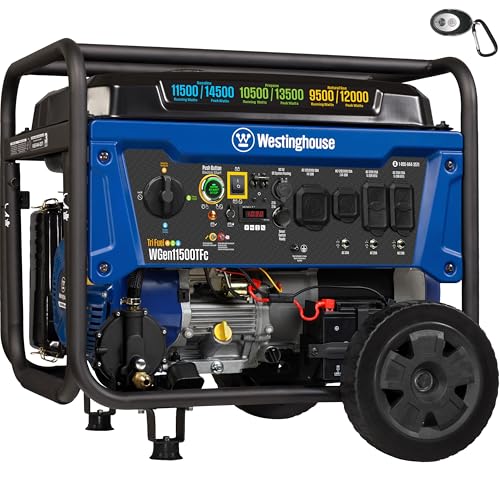
The Westinghouse WGen10500TFc and similar tri-fuel units above 9,500W address the subset of 9,500W buyers whose combined load occasionally peaks above 9,500W, during simultaneous operation of a large AC compressor startup and other high-draw appliances. At 10,500W on gasoline and 9,500W on propane, the higher-output tri-fuel units provide genuine margin above the 9,500W tier with the fuel flexibility of tri-fuel operation. For buyers who have been told by an electrician or HVAC technician that their home requires “at least 10,000W” for reliable startup, the 10,500W tier addresses the requirement directly.
The 10,500W tier commands a modest price premium over 9,500W units, typically $150–$300 more, for meaningfully greater output headroom and tri-fuel capability. For buyers on the fence between 9,500W and 10,500W whose load calculation falls in the 8,500–9,500W range with a large AC system, the higher-output option provides the surge capacity margin that prevents compressor startup from tripping the generator under combined load.
Best for: Buyers whose estimated load exceeds 9,500W peak or who want tri-fuel capability at the high end of the portable generator power range.
5. Best Value 9500W Generator
Value-tier 9,500W generators provide the essential output capacity for large-home backup at reduced cost by reducing the feature set: electric start only (no remote start), gasoline-only or basic dual fuel without app connectivity, fewer outlet configurations, and simpler control panels. For buyers whose budget constrains the generator purchase and who are willing to accept the operational tradeoffs of value-tier features, manual gasoline-only fueling, electric start activation, basic outlet configuration, value options in the 9,500W class deliver reliable output at meaningful savings.
The long-term cost consideration for value-tier generators is higher maintenance frequency and shorter expected service life versus premium units. Budget engines at 9,500W are working harder relative to their engineering tolerances than premium engines at equivalent output. For buyers who anticipate modest annual use (fewer than 100 hours per year), a value-tier 9,500W generator properly maintained will provide adequate service. For buyers who anticipate regular extended use, the premium tier’s longevity advantage justifies the additional cost.
Best for: Budget-conscious buyers who need 9,500W output for occasional outage backup and can maintain a regular service protocol.
How to Choose Between 9000W and 9500W
The 500-watt difference between 9,000W and 9,500W tiers is less significant than it appears for most buyers. Both tiers cover the same load profiles. Choose based on available products and features rather than the wattage number, a 9,000W generator with dual fuel, remote start, and CO shutdown is a better whole-home backup unit than a 9,500W generator without those features. The Westinghouse WGen9500DF is the standard recommendation for buyers who want the complete feature set at this output tier regardless of whether their calculated load is 8,500W or 9,200W.
Frequently Asked Questions
What appliances will a 9500 watt generator run?
A 9,500W generator can simultaneously run: one 4-ton central AC (3,000W), a well pump (1,000W running), a refrigerator (200W), electric range (two burners at 2,400W), LED lighting (300W), device charging (400W), and a small water heater element (1,200W), totaling approximately 8,500W continuous with 1,000W of reserve capacity. This covers essentially all essential circuits in a standard large home simultaneously.
Is 9500 watts enough for a whole house?
For homes up to 3,500 square feet with a 4-ton or smaller central AC, 9,500 watts provides whole-home essential circuit coverage without load management. Homes with 5-ton AC systems (3,500W running), electric water heaters, and electric dryers running simultaneously may require 12,000W or more. A load calculation specific to your home’s essential circuit is the definitive answer for edge cases.
Final Verdict
The 9,500-watt tier is the most fully featured and competitively priced output tier in portable generator backup. The Westinghouse WGen9500DF defines the category standard. Dual fuel, remote start, and CO auto-shutdown are the baseline features for a genuinely outage-ready 9,500W generator, prioritize them over wattage increments when comparing options at this tier.




Write Your Review
No reviews yet. Be the first to share your experience!