

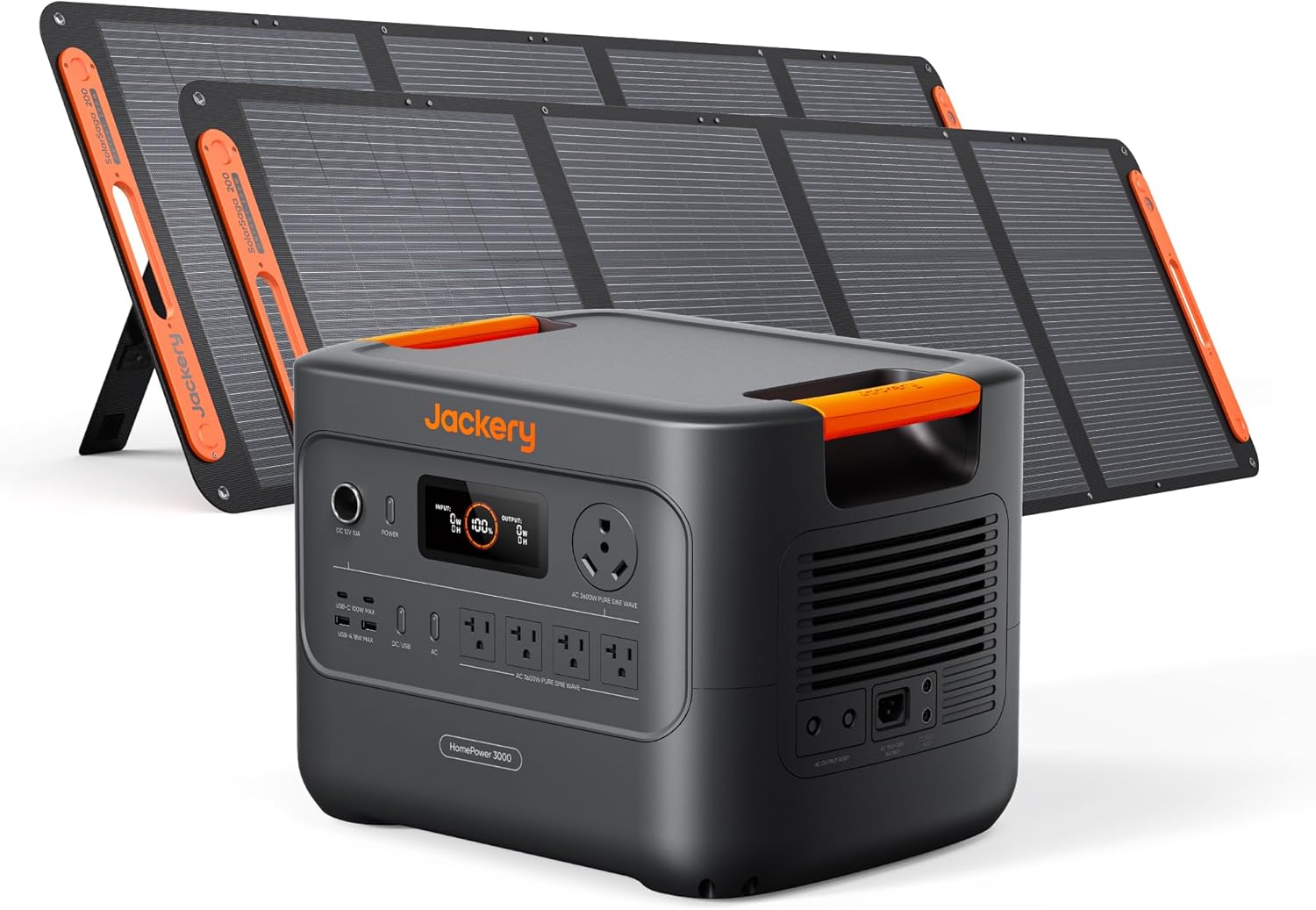

Quick Picks: Best 3,000-Watt Solar Generators
- Best Overall: Jackery HomePower 3000 with 2×200W Solar Panels, 3,600W output with 7,200W surge for whole-home backup
- Best Value Bundle: VTOMAN 3096Wh Portable Power Station Bundle with extra battery and 200W panel, maximum capacity at a lower price
- Best Portable Option: Anker SOLIX C1000 Gen 2 with 200W Solar Panel, 2,000W rated output at a compact form factor
- Best High-Output: EcoFlow DELTA 3 MAX Plus with 220W Solar Panel, 3,000W AC output with fast solar recharge
- Best Expandable: EcoFlow DELTA 2 MAX with Smart Extra Battery, expandable capacity for multi-day off-grid use
Choosing the Right 3,000-Watt Solar Generator
A 3,000-watt solar generator occupies the sweet spot between portable camping power stations and full home backup systems. At this output class, you can run a full-size refrigerator, a window air conditioner, a microwave, and multiple device chargers simultaneously, which covers the essential load for most homes during an outage. The three variables that matter most in this tier are: rated AC output (how many watts you can draw continuously), battery capacity (how long you can run at full draw), and solar input rate (how quickly the sun recharges the unit each day).
The products in this guide range from 2,000W to 3,600W rated AC output, with battery capacities from roughly 1,200Wh to 3,600Wh. For perspective, a 1,000Wh battery at 500W continuous draw lasts two hours; at 200W it lasts five hours. Recharge rate from solar panels included in each bundle ranges from 200W to 440W, meaning most units in this class fully recharge in four to eight hours of direct sunlight. For multi-day outages, solar recharge is what separates a temporary backup from a sustained off-grid solution.
The watt-hour capacity advertised on a solar generator is the theoretical maximum before depth-of-discharge limits are applied. Most lithium iron phosphate (LiFePO4) batteries can be discharged to 20 percent capacity without damage, giving you 80 percent of the rated capacity in usable energy. A 3,000Wh LiFePO4 unit therefore provides roughly 2,400Wh of usable power before the unit needs recharging. This distinction matters when planning runtime: a 3,000Wh unit at 300W continuous draw lasts approximately eight hours, not ten, under real-world conditions.
For buyers comparing the full range of solar generator sizes, the best solar generators guide covers options from 500Wh to 6,000Wh across all output tiers. For buyers focused specifically on RV and travel trailer use where 30-amp shore power compatibility matters, the best solar generators for RV article covers that use case in detail.
In-Depth Reviews: Best 3,000-Watt Solar Generators
Jackery HomePower 3000 Portable Power Station with 2×200W Solar Panels
The Jackery HomePower 3000 leads this list with 3,600W rated AC output and a 7,200W surge capacity that handles high-inrush appliances like refrigerator compressors, power tools, and HVAC fan motors without tripping the overload protection. The two 200W solar panels included in the bundle provide 400W of combined solar input, enabling a full recharge from flat in approximately nine hours of direct sunlight, or a typical day of mixed sun and cloud cover. The HomePower 3000 is designed for whole-home essentials: the 3,600W output covers a full-size refrigerator (150 to 400W), a window air conditioner (600 to 900W), a microwave (1,000W), and additional loads simultaneously. with solar panels included, it delivers premium output capacity in a bundle that is deployment-ready without additional panel purchases. For homeowners who need the highest continuous output in the 3,000W class, the HomePower 3000 is the reference choice.
VTOMAN 3096Wh Portable Power Station Bundle with Extra Battery and 200W Panel
Capacity rather than output is the distinguishing feature of the VTOMAN 3096Wh bundle, which includes an extra battery to bring total energy storage beyond what most single-unit competitors offer at the price point. For buyers who prioritize how long the generator runs over how many watts it can output simultaneously, the VTOMAN’s expanded capacity extends runtime at moderate loads significantly longer than units at equivalent output wattage. The 200W solar panel provides the standard daily recharge rate for this class. At its price, the VTOMAN 3096Wh bundle represents the best value per watt-hour in this guide for buyers whose primary scenario is extended moderate-draw backup during multi-day outages rather than peak surge coverage.
Anker SOLIX C1000 Gen 2 Portable Power Station with 200W Solar Panel
with a 200W solar panel included, the Anker SOLIX C1000 Gen 2 is the most accessible entry into the 2,000W-output solar generator class. Its 2,000W rated output (3,000W peak) covers the majority of home backup loads without the refrigerator-plus-AC-plus-microwave simultaneous scenario that the Jackery and EcoFlow units in this guide handle. For buyers whose priority loads are refrigerator, device charging, modem and router, and lighting without air conditioning, the C1000 Gen 2 covers that complete load. The GaN Prime battery technology reduces charging losses and the proprietary LFP cell chemistry is rated for 3,000 charge cycles before degradation begins. As the lightest and most portable unit in this guide, it is also the appropriate choice for buyers who plan to use the same unit for both home backup and camping or RV use.
EcoFlow DELTA 3 MAX Plus Portable Power Station with 220W Solar Panel
The EcoFlow DELTA 3 MAX Plus is positioned at the intersection of maximum output and practical portability: 3,000W AC output, a 220W solar panel included, and EcoFlow’s X-Boost technology that allows devices rated up to 4,000W to run at the station’s 3,000W maximum through active power management. This means a 3,000W air conditioner or a power tool with high starting surge can run from a generator rated at 3,000W rather than requiring the 4,000 to 5,000W tier. Fast AC wall charging reaches 80 percent capacity in approximately 70 minutes for the situations where solar isn’t the primary recharge source. For buyers who want the highest-output solar generator bundle under fast wall-charging capability, the DELTA 3 MAX Plus provides the most capable combination at this price point.
EcoFlow DELTA 2 MAX Power Station with Smart Extra Battery
Expandable capacity is the defining feature of the EcoFlow DELTA 2 MAX with Smart Extra Battery. The Smart Extra Battery adds 2,048Wh to the base DELTA 2 MAX’s capacity, bringing total available energy storage to over 4,000Wh, which extends runtime at moderate loads significantly beyond any fixed-capacity unit in this guide. This configuration is optimized for buyers who expect extended outages, off-grid living scenarios, or multi-day camping without reliable sun for recharging. The DELTA 2 MAX’s 2,400W AC output (3,400W with X-Boost) handles standard household backup loads. For buyers who prioritize multi-day runtime over peak output capacity and want a modular system that can expand further as needs grow, the DELTA 2 MAX with Smart Extra Battery provides the most flexible platform in the 3,000W class.
3,000-Watt Solar Generator Buying Guide
What a 3,000-watt solar generator can and cannot run
At 3,000W output, you can run simultaneously: a full-size refrigerator (150 to 400W), a window or portable air conditioner (600 to 1,200W), LED lighting (50 to 100W), phone and laptop charging (100 to 200W), and a television (50 to 150W). What requires more caution: central HVAC systems (typically 3,500 to 5,000W on startup), electric stoves and ranges (2,000 to 3,500W per burner), electric water heaters (4,000 to 5,500W), and electric dryers (5,000 to 6,000W). The 3,000W class covers the essentials of everyday living during an outage; it does not replace a whole-home transfer switch setup that would need to power high-draw heating and cooking appliances.
LiFePO4 vs NMC battery chemistry in solar generators
All units in this guide use lithium iron phosphate (LiFePO4) batteries rather than older nickel manganese cobalt (NMC) chemistry. LiFePO4 cells are rated for 3,000 to 6,000 charge cycles versus 500 to 1,000 cycles for NMC, which translates to a decade or more of daily use before capacity degrades to 80 percent of original. LiFePO4 batteries are also thermally stable, meaning they do not enter thermal runaway under charging or discharge abuse conditions that NMC cells can experience. For a home backup device that may sit unused for months and then be demanded to run at full capacity during an emergency, the reliability advantage of LiFePO4 chemistry is meaningful.
FAQs: 3,000-Watt Solar Generators
Q: Can a 3,000-watt solar generator power a house?
A 3,000-watt solar generator can power a house’s essential loads during an outage: refrigerator, lighting, device charging, modem and router, and a window air conditioner. It cannot power central HVAC, an electric range, an electric water heater, or an electric dryer simultaneously. For whole-home backup including high-draw appliances, the best portable battery generators for home guide covers higher-capacity options. For most homeowners, a 3,000W solar generator covers 80 percent of their actual emergency needs and the remaining high-draw appliances can be managed manually during an outage.
Q: How long will a 3,000-watt solar generator last on a charge?
Runtime depends on your continuous draw. At 500W continuous (refrigerator plus lights plus device charging), a 3,000Wh unit lasts approximately five to six hours. At 1,000W continuous (adding a window AC), runtime drops to two and a half to three hours. With 400W of solar panels recharging during daylight hours, a 3,000Wh unit at 500W continuous draw is net-neutral in good sunlight, meaning the solar input matches the load and the battery stays at a consistent level. At 1,000W continuous draw, 400W of solar input extends runtime but does not fully offset the draw.
Final Verdict
For buyers who want the highest output and are planning whole-home backup with air conditioning as part of the covered load, the Jackery HomePower 3000 delivers 3,600W continuous and 7,200W surge with two 200W panels included, covering the complete essential load without output constraints.
For buyers who prioritize battery capacity and extended runtime over peak output, the EcoFlow DELTA 3 MAX Plus with its 3,000W output, X-Boost technology for high-inrush appliances, and fast wall recharge provides the best-rounded combination for buyers who may rely on both solar and grid recharging.
And for buyers with a tighter budget who need a solid 2,000W solar generator rather than the full 3,000W tier, the Anker SOLIX C1000 Gen 2 with a 200W panel provides reliable LFP-backed power for refrigerator, device charging, and lighting at the most accessible price point in this guide.




Write Your Review
No reviews yet. Be the first to share your experience!